The old Federal Republic of Germany is dead. The two parties that ran the country, founded in 1949, are bleeding support to a surging far right and the Greens and far left, leaving them shadows of their former selves. The Christian Democrats (CDU), who gave Germany chancellors Konrad Adenauer and Helmut Kohl, and the Social Democrats (SPD), the party of Willy Brandt and Helmut Schmidt, are now being threatened with oblivion.
For the first time in the post-war era, this September the CDU was tossed out of a state assembly in elections in Mecklenburg-West Pomerania after failing to clear the 5 per cent hurdle. The SPD got a lousy 9.3 per cent in Saxony-Anhalt’s vote on 6 September, which was won by the far-right Alternative for Germany (AfD) with a landslide 43.8 per cent. In Berlin’s local elections in the same month, the SPD suffered a debacle, taking fifth place with just 12.1 per cent. This in a city once so dominated by the SPD that Willy Brandt won the 1963 West Berlin mayoral election with 62 per cent.
The CDU are trapped by their self-imposed ‘firewall’, banning cooperation with the AfD
Party hacks assume that the CDU and SPD will live to fight another day. But like Italy’s Christian Democrats or France’s Socialists, German political parties can die or be reduced to pygmies. Just ask the liberal Free Democrats (FDP) who supplied the illustrious foreign minister Hans-Dietrich Genscher. They’re now a party of the living dead, staggering around at between 3 and 4 per cent.
The AfD is the most popular party in Germany, with two polls placing them at 30 per cent with the Chancellor Friedrich Merz’s Christian Democrats in second place with 19 per cent nationally. Why? A stagnant German economy; the auto industry in crisis; migration; anger over energy prices; and rising mistrust of the state after the euro debt crisis, Covid lockdowns and the 2015 opening of German borders to Syrians, Afghans and Iraqis.
Germany would have a Christian Democratic-AfD majority government of about 50 per cent. But the CDU are trapped by their self-imposed Brandmauer, or ‘firewall’, banning cooperation with the AfD. The result is that when Germans vote CDU, they end up with coalitions binding the Christian Democrats to the left-of-centre SPD or Greens. This follows the former chancellor Angela Merkel shoving the CDU leftward during her 16 years in power. The CDU’s dilemma is now this: conservatives left homeless by Merkel’s leftward lurch moved to the AfD, and Merz has failed to win them back. Those who still vote Christian Democrat are dismayed that their party resembles a dog being wagged by its SPD and Green tail.
‘The firewall must go,’ said Wolfram Wickert, deputy district chairman of the CDU Seniors’ Union in Berlin-Mitte, last month. But the firewall deeply divides the CDU. Jan Techau, another Berlin CDU member, warned that ending the firewall won’t defeat the AfD. ‘The CDU needs strong centrist, policies and we need to forcefully impose them,’ says Techau:
Law and order, a trimmed and efficient social welfare net for those truly in need and we must be robust on migration.
Heinrich August Winkler, one of the nation’s preeminent modern historians, said the Christian Democrats and their Bavarian CSU wing must retake control over what’s deemed ‘conservative’:
The CDU and the CSU … [must] challenge the AfD’s claim to be the only true conservative party in Germany.
Yet moving rightward is devilishly difficult for Merz with his CDU in coalition with the SPD in Berlin and with the SPD or Greens in ten state chancelleries across the country. Such moves might tear these alliances to pieces.
‘Does this CDU still have a purpose?’ Merz says he’s been asked this question repeatedly. His answer: ‘Yes, Germany needs us. But we must provide a new rationale for our existence.’
For the SPD, the problems are dire. The party of the workers faces a world where the classical worker is gone. Making matters worse, the SPD found the remaining workers so boringly old-school that they transformed into the party of welfare recipients and migrants. It’s only a slight exaggeration to say the SPD became the party of losers – and they’re now stuck at 12 to 14 per cent nationally. The SPD lost support to the Greens among the university-educated, urban elite and to the far-left Die Linke party, which is home to an alphabet soup of leftist movements and Muslim migrants, which helped it win Berlin’s city elections in September.
The SPD’s last great election victory came when they moved to the centre. Gerhard Schröder’s 1998 election campaign, which led to the defeat of CDU Chancellor Kohl, ran on the slogan Die neue Mitte, ‘the new centre’. The ‘neue Mitte’ were high achievers. Berlin’s taz newspaper once described them as:
Skilled employees, committed managers, flexible small and medium-sized business owners, self-employed professionals, IT specialists, physicians, engineers, and scientists.
Schröder defeated Kohl – who brokered Germany’s 1990 reunification – by targeting voters from the backbone of the German economy, not the nation’s losers.
Despite deepening crises in both parties, there’s little evidence either the CDU or the SPD have the cojones to force through any wrenching policy shifts. Merz won Germany’s federal election last year with pledges of economic transformation. But he’s failed to deliver for two reasons: First, his victory with a paltry 28.6 per cent meant he had no mandate for massive changes. Second, his SPD partners are so allergic to economic reform that they’ve used key ministries to slow-walk legislation approved by Merz’s cabinet.
Given this, CDU members like Wickert are demanding an opening to the AfD. Yet Merz fiercely opposes changing the firewall. Partly because he despises the AfD and partly because this could tear his own party apart.
Unlike France’s Marine Le Pen, who has attempted to moderate her party, the AfD is radicalising; some of the party’s leaders have flirted with using banned Nazi slogans. Five of Germany’s 16 states have AfD branches that have been labelled ‘confirmed right-wing extremist’. At the federal level, the AfD was declared right-wing extremist last year, but this tag was rescinded after a legal challenge.
While AfD economic and migration policies have limited similarities to the CDU, its foreign and security policy does not. Its pro-Russia stance and demand that Ukraine, in effect, surrender to the Kremlin, is anathema to Merz’s party.
The party landscape in Germany is buckling
For the Social Democrats the problem is that they’ve marched leftward since Chancellor Schröder’s 2005 election defeat amid fury over his labour market, tax and welfare reforms. The policies fuelled an economic boom after Schröder left office. But the SPD has spent the past 20 years dismantling them. The party’s great new hope, state premier Manuela Schwesig in Mecklenburg-West Pomerania, wants to push the party further to the left. She’s forging an alliance with the Greens and Die Linke, formerly the party of the East German communists, after September’s vote.
Schwesig is famous for her role in facilitating the construction of the Nord Stream 2 gas pipeline under the Baltic Sea from Russia to Germany. To evade US sanctions, a ‘climate foundation’ was set up by her state government and given €20 million (£17 million) by Nord Stream 2 AG, a subsidiary of Russia’s Gazprom. The foundation handled orders for work on the pipeline. This allowed American sanctions to be evaded because they applied to private companies but not – in most cases – to government bodies. Schwesig now admits that backing Nord Stream 2 and setting up the foundation ‘was a mistake’.
Her goal now is reportedly to blow up Merz’s CDU coalition with her SPD. If Schwesig becomes the national party leader at the SPD’s January congress, she will do so by blocking every single Merz reform, says an unnamed party official. Schwesig denies seeking any national role.
A takeover of the SPD by Schwesig might force an early federal election next year. Schwesig’s soaring popularity is the one thing her party has going for it. An INSA poll shows she’s the second-most popular politician in the country, in contrast to Merz, who scrapes in at a miserable 19th place.
The problem for Schwesig is that, like Kemi Badenoch here in Britain, she’s far more popular than her party is. Triggering early elections would be an audacious gamble given that polls currently show that the AfD would win.
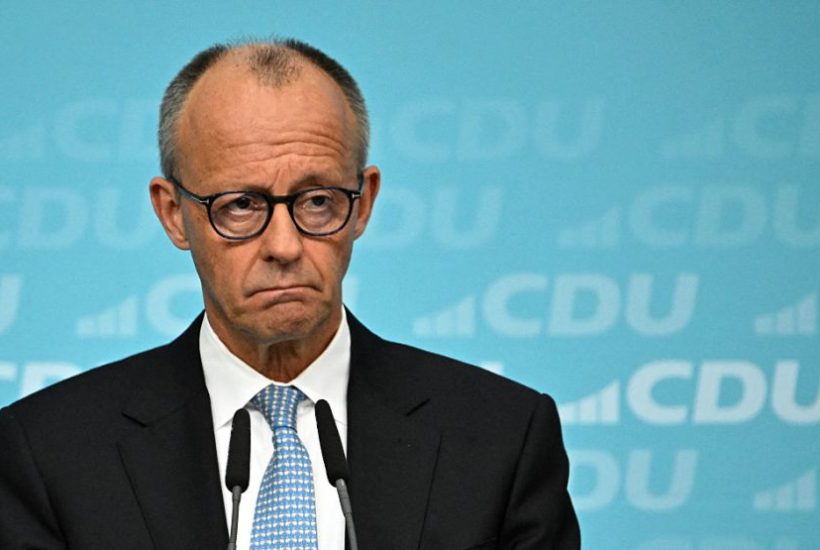
Merz has plagued the CDU with a chancellor who has appalling rhetorical skills and constantly fails to deliver party messages. ‘He’s a political weakling who’s aloof and lacks any common touch,’ said a CDU member in Berlin’s Mitte district who asked not to be named.
The man tipped as Merz’s potential successor is something of a Merkel 2.0. Hendrik Wüst is premier of North Rhine-Westphalia, where he happily heads a coalition with the Greens. Wüst believes the CDU’s salvation lies in allying with the Greens in Berlin. Good luck with that.
The party landscape in Germany is buckling. The Social Democrats will be lucky to survive. Too many parties are jousting for votes on the left and the SPD, founded in 1863, looks increasingly long in the tooth. The Christian Democrats, meanwhile, might survive but only if they rediscover their Bürgerliche or ‘middle class’, roots championed by Adenauer and Kohl. This is the idea that citizens create their own existence and aren’t dependent on the state. Crucially, the CDU must start delivering conservative policies its voters want – not the watered-down version their coalition partners demand.
It’s a tall order for both parties, each of which retains an arrogant sense of entitlement that they’re the natural rulers of Germany. ‘Everything must change so that everything can stay the same,’ wrote Giuseppe Tomasi di Lampedusa in The Leopard. That is the grim challenge facing Germany’s CDU and SPD: kicking the can down the road only works until you run out of road.