In 1891, in Thomas Edison’s makeshift film studio – a shack in West Orange, New Jersey – two men put on gloves and solemnly set about the serious business of battering each other senseless while Edison’s camera steadily watched. The resulting film, Men Boxing, lasted just a few seconds. There was no crowd, no purse and no title at stake; the fighters don’t even have names. Yet the entire history of modern boxing – the transformation of an act of violence into a spectator sport – was captured in that moment. Cinema had found its ideal subject and boxing the perfect machine to turn it into a global phenomenon.
This is where John Sutherland begins 97 Fights, his odd, brisk, learned and frequently appalling history of modern boxing. The title suggests some kind of lightweight compilation to set alongside, say, your downstairs bathroom copy of 1,001 Films You Must See Before You Die and some yellowing Schott’s Miscellany. But Sutherland’s better than that. Emeritus Lord Northcliffe Professor of Modern English Literature at UCL, he approaches boxing with a literary critic’s eye for character and plot, but without trying to improve the sport by turning it into some kind of fancy metaphor.
The 97 fights he chooses provide him with 97 perfect vignettes to be able to discuss matters of race, class, war, money, masculinity, empire, the rise of television, pay-per-view and much more. With boxing, somebody always owns the venue, controls the broadcast and decides who fights who. Oh, and somebody usually gets horribly hurt. So there’s plenty to discuss.
Boxing has already attracted more than enough heavyweight prose and recently some outstanding poetry (read, if you haven’t, Declan Ryan’s ‘Crisis Actor’). Sutherland, for all his strengths, is no great stylist, though he certainly has his moments: writing about the Rumble in the Jungle, he remarks of Mobutu Sese Seko, the then leader of the Democratic Republic of the Congo, that he was ‘devouring his country from the inside, like a monstrous tapeworm’; of Alan Minter, the great British middleweight of my youth, he says: ‘There is a beautiful remoteness in his boxing’ – which is absolutely correct.
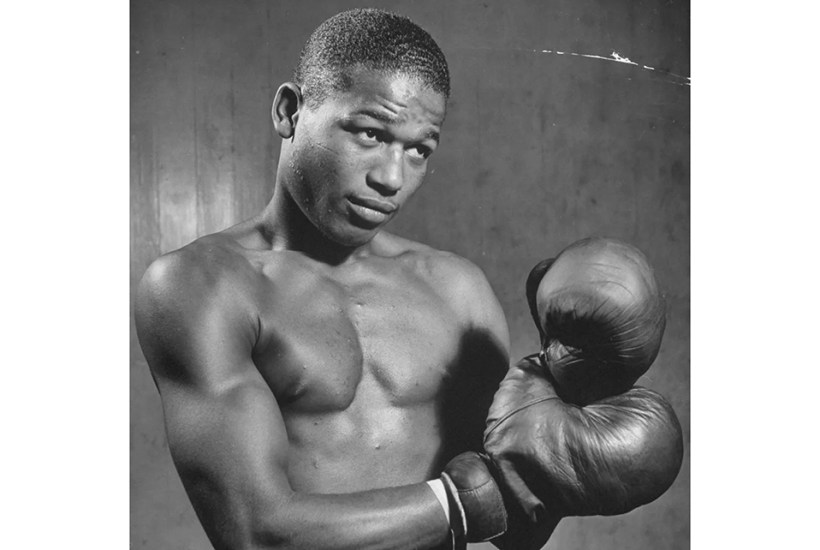
But where Sutherland really excels is with all the hard-hitting facts and details about purses and injuries – the sort of stuff that fight fans love. He notes Manny Pacquiao’s 50 amateur fights as a juvenile, which set him up for success; analyses Ricky Hatton’s rough-housing style; retells the sad story of the heavyweight Tommy Morrison; and on and on, all the way back to Corbett, Fitzsimmons and Jack Johnson. Dempsey, Tunney, Louis, Schmeling, Robinson, LaMotta, Ali – all the big hitters are here.
The arrangement is broadly chronological, though Sutherland steps sideways when a particular theme demands it: the Klitschkos and Usyk are grouped together, predictably, under the heading ‘Slava Ukraini’. Details of individual bouts are sometimes obscured by the weight of social history: the fights between Joe Louis and Max Schmeling, for example, are described more as acts of global political theatre.
But Sutherland’s extremely good on the history of women’s boxing, starting with Barbara Buttrick, the ‘Mighty Atom’ from Yorkshire, who began fighting in fairground booths and later helped establish women’s professional boxing in America. The book’s 97th bout is Katie Taylor vs Amanda Serrano in 2024, an exhilarating contest placed on the same bill as the utterly miserable encounter between the 58-year-old Mike Tyson and the YouTube influencer Jake Paul. The pairing could hardly be improved upon as a statement about where we’re at and where we might be going, with one fight demonstrating what boxing can still be and the other what the entertainment industry has made of it.
Sutherland’s broad point is that boxing has always depended on new media, dubious money and manufactured antagonisms, and that the very forces which created modern boxing more than a century ago may now be finishing it off. To his credit, though, he refuses simple nostalgia, resists waxing too lyrical and never loses sight of the central and obvious obscenity – this is, after all, a sport whose sole aim is to inflict maximum damage upon another person. Which is, of course, why it matters: it reminds us, for better and for worse, what we’re capable of.
Yet exactly why an elderly, distinguished Eng. Lit. prof might wish to devote so much serious time and effort to such a sport remains a mystery throughout the book, until, in an incredible finish, on the last page – indeed, in the very last sentence – Sutherland delivers an absolute haymaker. He acknowledges his father, ‘whose charred remains after his plane crashed in the second world war were identified by missing teeth, which he claimed had been first loosened in an exhibition round with the visiting Max Baer taking on all comers’. An unexpected knockout.
Got something to add? Join the discussion and comment below.
You might disagree with half of it, but you’ll enjoy reading all of it. Try your first month for free, then just $2 a week for the remainder of your first year.