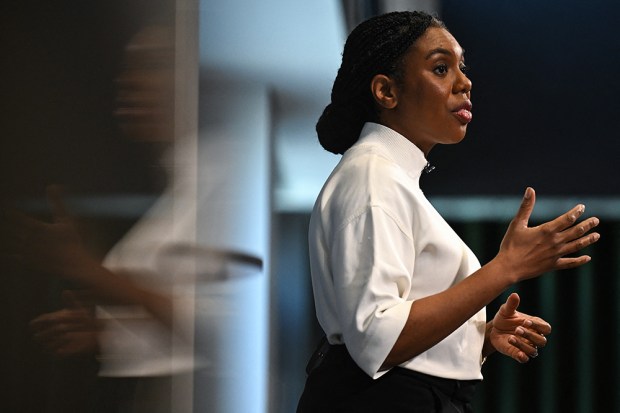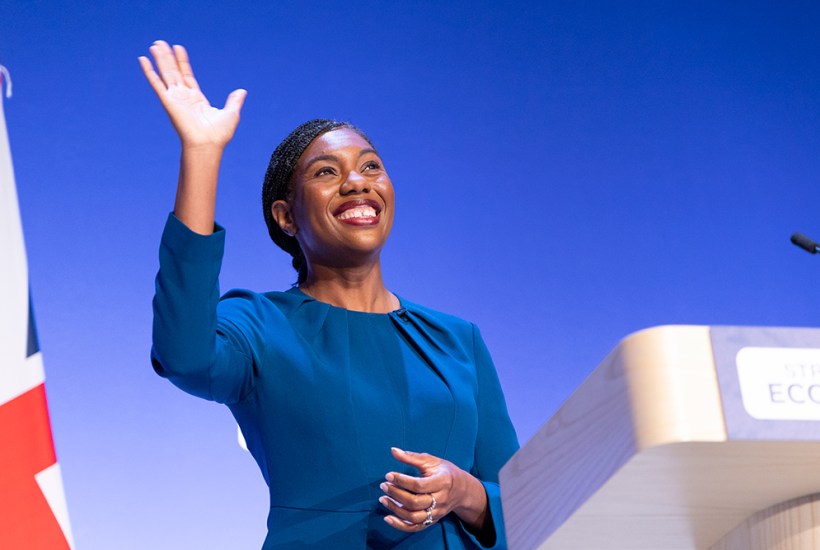
Last year’s Conservative party conference was a difficult one. Reform UK was leading the polls; the local election results had been as painful as the general election the year before; and the story at conference was not Kemi Badenoch’s successes, but speculation over Robert Jenrick’s attempts to replace her. Adversity, however, proved her friend. The past year has seen Badenoch’s leadership blossom, with confident public appearances, a by-election victory in Aberdeen and Jenrick’s fortuitous exit to Reform. This week, she stood up in Birmingham as a leader truly in command of her party – and with a plausible route back into government.
There are still a great many obstacles to overcome. Nigel Farage’s success, though diminished, still puts his party ahead of the Conservatives. Reform’s popularity is built in large part on voter antipathy towards the Conservatives and these voters will not be easily won back. Badenoch confronts a Prime Minister who is not entirely sure what he wants to do with power but who has inherited a landslide majority, a parliament with three years left to run and MPs that are far more loyal to him than they were to Sir Keir Starmer. Badenoch said in Birmingham that she is engaged in a ‘battle for the soul of this nation’. She is right that Britain today is not unlike the country of 1979, which ushered in Margaret Thatcher and the ‘40 years of neoliberalism’ that Andy Burnham so deplores. The public is wary; the world is chaotic. But Badenoch has given the Tories their confidence back.
Her willingness to criticise past failures proves she is the most serious of all the current options facing voters
No Tory leader can escape the Thatcher comparison. Yet it is hard not to draw parallels between Thatcher’s early leadership and Badenoch’s. Thatcher did not find those early years easy; similarly, Badenoch faced criticism on everything from her PMQs performance to her taste in lunches. Both Thatcher and Badenoch proved themselves able to overcome early scepticism of their leadership. And Badenoch is willing to tell her party uncomfortable truths. In fact, the most important development to come from Conservative party conference was not a particular policy announcement or speech but a document.
The Right Way is a 95-page paper that outlines the failures of the previous Conservative governments and defines the movement today. It is a self-conscious reference to The Right Approach, a paper published by Thatcher and Sir Keith Joseph 50 years ago. That too was a blueprint for how to reverse Britain’s economic decline, beginning from foundational principles.
The Right Way is far more substantial than anything yet scribbled on the back of a beer mat by Burnham or Farage. It makes clear that, under previous Conservative governments, the state and tax burden grew because ministers ‘did little to reverse the structural changes Labour had made’. Net zero was ‘legislated for before we had an economically feasible route to get there’; on immigration, ‘Brexit gave Britain the chance to design a different immigration system’, but that Conservative ministers instead ‘widened eligibility’ and numbers soared. As Badenoch puts it in her foreword, if ‘the tone is harsher on Conservative governments it is not’ because she believes that ‘Labour knows any better’ but because Labour goes ‘wrong when it follows its principles’ but the Tories ‘go wrong when we fail to follow ours’.
Badenoch’s return to first principles also comes with a healthy element of realism. She promised to reduce inheritance tax but not abolish it, demonstrating a fiscal prudence that was lacking in the short ministry of Liz Truss. She has said her party will commit to leaving the European Convention on Human Rights only after all other options for reducing immigration have been exhausted. This, too, shows a sensitivity to such a policy’s significance. There is little about Badenoch’s Conservatives that any holdout Jenrick supporter could now criticise: a harder line on immigration, serious policy development and an energetic shadow cabinet, bolstered by Andrew Griffith’s promotion and the addition of respected stalwarts such as Tom Tugendhat and Katie Lam. She has a shadow chancellor with more private sector experience than all Burnham’s cabinet put together; and unlike Farage, she actually has foreign affairs and defence spokespeople.
But while Badenoch can celebrate a successful conference, there is much still to do. As she mentioned in her recent interview with Tim Shipman, her party’s popularity still lags behind her own. Nonetheless, against Burnham’s government-by-TikTok and a Reform party distracted by scandal and infighting, Badenoch has an opportunity to take the Conservatives back to their natural home: government. The path is steep; the hurdles great; the opportunities for disaster frequent, but Badenoch has the right approach.
Her willingness to criticise past failures proves that she is the most serious of all the current options facing British voters. If this country is to revive its prospects, it needs a leader who is able to confront those failures. Badenoch knows exactly what the Tories got wrong – now she has the chance to show the right way ahead.
Got something to add? Join the discussion and comment below.
You might disagree with half of it, but you’ll enjoy reading all of it. Try your first month for free, then just $2 a week for the remainder of your first year.