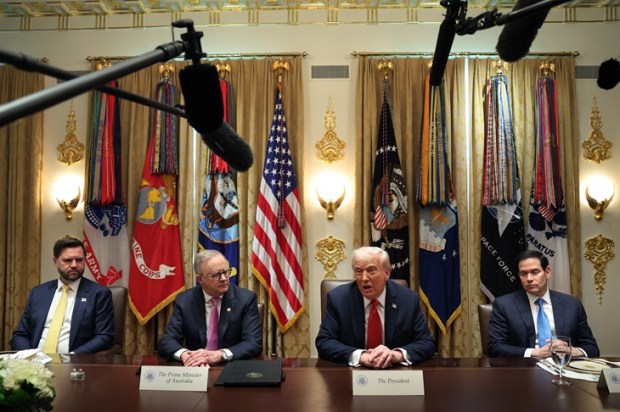
The Special Relationship has seen more special days. Earlier this year, President Trump delivered his verdict: ‘How is the relationship? It’s the relationship where, when we asked them for help, they were not there. When we needed them, they were not there. When we didn’t need them, they were not there. And they still aren’t there.’
Trump was referring to divisions between the US and UK over the wisdom and conduct of the war in Iran. (Even amid a spat, though, he can dish out praise. Just this week, following the arrest of five men outside RAF Fairford, used by American bombers to strike Iran, the President said the UK authorities had done an ‘amazing job’.) But his remarks landed at a moment of divergence in the US-UK relationship that extends well beyond Iran. Washington has imposed and reimposed tariffs on Britain. Last year the UK paused intelligence-sharing that could have assisted American strikes against suspected drug boats in the Caribbean, which London views as illegal. Trump has branded the deal to hand the Chagos islands to Mauritius an ‘act of great stupidity’.
All this has resulted in a great deal of hand-wringing about the resilience or otherwise of the Special Relationship. There is a great fear of change, given how historically close the relationship is, particularly in intelligence. The Special Relationship’s entire origin story, in fact, is a cryptographic exchange over German and Japanese codes at Bletchley Park in 1941. Eighty-five years later, the intelligence connection between the US and UK remains central; having the same set of eyes and ears means you see the world similarly and act accordingly.
Britain is the decidedly junior partner. When push comes to shove, the CIA wins out
But might gathering political headwinds blow hard enough to damage it? To understand how – or if – the intelligence partnership might come apart, it is helpful to examine how it actually works.
This is the subject of my new novel, London Station, in which I imagine a scenario where the CIA and MI6 begin spying on each other. There is a historical precedent for this. Prior to the second world war, Britain intercepted US diplomatic traffic and conducted influence campaigns on American soil. In one instance, British spies drew up and disseminated a supposed Nazi map depicting Germany’s vision for a partition of South America in a bid to frighten US policy-makers into entering the war.
This is not how the relationship works today. Now, the CIA and MI6 share extensively and conduct joint operations. The same is true of the two domestic security services, the FBI and MI5. Though details about the Fairford plot are still emerging, Trump’s praise and his cryptic claim that ‘we had them under view for a long time’ hints at another example of US-UK intelligence cooperation.
The CIA and MI6 share a lot of human intelligence – HUMINT – even if they don’t always offer the names of their sources. There is no published percentage of exactly how much they share. In my conversations with current and former officials, it’s obviously not 100 per cent, but I’d wager it’s fairly close to that.
The two services also don’t conduct operations on one another’s soil without the consent and participation of their opposite numbers – although my contacts did acknowledge both sides’ occasional naughtiness. Perhaps, in theory, an MI6 officer under commercial cover might be dispatched to the US to hobnob with interesting targets, and the Americans might not be informed.
On signals intelligence – SIGINT, referring to intercepted communications – the two countries are even closer, and there is very little naughtiness. The US National Security Agency (NSA) and its British equivalent, GCHQ, often work off shared systems and collect the intelligence together. As Richard Kerbaj notes in his fabulous book The Secret History of the Five Eyes, the NSA has even paid the operating expenditure for some GCHQ sites.
But if the Americans have more money, geography still matters for intercepting satellite communications and tapping fibre-optic cables. Britain’s imperial legacy creates unique value through a network of installations across Europe, the Middle East and south-east Asia. After 9/11, when the US was considering contingency plans if a terrorist attack took the NSA offline, the answer was to use GCHQ as the backup. That level of trust is likely without equal in the espionage business.
Underlying the HUMINT and SIGINT ties is a web of personal relationships. When I was researching for London Station, I asked my CIA contacts for warm introductions to their British counterparts and found dozens of officers who were in close touch, many after retirement. The scale of these networks is beyond those US officers share with any other western intelligence agency. I attempted a similar feat for my last novel, about Mossad, and found it much harder to find CIA officers in close contact with their Israeli equivalents. John Brennan, former director of the CIA, has said that he ‘had no qualms whatever about sharing our most sensitive secrets with my British counterparts’.
This is not to say that the interaction is frictionless. My research turned up cases in which the two services compete to recruit the same assets, jostle for primacy and are sometimes – shock, horror – less than forthcoming with one another over the targets they’re pursuing. And Britain is the decidedly junior partner. Several former CIA officers have told me that when push comes to shove, the CIA wins out. If it wants a thing – a case, some assistance – it almost always gets it. The reverse is not true, and this can rankle.
Tension aside, the overarching logic is simple but powerful. Let’s say the combined value of the US-UK intelligence relationship is 100 units. The US contributes 80, the UK 20 (these figures are estimates for the purpose of demonstration), and both partners receive the full 100. The US grumbles that the UK does not pull its weight: ‘The Brits are pickpockets’, in the uncharitable words of a former senior CIA officer I interviewed. And UK intelligence officers might complain about the damn Yanks throwing their weight around and ignoring the British contribution, which can be significant. But 100 units is greater than the individual contributions of both nations.
This all adds up to a relationship that is both deep and flexible. First, the depth. Political bluster aside, the two countries share largely overlapping geopolitical interests. Public spats over, say, the means of dealing with Iran hide basic agreements over the nature of the threat from the regime. The same could be said for China and Russia.
Flexibility is also an advantage in an era when, as a recent House of Lords report aptly puts it, the ‘once easy cultural bonds between Britain and America are beginning to fray’. The Special Relationship is not a formalised and rigid arrangement. A president cannot withdraw from it, nor rip up a piece of paper, because one does not exist. This flexibility means that cooperation can continue or even deepen in one domain even as it weakens elsewhere. The two nations’ intelligence services will keep open lines of communication amid any public mudslinging.
So what, if anything, could splinter the partnership? Over its long history the Special Relationship has experienced strain. Consider policy differences over the Suez crisis in 1956, the Vietnam war (Britain did not send troops) and the extent of Britain’s tilt toward Europe in the early 1970s. The last of these led President Nixon to temporarily cut off some intelligence sharing; the Brits retaliated during the Yom Kippur war of 1973 by placing restrictions on US intelligence activities and overflights from bases in Britain and Cyprus.
Similarly, we should now expect divergence, in at least in some areas. The two countries are decades from the shared experiences of the second world war and Cold War. Elements of the US political class, particularly in MAGA-world, are sceptical of global entanglements and increasingly see the UK as weak and irrelevant. In London Station, I imagine a CIA run by a character named Bobby Jerome, the founder and CEO of the nation’s largest residential home-building business, a commercial animal with strong political instincts, a cultural distaste for the Brits and a desire to review the agency’s foreign partnerships. This is perhaps not so unbelievable; Trump appointed Bill Pulte, heir to a home-building fortune, as acting director of National Intelligence (this happened, I should note, after I’d finished the novel).
But even Bobby’s reign of terror runs into the cold logic of the US-UK intelligence relationship: he discovers that the CIA is getting more out of the partnership than it puts in. There can be more divergence, more tension and less shared affinity even as the relationship remains close. It does not have to be ‘special’ to deliver benefits to both countries.
This means that even if a J.D. Vance or Alexandria Ocasio-Cortez administration – both likely to be sceptical of European commitments – takes power in Washington, the relationship is primed to adapt and shift, not to break. If policy disagreements widen, as they probably will, over the wisdom of military American interventions, the value of Nato, the geopolitical competition with China or Washington’s more go-it-alone, abrasive diplomatic attitude, the machinery exists to continue delivering military, security and political benefits that advance the interests of both nations.
The flexible, adaptable and mutually beneficial intelligence partnership is exactly the sort best positioned to evolve and survive amid stormy political seas on both sides of the Atlantic. Let’s hope it does.
Got something to add? Join the discussion and comment below.
You might disagree with half of it, but you’ll enjoy reading all of it. Try your first month for free, then just $2 a week for the remainder of your first year.