A YouGov ‘mega poll’ out yesterday has been making headlines because it shows Reform UK pushed into third place, behind Labour and the Conservatives – a reversal from this time last year. But such is the desire of some commentators to write off Nigel Farage’s party, they risk overlooking other significant details.
Reform’s predicted 123 MPs is a massive increase on the party’s current parliamentary representation (8 MPs) – hardly a failure. Meanwhile, with Labour looking likely to lose 162 of the 403 seats it currently holds, the so-called Burnham bounce seems to have fallen flat before it ever gained momentum. And with the Conservatives predicted to gain 12 MPs, bringing their total to 130, no one party has enough support to win an overall majority were an election to be called tomorrow. This, surely, is the mega poll’s real story: we are in a volatile era where old party loyalties linked to social class and geography have been abandoned, and multiple parties now compete for voters’ attention.
So what factors now determine who will mark their X where? Another poll out this week, this time from More In Common, makes for interesting reading. It suggests the UK’s political gender divide has shifted, with Labour now the most popular party among male voters and the Conservatives most popular with women. Whereas 29 per cent of men say they would back the Labour party, only 23 per cent of women would do the same.
Add together the numbers that intend to vote for either the Conservatives or Reform and we find that 44 per cent of men, and 45 per cent of women, now land on the right of the political spectrum. This gender balance should, perhaps, be unremarkable. But it comes after a decade when women – and young women in particular – have aligned much more strongly with the left. In the 2024 general election, more women than men backed Labour, the Liberal Democrats or the Green party. Only 38 per cent opted for a party on the right. A narrative that women were responsible for the rise of ‘woke’ and the so-called ‘feminisation’ of the workplace and broader society gained ground.
But even then, those who looked closely found reason to question the simplistic assumption that women leaned left. True, Reform polled far better among men than women, picking up 17 per cent of male voters, compared to only 12 per cent of females. But even in 2024, the Conservatives had a three-point lead among women. So, the More In Common poll shows that women are sticking with the Conservative party, moving to Reform, and abandoning Labour in droves. Some men have also moved to Reform, while others seem happy to stick with Labour.
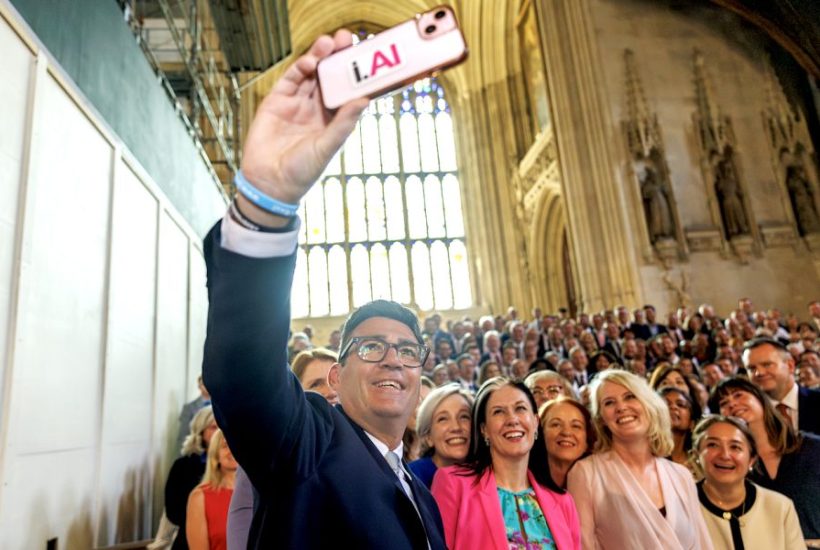
Why are women giving up on the Labour party? Certainly, not all who do so are heading to Reform: the Green party and the Liberal Democrats both have more support among women than men. But there is also a perception, however inaccurate, that Labour is a ‘boys’ club’ unwilling to elect a female leader. This was reinforced by the blokeish Burnham being handed the reins of power without a contest. Other issues hit home, too, particularly for older women.
There’s the not-insignificant question of what it means to be a woman. Senior Labour figures trying to determine what percentage of women have a penis, or whether or not a cervix can be grown, leave most sensible women cold. If further evidence was needed that a party that cannot define ‘woman’ cannot be trusted to keep women safe, then it came with Bridget Phillipson’s reluctance to back the Supreme Court’s ruling that ‘woman’ meant a biological female. It took Labour 13 months to approve the Equality and Human Rights Commission’s draft code on how the law should be implemented. That’s more than a year of women having to share hospital wards, changing rooms and public toilets with men in dresses.
Then there’s uncontrolled migration and numerous accounts of women having been assaulted, raped, or even murdered by young men recently arrived in the UK from Afghanistan, Syria, Sudan and elsewhere. The villagers of Piddington and the Pink Lady protests in Essex show that women are fearful of nearby hotels or disused army bases being used to house predominantly male migrants – and not without good reason.
But other things matter to women, too. Mothers worry about their grown-up children’s job prospects and their capacity to one day buy a home of their own. It’s more likely to be women, rather than men, who battle with the NHS to get secure hospital appointments for elderly parents. And perhaps women find it harder to ignore the growing sense of lawlessness and anti-social behaviour that stalks Britain’s town centres.
In a multi-party era, Labour can no longer depend upon the loyalty of female voters. Some have stuck with the Conservatives, others have gone to Reform. Without a change of direction, Burnham will struggle to regain their trust.