Many decades ago (or so it seems, it was actually January 2023, but things move fast in AI-world) I wrote a Spectator piece claiming that The End of Writing was coming, thanks to AI. In return for this favour, I got large amounts of angry and derisory scorn, mainly from writerly types, who banged on about the uniqueness of human creation, but also from techy people, who pointed out that as a mere hack I could not possibly know anything about AI, and anyway AI was just a glorified next-word-predictor.
The French, being French, have responded with wise philosophy, or cowardly evasion, depending on your taste
Now, I’m not the sort of cheap, mean-minded person who says ‘I told you so’, so I’ll just say ‘I told you so.’ Or, as they put it in France, ‘I told you so, you bande de cons’. And I say it in French because the latest proof that I was right, back then in January 23, has emerged from France. Where the finest new novel of the French literary season was, it turns out, potentially written with AI. Mais oui.
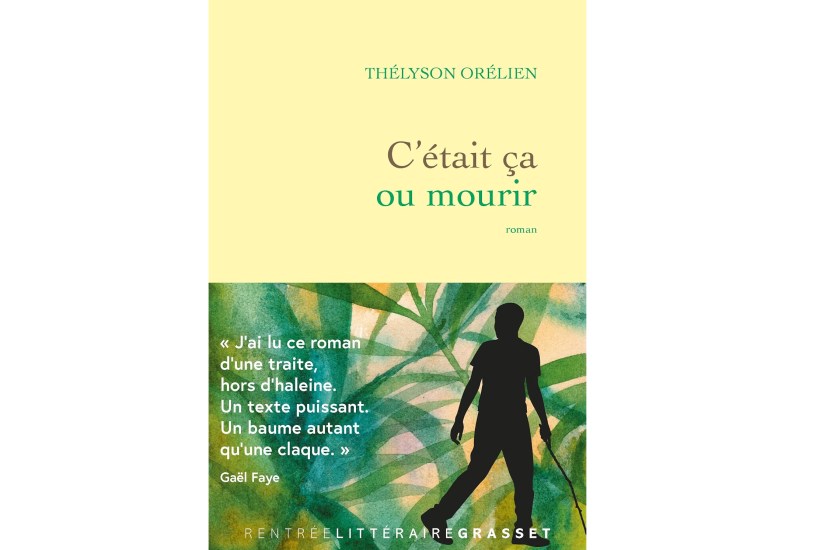
The novel is C’était ça ou mourir (It was that or die), by Thélyson Orélien, a Haitian-born poet living in Quebec. It is the story of a Port-au-Prince schoolteacher fleeing the gangs, and it is the phénomène of the rentrée. Grasset bought the French rights at auction, and the foreign rights have gone to more than 20 countries. Meanwhile, nearly 35,000 copies have sold in France, in a mere five weeks.
And it’s not just sales. The novel has already won the Méduse, the Première Plume and the RomanNews, it is on the Goncourt, Renaudot, Femina and Médicis lists, and on Monday it won the Prix du Roman Fnac, judged by 400 booksellers and 400 members. Le Monde, Le Figaro and Le Point have all agreed. It is Le Book of the Year.
Then, on Monday, the day of the Fnac prize, an anonymous account on X fed parts of the novel into Pangram, the best AI detector on the market, and announced that it was almost completely and poorly written by AI. That was retweeted by a Figaro columnist, and now the whole thing has exploded all over social media.
The French, being French, have responded with wise philosophy, or cowardly evasion, depending on your taste. Some say the accusations are ‘rumours’; others ask whether the problem is really that Thélyson is black and Haitian. Grasset categorically denies the allegations and has defended Thélyson. The author himself has denied using AI and told Liberation, ‘I’ve always loved creating and writing; I don’t see why I would use a machine.’
An essay entitled ‘literary racial profiling’ argues that the detector is not spotting the AI, it is spotting the accent, because Orélien writes a creolised French, and machines punish anyone with unusual stylistic tics.
There is a fair point here. Pangram, like all AI detectors, makes mistakes. Entirely human texts, written long before GPT, are sometimes registering as written by AI. Nobody should be convicted on Pangram alone.
But there is other evidence. A French blogger dug out 20 texts Orélien wrote between 2010 and 2017, before the machines, and ran them through the same detector: 14 came back fully human, six mixed, and none AI. So either Orélien’s entire style drastically and suddenly changed in about 2023, or a different voice has intruded.
We have been here before, of course. In March, Hachette pulled Mia Ballard’s horror novel Shy Girl after Pangram said it was partly machine-made; Ballard said a freelance editor must have added the AI without her knowledge. In Japan, Rie Kudan admitted about 5 per cent of her Akutagawa-winning novel was ChatGPT verbatim, and kept the prize. So the industry’s policy is as clear as mud: it’s fine unless you are caught, and if you are caught it depends who you are, and maybe where you’re from. But if you admit it upfront, that’s fine. Or not. Peut-être.
Which brings me back to my original conclusion: this is what The End of Writing looks like. Not robots on the bestseller list, though I give that two years. It looks like a world in which the entire French literary establishment read a novel, and wept, and gave it every prize they had, and could not tell it was bad AI, which means the end of writing. Or the machine can now write a prize-winning French novel about exile and loss, which is also the end of writing.
And I know whereof I speak. I’ve been playing with these machines for six years now, and I’m aware what they can do; one of them recently accused me, in all sincerity, of plagiarising the style of Sean Thomas, the Spectator writer. As for the French novel, the Prix Goncourt jury meets at Drouant in November, to award a symbolic ten euros to the best novel in France. They may want to check the address before they post the cheque, in case the author turns out to be a data centre in Idaho.