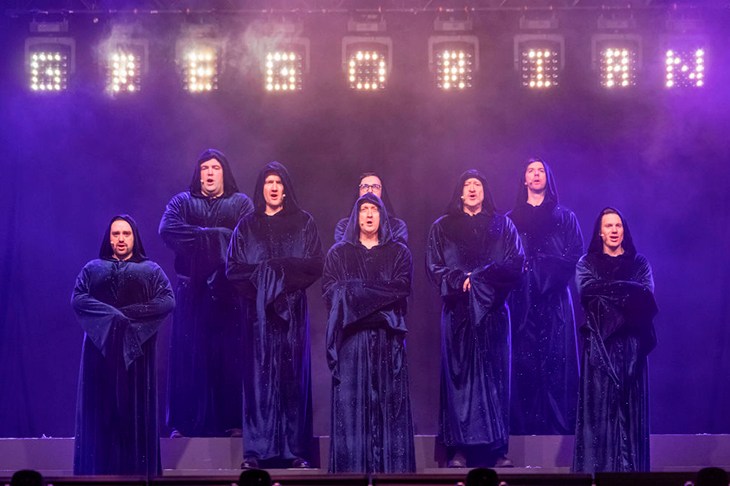
Sitting next to an archbishop at a recent Saturday night dinner, I wondered what sort of conversation to make. I chanced my arm on a long shot, and asked if he knew of any Gregorian chanting in town the next morning. Years ago, on a trip to London, I had developed a taste for sacred music after stumbling upon four accomplished choristers singing a capella at dusk in an otherwise-deserted Westminster Abbey. The pure notes and harmonies reverberated through the towering Gothic arches as beams of fading light hung in the air, turning dust motes golden; it was a magical moment. And thus emerged a wonderful tale.
Sydney Catholic Archbishop Anthony Fisher said he didn’t know of any performances the next day, but offered that a recent grass-roots revival of Gregorian chants among schoolchildren had taken off in Sydney, with thousands of children now taking part. He seemed both delighted and surprised by it, saying the initiative had come from the children themselves, and seemed to benefit them. ‘It calms them,’ he said.
Gregorian chanting is an unaccompanied European Christian choral tradition developed between the 6th and 9th centuries, and sung in religious orders and churches. It is not an obvious candidate for a modern revival, yet nearly 8,000 schoolchildren aged from 7 to 12 and based at 36 schools, are now learning it, mostly in Sydney. The Jubilate Deo (‘Sing joyfully to God’) Programme has become the largest children’s musical program in the Catholic church worldwide. Talks are underway to spread the programme internationally.
The spark for this initiative came in 2018, with a Brigidine College, Randwick, teacher sharing sacred music aspects of a USA trip with her students – who then asked to be taught the chants. Dr Ronan Reilly, Jubilate Deo director, says a 1974 core repertoire of Gregorian chants was used to develop the five-year programme, which spans Years 2 to 6. ‘Universally, there’s a lot of enthusiasm for this programme. There’s obviously a thirst for it. It’s very interactive, the kids love singing, and the reception is one of joy and involvement.’
Once they have started the programme, which for the younger children is in ‘little bits here and there’ during the service, the kids expect to sing during church, and give responses during the liturgy. Reilly agrees that the chant makes kids calmer; he also says it makes them more receptive to whatever’s on offer. And knowing that God has been worshipped with this form of music for many centuries makes kids feel part of a grand tradition.
Music’s capacity to affect human emotion is undeniable. There’s the high excitement of rock’n’roll, the generally serene power of classical music, not to mention the ‘singer’s high’, a release of ‘feel good’ chemicals such as endorphins and dopamine in the brain that the act of singing produces. Choral singing also releases oxytocin, which enhances social bonding and sense of community. Even humming has been shown to clear the sinuses, stimulate the vagus nerve and reset the body from a stressed state into a more relaxed one.
Reilly himself was a chorister from age 11, and he says neuroscience shows that babies respond to melody before language. And when two or more people sing together for 30 seconds or more, their heartbeats and temperatures start to synchronise. Instead of boring kids with rituals that are dull and meaningless to them, which was my memory of early Anglican church services, the Gregorian chant is something that can elevate and move them, filling them with a sense of awe and wonder.
Across the West, there are green shoots for Christianity among Gen Z and Gen X, and in parts of the Third World, even as Christianity declines in older age groups, and a wave of church burnings in France and England shows the hostility of some, and even many, to religious traditions. It is heartwarming to think that new generations are resurrecting the power of the spiritual in such a traditional and beautiful manner, pun intended.
Got something to add? Join the discussion and comment below.
You might disagree with half of it, but you’ll enjoy reading all of it. Try your first month for free, then just $2 a week for the remainder of your first year.