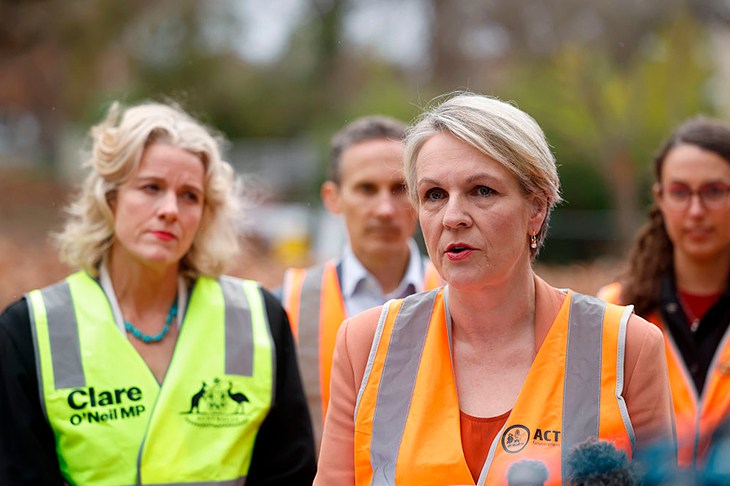
It’s surely impossible to imagine Tanya Plibersek – Plibbers to most of us – ever being the prime minister of this country. (Mind you, we might have had the same thought about Albo.) But her name regularly pops up on lists of possible contenders.
Were there to be a contest for the leadership of the Labor party, it’s reasonable to assume that Plibbers would get the backing of the mushy, left-leaning membership, although the support of her fellow parliamentarians is uncertain.
Now I’m not sure what Plibbers’ IQ is, but it’s clear that not too many fingers and toes are required to make a fair estimate. Perhaps all those worthless years in federal parliament have knocked off a few points.
Notwithstanding the obvious wreckage in the housing market, courtesy of the budget’s tax measures and the recent hikes in interest rates mainly caused by excessive government spending, Plibbers has confidently declared that there has never been a better time to be a first-home buyer. And the period she defines is her lifetime!
Plibbers was born in 1969; she is 56 years old. So, over that entire time, it is currently the best time to be a first-home buyer, according to her. Forget that time when average house prices were only twice the median income – they are now closer to ten times. Since 1975, the increase in average home prices in our capital cities has risen three times faster than wages.
But, hey, Plibbers knows best. Forget what the experts say, forget the figures – first-home buyers, eat your heart out. You have never had it so good, and you can thank the Labor party for that outcome.
By the way, you lucky first-home buyers, just ignore the downside of buying in a falling market. It’s called the danger of catching a falling knife, but that may be above Plibbers’ (very generous) pay scale.
But always keen to maintain public exposure to her absurd prognostications, she has gone a step further by claiming that the Coalition’s proposal to reduce the rate of tobacco excise by 80 per cent, legalise vapes and tobacco pouches and step up enforcement against illicit products will kill people. That’s right, it will kill people.
According to this deep thinker, ‘We have some of the lowest smoking rates in the world because cigarettes are expensive. Tobacco is the only legal product that regularly kills two-thirds of its regular users. This is a dangerous product and giving in to the bikies and the organised criminal gangs from overseas is not a solution to the illegal sale of these dangerous products.’
Leaving aside the fact that she has clearly been hanging around with the insane public health crowd for too long, it’s worth going through her false claims. Estimating smoking rates using survey data is like asking people about their sex lives or drinking habits. People don’t always tell the truth because they can get away with lying.
Now if people lie consistently, it might not matter that much when it comes to estimating trends. To be sure, the actual rate of smoking revealed by surveys will be inaccurate, but the change figure might have a degree of reliability.
But the infiltration of illicit tobacco into the market has changed that dynamic. It’s one thing to admit to smoking a legal product; it’s another thing altogether to fess up to buying the chop-chop stuff sourced from a seedy-looking tobacconist store on the main street. In other words, the consistency of the change estimate has been degraded.
When illegal tobacco was relatively rare, the excise revenue also provided some evidence on smoking rates. But it’s now estimated that around 80 per cent of tobacco products consumed are illicit, which is in keeping with the massive decline in the excise revenue. The stores selling the legal stuff will tell you the same story.
Given that a legal pack of cigarettes might cost 50 bucks, most of this being made up of the excise, and you can buy a packet of the contraband stuff for around $15, it’s doesn’t take a genius to figure out what is going on, although it is clearly beyond our Plibbers. People might prefer to buy the legal stuff – it’s better regulated and probably better quality – but with that price gap, it’s a no-brainer.
This is where the Australian Bureau of Statistics comes into the story. This is an agency not known for taking risks or being amenable to innovation. But evidently a relatively junior member of staff came up with the suggestion of using the nicotine content of wastewater to estimate the rate of smoking without relying on dubious surveys.
And here are the results. ‘The quantity of nicotine consumed in Australia increased by almost 40 per cent from 2017 to 2025, with most of the increase occurring since 2021. The increase was underpinned by a large rise in illicit cigarettes as well as increases in e-cigarettes and other nicotine products. Consumption from illicit sources as a share of total tobacco consumed rose from 12 per cent in 2017 to 80 per cent in 2025. Prices for legal tobacco products have almost tripled since December 2016 driven by annual tobacco excise increases, while estimated prices of illicit tobacco products have remained relatively constant.’
Unsurprisingly, the public health clique went nuts. We got to know them during Covid. We know the type. They are zealots; they don’t understand costs; they don’t understand trade-offs. There has never been a costly public health intervention they haven’t endorsed. Don’t we realise that those vapes and pouches contain more nicotine than ordinary cigarettes? The ABS results are meaningless. Just look at the survey results that show the lowest rate of smoking eva! These are their talking points.
But let me get back to Plibbers. Even the most fervent anti-smoking type wouldn’t argue that higher excise is the only factor driving smoking rates. There are all those liberty-restricting bans on smoking, warnings on packets and public re-education campaigns that add to the mix.
By what tortured logic would reducing the price of legal tobacco products assist the organised criminal gangs who profit from peddling the illegal stuff? It’s the price gap that gives them the leg-up, in combination with inadequate enforcement. After all, only around one per cent of containers coming into this country are inspected. So, the probability of the importation of illegal product being detected at this point is effectively zero.
To be sure, state governments are having a shot at closing some of the outlets of the illegal tobacco products, but it won’t ever be effective when the price incentives are so strong for the consumers and lucrative for the sellers. And these gangs mean business, with firebombing the preferred enforcement mechanism.
Cutting the tobacco excise will lead to a shift in the market back towards the legal product. All things considered, many consumers would prefer to consume the legal stuff. Incidentally, the Parliamentary Budget Office reckons an additional $2 billion in revenue will be raised each year because of the change. But somehow this is going to kill people compared with the hopeless status quo. Yeah, right.
My advice to Plibbers: if you are going to defend the indefensible, work on the logic and figures before you say anything. And don’t even try to justify the melon man’s behaviour.
Got something to add? Join the discussion and comment below.
You might disagree with half of it, but you’ll enjoy reading all of it. Try your first month for free, then just $2 a week for the remainder of your first year.