Aaron Patrick spoke at the Gallipoli Memorial Club’s inaugural Lone Pine Dinner. At the event, he signed copies of his book on Australia’s war in Afghanistan, and in particular, accounts of Ben Robert-Smith’s actions that earned him the Victoria Cross. The book is entitled The Last Battle. If you are a patriot like me, you’ll read it in one sitting. I wrote about it previously.
Aaron’s speech was not just about the book, but about the Battle of Shah Wali Kot in June 2010, and about what Australians do and do not know of the war in Afghanistan.
What follows is a written question-and-answer. The questions are as put to him. The answers are as he returned them.
The Last Battle: Australian SAS, Commandos and our Greatest Victory in our Longest War is published by Pan Macmillan. Patrick is chief writer at The Nightly and a former senior correspondent and deputy editor of the Australian Financial Review. He has written for the Washington Post and the New York Times.
The Last Battle had me pacing like parts of The Odyssey.
Q. Your fiancée mentioned that your middle name is Odysseus. The Last Battle has a drive that, for this reader, recalled the slaying of the suitors in The Odyssey. How did the name come about, and how much – if at all – was Homer in your head while you researched and wrote the battle?
A. My father was an archaeologist and a huge fan of the classics, which is why he gave his three sons names from ancient Greece. I liked the connection and decided to continue the tradition with my son and daughter. When I was writing for the Washington Post and the New York Times while at Fairfax and Nine in Sydney, I used Odysseus in my byline to create some separation between my local and international work. Some people assumed the name was made up, which it wasn’t.
The Last Battle did not start out as the story of an odyssey. It evolved into one as I concluded that the battles fought by 2 Commando and the Special Air Service Regiment in June 2010 in Afghanistan weren’t just independent, violent clashes. They were important components of a decade-long drama that continues and will play out for many more years.
The Anzac Spirit
Q. The Anzac story in many families still carries a classical idea of honour under fire. Where did the emotion in the storytelling come from, if not from that inheritance?
A. The concept of honourable war is incredibly important for Australians. We rightly venerate our military history, mainly starting with the Gallipoli landings. The commandos and SAS showed such courage in Shah Wali Kot that I still get the chills when I read some of the combat passages. Even though it was our longest war, it is not a well-known war. I wanted to help Australians understand what these men did on our behalf by focusing on the most important battle of the war, which was recognised as such by the Army’s first battle honours since Vietnam.
Ben Roberts-Smith
Q. After the dinner you signed copies for some of my neighbours in regional New South Wales. They were visibly moved, and the conversation afterwards was about Ben Roberts-Smith and what they see as a gulf between popular feeling and official treatment. Without touching live proceedings, what responses has the book drawn from ordinary readers, and has anything in that reaction surprised you?
A. Ben Roberts-Smith was awarded the Victoria Cross for storming a machine-gun position during the battle, an act I describe in detail in The Last Battle. While the medal made him famous, he was one of more than 100 Australians (and Brits, and at least one New Zealander and an American) who participated in the battle. The main reason the war is so little understood is because the serious misconduct allegations in the Brereton Report overwhelmed everything else that happened in Afghanistan. That’s a shame. There were many Australian heroes in the war. They deserve recognition.
Reflections on the research process
Q. The research is unusually candid about what you could and could not get. What did the process actually look like – access, the Army, competing memories of the same fight – and what have you concluded, looking back, that you could not have said while you were still reporting it?
A. I believe in transparency in media practices. This principle has influenced my political reporting. It is also why I am happy to answer the most common question I receive about The Last Battle, which is whether I interviewed Ben Roberts-Smith.
I had never met him or exchanged messages before writing the first draft of the book. He rebuffed my initial approaches to discuss the Battle of Tizak. I later found out he intended to write a memoir, although that plan fell away with his legal problems. Eventually he agreed to an interview on the condition he could read the manuscript before meeting me. I refused and sought an unconditional interview. He agreed to meet on the day before the manuscript was due to be submitted to the publisher. He cancelled the day before, which allowed me to make my deadline but forced me to rely on his extensive testimony about the battle in court. One day I hope we can do the interview, although that will probably have to wait until his criminal case is resolved one way or the other.
I first thought that Aaron Patrick had recaptured some of the Anzac spirit that was lost in the public imagination due to weak political leadership. But after handing out a few signed copies of Aaron’s book to my neighbours in regional NSW, the conversations quickly turned to politics. Not just between my neighbours and I, but between their neighbours and others who joined in.
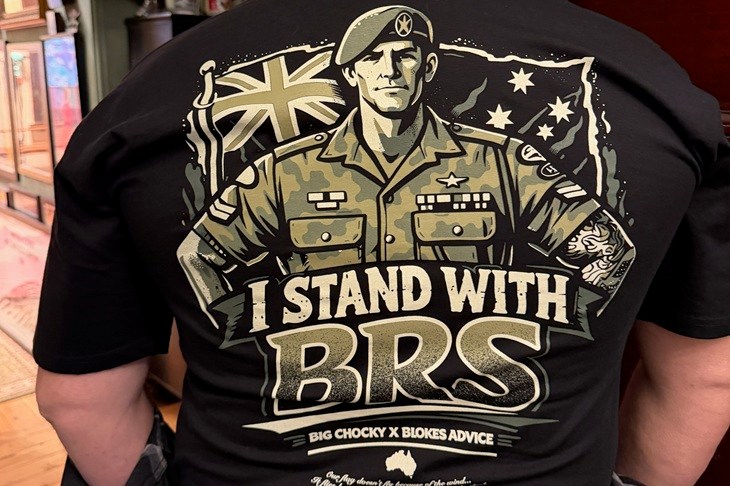
I wore my Blokes Advice Big Choky ‘I stand with BRS’ T-shirt to the local pub recently. Almost everyone asked me where they could buy one. While Aaron’s work is factual and independently reported, there is something about the subject matter that ordinary Australians see through.
They don’t see a disgraced war hero. They see a war hero who has been let down by limp leadership. But don’t listen to me, read Aaron Patrick’s The Last Battle and decide for yourself. After all, that’s the very principle the sons and daughters of Anzacs commit to when they wear our country’s uniform.
Dr Michael de Percy @FlaneurPolitiq is the Spectator Australia’s Canberra Press Gallery Correspondent. If you would like to support his writing, or read more of Michael, please visit his website.