Imran Khan is dead. At least he may as well be. Last week, the former England cricket captain Michael Atherton stuck his neck out and interviewed Khan’s two sons, Sulaiman, 29, and Kasim, 27, at Lord’s for Sky TV. Showing maturity and restraint, of which their father would be proud, Imran’s sons explained at length how the Pakistan government was orchestrating their father’s murder.
The response to the interview was explosive. In protest, the craven Pakistan Cricket Board immediately threatened to withdraw the country’s team from the ongoing Lord’s Test match. They did not follow through. Sulaiman reported that his father, in addition to having a problem with one of his eyes, had ‘rising blood pressure due to isolation and solitary confinement’. Despite a supreme court order for him to be taken to a hospital to see his own doctors (and his sister), the government flouted the instructions and only allowed a ‘visibly stressed’ Imran a brief meeting with a government physician.
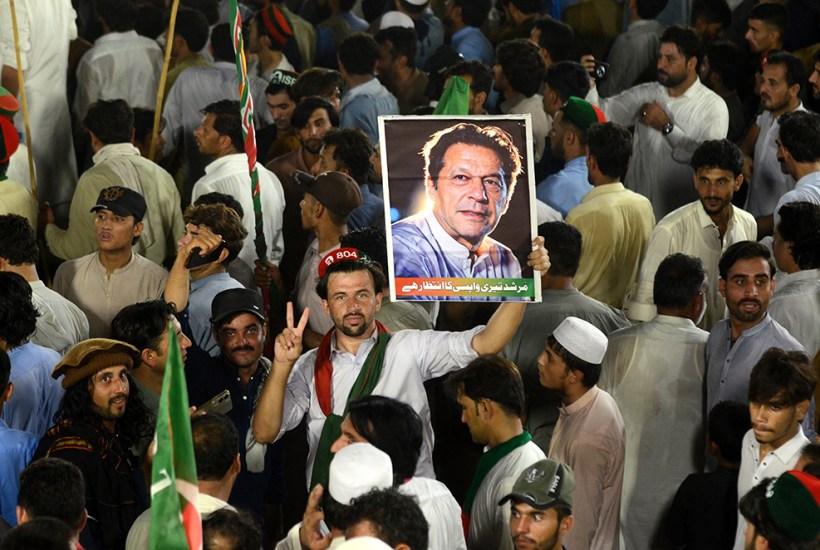
After being removed as prime minister in 2022 by skulduggery involving Pakistan’s kleptocrat political parties, the army and very likely the CIA, Imran used his charisma to bring out his supporters in huge yet peaceful rallies. Several failed assassination attempts followed. At one rally marching on Wazirabad, while standing on the bed of a truck, he was shot in the leg and thigh by two gunmen. Imran accused his successor as prime minister, Shehbaz Sharif, of being behind the attack. (Sharif called that allegation ‘false and cheap’.)
He was a magnet for women and had a particular fondness for the daughters of London’s high society
Later, in 2023, Imran, the only honest political leader in Pakistani politics, was locked up on trumped-up corruption charges; he has remained incarcerated under increasingly tough conditions ever since. In essence he is in prison because he is not corrupt. The Pakistan people know it. Khan is the most popular politician in the country’s history and, to the despair of the legacy parties, remains so despite his incarceration.
His imprisonment may not last for long. Locked in an incommodious cell for 23 hours a day, he is denied visitors and books. These are appalling conditions for an ill 72-year-old who has to survive the brutal summer heat without air conditioning. This is designed to kill him. His sons, who for the first two years were allowed to speak to him, albeit in often truncated calls, are now denied contact.
The Pakistan government officially says that Sulaiman and Kasim are allowed to visit their father, but at the same time denies them visas. They haven’t spoken to him for six months and he has had no visitors for ten. The government, led by Sharif but underpinned by the army strongman Field Marshal Syed Asim Munir, does not dare release Khan. Even now, three years after his arrest, polling still shows Imran having upwards of 60 per cent popular support. The government’s intention seems to be to keep him in prison till he dies.
Ahead of the election in 2024, Imran was given an additional seven-year prison sentence for marrying the Sufi prophetess Bushra Bibi too soon after her divorce. Nevertheless, the PTI party (Pakistan Movement for Justice), which Imran founded, won 31 per cent of the vote, some eight percentage points ahead of Sharif’s Pakistan Muslim League party. It was a victory achieved despite widespread electoral fraud which brought protests from western governments. Opinion polls at the time suggested that the PTI should have won by a landslide, and with it an outright majority of seats.
Since Imran was barred from standing, his place was taken by his finance minister, Omar Ayub. After the elections and the demonstrations that followed, Ayub was arrested and imprisoned for ten years. Other PTI leaders, including Imran’s wife were rounded up and imprisoned. Thousands of Imran supporters were similarly arrested, and some even killed. Sharif says there is no ‘personal vendetta’ against Imran and his government called the election ‘free and enthusiastic’.
So who is the real Imran Khan and what accounts for this enduring popularity which makes the Pakistan army and the traditional elites so determined to kill him?
For full disclosure, Imran is my former brother-in-law, a relationship which allowed me to see him close-up. When I think of the most impressive politicians I have talked to in my life, including Margaret Thatcher and Henry Kissinger, Imran is among them. And not because I always agreed with his political views – I didn’t. In my view his anti-Americanism was particularly misguided.
Nevertheless, I was never in doubt about his integrity, scrupulous honesty, his capacity for hard work, his piety and moral probity. This last quality might come as a surprise, given his not undeserved youthful reputation as the great globe-trotting playboy/lothario of his generation. He was a magnet for women and had a particular fondness for the daughters of London’s high society. In London, Annabel’s nightclub was a second home. He loved to party, though his preferred tipple was a glass of milk.
His Islamic version of a Damascene moment came in 1985 when his mother, Shaukat Khanum, developed cancer and died. After captaining Pakistan to their first cricket World Cup victory in 1992, he retired and, rather than use his fame to line his pockets, travelled the world to raise money from the 13 million-strong expat communities to fund the largest cancer hospital in Asia. The Shaukat Khanum Memorial Hospital and Research Centre, based in his home city of Lahore, treats 75 per cent of its patients for free. When he took me around this remarkable facility, he was treated as a demi-god.
Anyone doubting the regard with which he is held in the world should raise the subject of Imran with their next Pakistani Uber driver. The response is always gushing adoration. Sometimes I reveal that Imran was my brother-in-law, and the reaction is always dramatic. A few weeks ago, a driver insisted on having a photo taken with me and shook me heartily by the hand. To avoid accidents, it is a reveal that I only make when my Uber is stationary.
He was given rockstar treatment wherever he went in the subcontinent – even in India, Pakistan’s long-term enemy. On one occasion I took him and his former wife Jemima to Trishna, a fish restaurant in downtown Bombay. The crammed and noisy establishment instantly fell into a shocked silence. Rumour spread quickly. Upon leaving the restaurant, we had to wade through crowds in their thousands.
Imran’s charisma was infectious even though he was not a great speaker; he speaks in a flat baritone drawl which his in-laws would delight in imitating. But he had an air of command I have rarely seen since. His physical presence was intimidating. Sunil Gavaskar, the great Indian opening batsman and former captain, once told me how the Indian players were cowed by him. Sunil recounted that on one occasion Imran, a veritable Adonis as a young man, strode purposely through the changing room to the showers wearing nothing but a small towel ‘while we tried desperately to cover up our very inadequate physiques’.
I first met Imran in 1994 at a Hollywood welcome dinner at the Taj Mahal Hotel in Bombay, where he was accompanying the visiting Hollywood stars Goldie Hawn and Sally Field, and Ismail Merchant, the Indian film producer. It was here that Imran confided that he was looking for a bride. My ex-wife suggested her half-sister, Jemima Goldsmith. Imran followed up and the next year a registry wedding in London took place, followed by a traditional wedding and party at the Khan family home in Lahore.
It was a modest affair compared with the weddings of prodigiously rich Pakistan families. But Imran had a deep interest in Sufi poetry and Islamic culture, and in that garden his friend, the late Nusrat Fateh Ali Khan, the greatest ever singer of qawwali (a rhythmic chanting of devotional Sufism), provided one of the great musical experiences of my life. Imran had always had an interest in politics – he took a degree in PPE at Keble College, Oxford – but when he married Jemima he was not yet at the start of his political career and we had many discussions about what he should do. My first piece of advice was simply: ‘Don’t go into politics, the chances are you will be assassinated.’ Some 48 Pakistani political leaders have been assassinated or executed, including leaders such as Liaquat Ali Khan, Zulfikar Ali Bhutto, Zia-ul-Haq and Benazir Bhutto.
Imran’s response was to point out his religious faith. And he would often quote a line from President Franklin D. Roosevelt’s 1933 inaugural address: ‘The only thing we have to fear is fear itself.’ If there was only one word I could use to describe Imran, it would be ‘fearless’.
His main motivation for entering politics was his desire to eradicate Pakistan’s endemic corruption
The day after he announced his intention to go into politics, a bomb was placed in a chemotherapy waiting room at the Shaukat Khanum Hospital, killing six people and injuring 34. Given the timing of the terrorist attack, it was assumed by many that this was a warning from the political Establishment, perhaps even from Benazir Bhutto, the then prime minister. At Oxford, she and Imran had been close – perhaps very close.
As he forged ahead with preparing to form a party, I took Imran to lunch with Sir John Banham, then chairman of the Audit Commission. Imran pummelled him with questions. One of his main motivations for entering politics was his desire to eradicate Pakistan’s endemic corruption.
Amnesty International, Human Rights Watch and the International Federation of Human Rights have all protested Imran’s trial, his jail sentence and his barbaric incarceration. Western governments, however, have remained silent. Why? The reasons are geopolitical. Pakistan is a nuclear power sensitively positioned between China, Russia, Iran and Afghanistan.
For America, Pakistan is a bulwark between all these enemy powers. The two countries have maintained strong military ties. Pakistani officers often train in the US, and in the past 25 years America has provided Pakistan with $35 billion of aid. Despite relations having often been strained by Pakistan’s sheltering of jihadists – including of course Osama bin Laden outside the town of Abbottabad – America prefers a half-in to a wholly-out relationship.
In effect, Pakistan plays its neighbours off against each other, with only India as its forever enemy. In the game of realpolitik and global security, America and its Nato allies cannot afford to weigh the human rights of a former great cricketer and ousted prime minister in the balance. Thus Andy Burnham and his foreign secretary, Ed Miliband, both normally keen to pander to the Muslim vote, have not said anything about Imran’s imprisonment, despite his British family and his deep connections with the UK.
Got something to add? Join the discussion and comment below.
You might disagree with half of it, but you’ll enjoy reading all of it. Try your first month for free, then just $2 a week for the remainder of your first year.