We all know the Australian, the national newspaper Rupert Murdoch created in 1964, as a publication that generally occupies the conservative side of Australia’s political and ideological divide. From economic policy and US alliance management to the culture wars, the Oz is rarely mistaken for a left-of-centre newspaper.
But it was not always so. In the late-1990s and early-2000s, the Australian was, in many respects, a pale imitation of more progressive outlets such as the ABC, the Sydney Morning Herald and the Age.
During the 1999 republic referendum, it campaigned enthusiastically for an Australian republic and gave relatively little space to monarchist arguments or advocates of a directly elected president. And, most intriguingly, it was one of the leading critics of the Howard government’s response to the Tampa asylum-seeker stand-off.
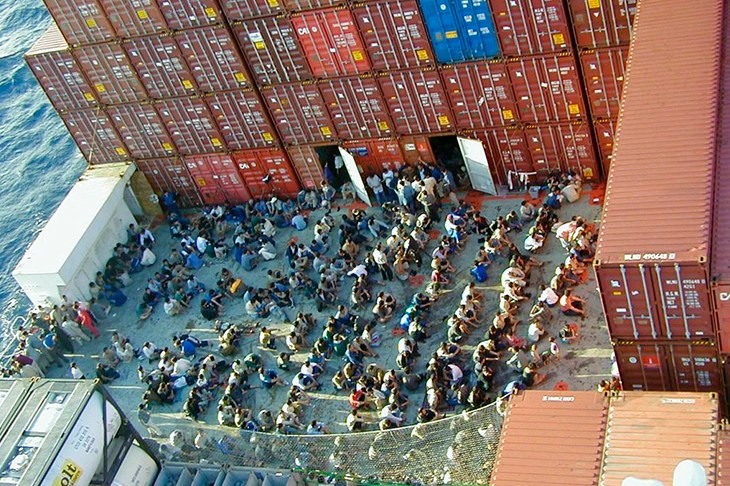
That crisis began on August 26, 2001 – 25 years ago – when a vessel carrying 438 asylum seekers began to sink in international waters north of Australia. The Norwegian freighter Tampa rescued them and initially headed towards Indonesia. After several of those rescued pressured the captain to change course, however, he turned towards Christmas Island and sought permission to enter Australian waters.
John Howard’s government refused. Australian troops subsequently boarded the Tampa, creating an extraordinary political, legal and diplomatic stand-off. The government insisted that Australia could not allow people smugglers to determine who entered the country simply by putting asylum-seekers on boats and sending them towards our shores.
The controversy became one of the defining episodes of modern Australian political history. The government responded with offshore processing and what became known as the Pacific Solution. The argument put forward by Howard and the immigration minister Philip Ruddock was ultimately straightforward: the people’s elected representatives, not people smugglers, would ‘determine who comes to this country, and the circumstances in which they come’.
I have a personal reason for remembering Tampa. At the time, I was working at the Australian Financial Review and found myself at odds with my colleagues at what was then known as John Fairfax Publications, which included the Age and the Sydney Morning Herald.
Much of the journalism and commentary around me – along with the sundry intellectuals who had appointed themselves guardians of the nation’s conscience – regarded tough border protection as callous, cruel and immoral. Australia was portrayed as an ‘international bully’, a ‘white fortress’ and a country abandoning its reputation as a humane and tolerant immigrant nation. They were ashamed to be Australian. I was – and remain – proudly Australian.
A month later, in late September 2001, I was hired as the Australian’s opinion editor. Despite my policy differences with many of my Fairfax colleagues, I had mixed feelings about leaving to join what was then known as News Limited.
On the one hand, I had long admired Rupert Murdoch for his support for my political heroes, Margaret Thatcher and Ronald Reagan, and for creating Fox News Channel, which I watched devotedly in those days. On the other hand, I was a die-hard South Sydney supporter and still furious that News had kicked my beloved Rabbitohs out of the National Rugby League in late-1999!
I was also sceptical of the paper’s increasingly ‘wet’ tendencies – its drift away from Howard conservativism. What especially struck me was how hostile even the Australian had been towards Howard and Ruddock over their handling of the Tampa crisis.
Its editorial of 30 August of that year, for instance, described the government’s response as an ‘offensive, inhumane embarrassment’ that had degenerated into a ‘full-blown domestic and foreign policy crisis’. John Howard, it declared, was putting ‘deterrence first and decency last’, and urged him to allow the asylum seekers ashore.
The newspaper that would become the flagship of the Howard-era conservative settlement was, at the time, overwhelmingly opposed to one of the Howard government’s defining policy agendas. Nor was this confined to its editorials or the cartoons of its star cartoonist, Bill Leak. The broad thrust of its opinion pages was overwhelmingly critical of Howard and Ruddock.
Greg Sheridan accused Howard of exploiting ‘the darkest fears’ of the Australian psyche and described the affair as ‘perhaps the most embarrassing and dishonourable episode in recent Australian diplomacy’. Greg’s central objection was that the Tampa operation could not deter future arrivals: smaller boats, he argued, would simply evade measures designed to deal with a large commercial vessel. Although Paul Kelly did not reject the principle of border control, he argued that Howard had created a ‘deep but false sense of national crisis’, reverted to a ‘Fortress Australia mind-set’ and brought out ‘many of our worst attitudes’.
There was one striking exception inside the Australian. Frank Devine, a former editor of the paper, dismissed the emotionalism of the moment as ‘soft-headed’ and defended the government’s right to take a stand against unauthorised arrivals.
I was understandably cautious about my new employer, but I soon grew into the job, particularly after Rupert appointed Chris Mitchell, a brilliant and deeply well-read editor with an instinctive feel for middle Australia, as editor-in-chief. Chris, who had arrived from Brisbane’s Courier-Mail a few months after I joined the Oz, was determined that the newspaper should represent not merely its readership but what he saw as the national interest. In neoconservative parlance, my colleagues got mugged by reality.
As a result, our opinion pages (which I edited from 2001 to 2008) provided a platform for writers who defended the intellectual case for firm border control, among them Owen Harries, John Hirst, Janet Albrechtsen, Tim Blair and Imre Salusinszky, as well as international observers such as John O’Sullivan and Mark Steyn.
The argument that Chris, Janet et al. and I were making – and which had seemed politically risky and morally dubious in 2001-02 – gradually became part of the mainstream case for immigration.
The policy condemned at the time as cruel and politically opportunistic would eventually become the foundation of one of the world’s most effective systems of maritime border protection.
People smuggling stopped, which boosted public confidence in immigration.
In retrospect, the remarkable thing is not that the Australian changed from 2002 onwards. It is that it lost its senses in the first place.
Got something to add? Join the discussion and comment below.
You might disagree with half of it, but you’ll enjoy reading all of it. Try your first month for free, then just $2 a week for the remainder of your first year.