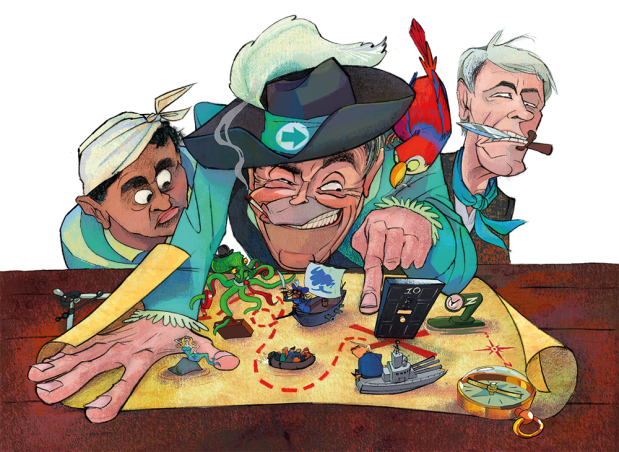
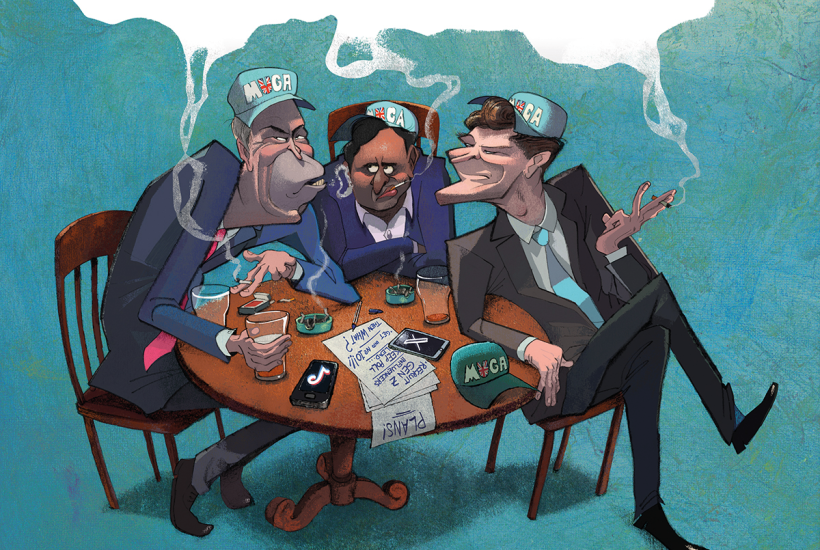
If Tolstoy had written about British politics, he might have noted: ‘Happy parties are all alike; every unhappy party is unhappy in its own way.’ Reform UK is beginning to resemble a laboratory test for the idea that every party run by Nigel Farage is unhappy in the same way. Just as in Ukip and the Brexit party, a highly dominant leader exists at the centre of a court, with extreme tensions between loyalist long marchers and arrivistes, between insurgency and respectability, between campaigning and preparing for government.
On Monday a new round of bloodletting erupted, when the founder of ConservativeHome, Tim Montgomerie, who defected to Reform two years ago, was suspended following his public criticism of Farage and the home affairs spokesman Zia Yusuf. This decision came between the recording and broadcast of an interview Montgomerie gave to The Spectator expressing his concern about tone, tactical voting and party structures.
Montgomerie was stating what many say in private. But for those at the top of the party, the most significant thing to happen on Monday was not the Montgomerie affair. ‘For the first time since Easter, we held a press conference and no one asked about Nigel’s finances or the £5 million,’ says one Reform source, referring to the simmering row about Farage’s acceptance of a £5 million ‘gift’ from the crypto-billionaire Christopher Harborne and donations from his close associate ‘Posh George’ Cottrell.
Instead, for the first time in months, the lead item on the main TV news bulletins was a Reform policy announcement – from Robert Jenrick and Richard Tice – to slash welfare spending by £50 billion by barring foreign nationals from claiming almost all benefits, restricting disability payments to the most afflicted and re-instituting the two-child benefit cap.
Farage was away on Monday, and did not know that Tom Waterhouse, the general secretary, and Lee Anderson, the party chairman, were going to suspend Montgomerie. But it was Farage, in the spring, who had ordered a benefits-cuts plan be drawn up, following taunts from the Tories that he was ‘soft on welfare’ because his party’s voters live in places where it is rife.
The infighting, the rows and the questions about court structure are all off-putting to serious people
This, Reform staffers say, is missing the point. ‘Yes, Reform constituencies have very high numbers of people who are claiming, but our voters aren’t those people,’ says one. ‘They’re those people’s neighbours.’
A recent Reform focus group with Labour voters in the north-west who are considering switching to Reform found outspoken backing for welfare cuts. Polling shows that 65 per cent of all voters (and three out of four Reform voters) think people should have to work for their benefits after six months.
Once Farage resigned his seat to fight a by-election in Clacton, he envisaged the welfare plan as part of a ‘one-two punch’, alongside the by-election victory, to ‘get back to a situation in which we are the master, not the follower, of the news’.
Further policy offerings will follow. On Thursday, Suella Braverman, the shadow education spokeswoman, will outline plans for apprenticeships, designed to improve the skills of the British population. Tice will set out plans for housing reform on Monday. Both are designed to signal that Reform’s people are Britons who work, rather than migrants who don’t. ‘People will be left with no sense of subtlety as to who Reform is trying to help,’ says one insider. ‘We are un-ambiguously a party of workers.’
The welfare policy has stolen a march on the Tories. Helen Whately, the shadow work and pensions secretary, announced a policy review last year, but it has not delivered. The Tory offering risks looking like a Reform retread. Irate members of the shadow cabinet, who think Whately has dropped the ball, have dubbed her ‘Helen Lately’. A source familiar with the process says: ‘Both the Tories and Reform wanted to find some money from benefits which they could then spend at party conference. Helen has, in essence, spent the last year with her thumb up her arse.’ There is an expectation inside Reform that the Tories will use the cash to announce that they would scrap inheritance tax.
Reform’s conference, in Birmingham, comes first, beginning on 3 September. The original slogan, ‘It’s Time For Reform’, has been scrapped. ‘The focus is all on the first hundred days’ of a Reform government, one source explains. ‘Nigel believes there will be an election sooner rather than later, very likely in 2027,’ a party source says.
Reform high command remains bullish about its electoral prospects. ‘Nigel could get run over by a bus and we’ll walk away with 125 seats at the next election,’ another senior figure says. Candidates in target seats are divided into ‘three tranches of 125’. The source explains: ‘125 is the basement, 250 is the median expectation, 375 is the target.’ The last would represent a Reform majority of 100. Candidates for the first batch of highly winnable seats will be selected and announced ‘pretty darn soon’. Another staffer says: ‘There are some very serious people.’ Farage also plans to unveil ‘two or three’ new members of his ‘shadow cabinet’. He continues to woo business leaders, former military men and ex-NHS administrators to join up and lend an air of professional expertise to the party’s spokespeople.
But this is where the Montgomerie affair and the criticism he has levelled are a problem. The infighting, the rows and the questions about the court structure of Team Farage are all off-putting to serious people, most of whom would have to take a huge pay cut to sign up. They would also only do so if there were a serious prospect of Reform forming a government. Both Farage’s funding issues and Yusuf’s brutal approach to people (branding Ben Wallace a ‘traitor’) and policies (his tougher-than-Trump desire to deport every single illegal migrant) appear to fuel tactical voting against Reform.
Yusuf is probably the most divisive figure at the top of British politics. A highly successful ex-businessman, who sold his company for £250 million, he seems fired by rage at the state of the world and the Conservatives in particular. As party chairman, he was responsible for helping Reform expand from a start-up into the most professional operation Farage has led. ‘Nigel is in frank admiration for what Zia can do,’ says a party official. ‘All the things that normally go wrong with a business-background politician, he has managed to avoid. He has never put his foot in it in a broadcast interview – not accidentally, anyway.’ Montgomerie agrees: ‘He made the party organisation work. He has so many qualities, but he has to be a team player.’
Yusuf also seems compelled to feud with enemies, external and (wearingly) internal. ‘Zia did not talk to me for three months when he found out I was involved in bringing Jenrick over,’ says Montgomerie. ‘You cannot behave like a child in politics.’
Montgomerie is not alone. ‘At any given point, the list of people that Zia is not speaking to tends to be longer than the list of those to whom he is,’ says another insider. ‘And if you do have the misfortune to be on the list of those he is speaking to, you can rest assured that you’ll soon be back on the banned list.’ In an extraordinary measure of the intense feelings Yusuf generates, a Reform insider says: ‘Zia is an omni-c***. It’s not personal. He’s just like it to everyone.’
Critics point out that by attacking Rupert Lowe and reporting him to the police (a process which resulted in Lowe’s guns being confiscated), Yusuf effectively drove Lowe to set up his own party, which is now leaching votes from Reform. ‘Zia’s original sin was that he created Restore by handling Rupert the way he did,’ says one internal critic. ‘They are now at 4 per cent. Every one of those percentage points having come from Reform’s vote.’
Yusuf’s critics think his abrasive style has repelled Reform-curious voters. Montgomerie says: ‘Zia is completely uninterested, it seems to me, in unwinding Reform’s number one problem, which I think is tactical voting against us – I think he reinforces that.’ A second Reformer adds: ‘There’s no way around it. Zia doesn’t play well with women.’
Montgomerie has a theory. ‘If you understand him as… he wants to succeed Nigel Farage, almost everything he does makes sense. The loyalty to Nigel, the freelancing, the indifference to the wider electorate… If we don’t look like decent people, even people who agree with us on deportation won’t trust us with those policies. You have to pass a basic decency threshold to unwind that tactical voting.’
The fear of some is that Farage also appears too angry. ‘He’s not the Nigel I used to know,’ says one of his former drinking partners. Asked how much internal discussion there was about how to handle questions about Farage’s finances, one source says: ‘Zero.’ The result was a series of confrontational exchanges.
‘The list of people Zia is not speaking to tends to be longer than the list of those to whom he is,’ says an insider
Montgomerie says: ‘Nigel is probably one of the best media performers of the last two decades. What he cannot do is, if it’s about him, his personal circumstances or his personal finances, particularly if he’s interviewed by a woman – he’s not good. When he is facing hostile questioning, he doesn’t perform well.’
Farage loyalists think they can bypass the mainstream media. But like Trump, there is a tension between running an insurgency and shackling Farage’s campaigning genius to a more structured organisation. ‘He doesn’t have a chief of staff,’ says Montgomerie. ‘He doesn’t have regular meetings with his MPs. There isn’t someone at shadow cabinet level in charge of selecting candidates.’
Montgomerie also complains that ‘our ground operation is not what it should be’ and gave Farage the wrong steer on recent by-election results. ‘We were going to win Runcorn handsomely. We won by six votes. They thought they were close on the night of Makerfield. So the intelligence was wrong.’
He is also critical of the polling, calling it ‘thinner’ than that of the Tories. ‘It’s not asking the awkward questions. It’s not understanding the nature of our women problem, or how you address tactical voting.’ This is a view that is less widely shared – Farage’s numbers man, Chris Bruni-Lowe, is a highly regarded message-writer and is in demand from political parties around the world.
The age-old criticism of Farage is that he values loyalty above ability. ‘There are people around him who have been around him for quite a long time who, if there were a competitive tendering process, I’m not sure would survive,’ says Montgomerie.
Reform’s answer is that Montgomerie held no party position and does not see a lot of what goes on in headquarters. ‘It’s a very professional operation,’ says one staffer. ‘The shadow cabinet is a very cohesive unit. Everyone’s shoulder is to the wheel.’ They insist that the upcoming announcements will put a difficult summer behind them.
Reform is also back on top in the polls and Montgomerie says he will fight his suspension. ‘If Reform gets it right, the sky is the limit,’ he says. ‘But we’re not getting it as right as I think we need to yet.’
It turns out Tolstoy touched on the challenge ahead for Farage, in his appropriately titled ‘Three Methods of Reform’: ‘Everyone thinks of changing the world, but no one thinks of changing himself.’
Got something to add? Join the discussion and comment below.
You might disagree with half of it, but you’ll enjoy reading all of it. Try your first month for free, then just $2 a week for the remainder of your first year.