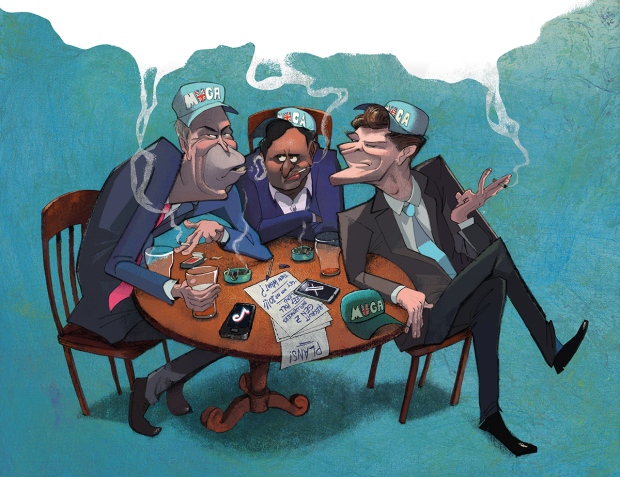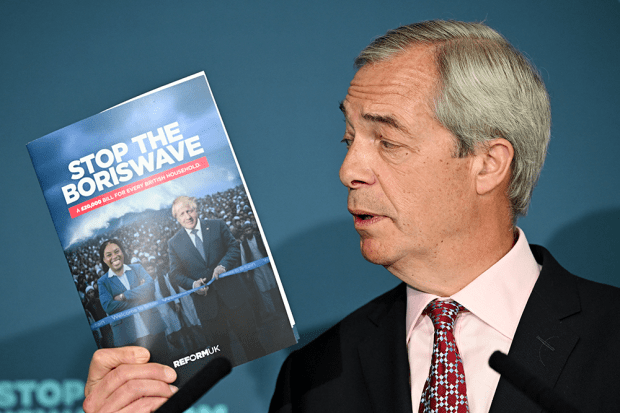
Emulating Donald Trump may be a strategy with diminishing returns in British politics, but Nigel Farage plans to channel the US President’s time on The Apprentice if he becomes prime minister, telling his cabinet ‘You’re fired!’ if they fail to deliver within 100 days of taking office.
In a bid to show voters Reform UK is serious about delivering change, Farage will tell his party conference in Birmingham this week that ministers will be forced to resign, or face being kicked out, if they cannot keep their promises. The pledge will form a centrepiece of Reform’s second annual jamboree, where the party will outline its plans for ‘the first 100 days’ in Downing Street. An aide says Farage will dispense with failing colleagues without qualms: ‘Nigel doesn’t give a fuck.’
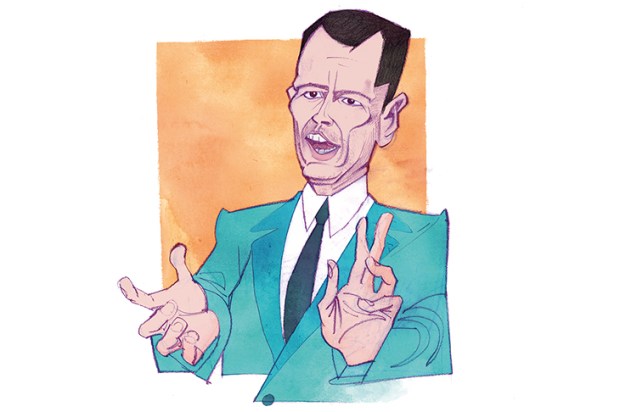
One of those whose head will be on the block is Richard Tice, the deputy leader and business spokesman, who will use his platform speech on Friday, just before Farage takes the stage, to outline plans to revive house-building and Britain’s high streets. Most politicians promise jam tomorrow, but Tice plans to offer a return to the jam of yesteryear with radical reform of planning law to make it easier to build homes and tax breaks to make it cheaper for developers. ‘Our town centres are in a state of national crisis, to the point of an emergency,’ he says.
‘The plan for conference is for the country to fall in love with Nigel again’
In an interview with The Spectator, Tice explains how he sees the problem: ‘It’s what I call the doughnut. Twenty-five years ago, every town had some jam in the middle, which was lovely – retail, and then housing on the outside of the retail. Now you’ve got a doughnut that’s not filled with jam, it’s filled with mouldy old cheese. On the outside, you’ve got nice new greenfield developments, out-of-town retail parks, out-of-town shopping centres with free parking. On the inside, you’ve got a war zone of vacancy, high business rates, homelessness, antisocial behaviour, expensive parking.’
At the moment new development is split roughly 50-50 between greenfield and brownfield sites. Tice, who made his money in property development, wants to shift the balance so it is 75 per cent on brownfield sites. ‘Before anybody says there aren’t any, they’re all used up, that’s bullshit,’ he says. ‘There are loads and loads of them, right in the heart of town centres. You’ve got to make planning really simple. On brownfield sites there will be a complete removal of many of the costs, impediments and delays.’
Reform is proposing what Tice calls ‘a five-year emergency plan’ that would ‘get rid of all the affordable-housing requirements’ outside of the few cities – London, Manchester, Leeds and Bristol – where development currently works. That would mean developers no longer have to build cheap homes alongside more profitable housing.
Tice would also ‘remove the need for an environmental statement, remove biodiversity net gain, remove the habitat regulations, remove the newts and bats regulations’ (which allow the presence of these creatures to impede human development). He would also scrap the Community Infrastructure Levy on new development.
On the tax side, Tice says: ‘All new brownfield residential homes would be stamp-duty free, capital-gains-tax free and rental-income-tax free for a decade. We’ve got to dramatically incentivise.’ This, he calculates, will cost around £1 billion a year. But he says there would be a ‘GDP multiplier effect’ that would recoup the costs. ‘If you had an extra 20,000 units a year built because of this, give or take – the GDP on that is £4 billion to £5 billion. If nothing gets built, if I’m wrong and it’s not an incentive, there’s no cost. There’s no government money going into this. It’s what they do in the States: you get a tax-free area, it incentivises people to invest their own money in something, and then they’ve got a tax-free asset.’
All this, he believes, would be a boon for ‘small builders, small contractors, small developers who’ve basically given up and said, it’s too difficult, sorry, I’m off to the golf course or the south of Spain’.
Tice also plans to shift the balance from out-of-town retail to shops on the high street. ‘We’ll consult on removing [business] rates or dramatically lifting the threshold [at which they are paid] on retail, hospitality and leisure [businesses] in town centres.’ That threshold currently stands at £12,000.
That would be paid for by a ‘very small online-delivery tax’ and higher costs for out-of-town operators. ‘The big sheds out of town have got away with blue murder,’ he says. ‘Companies have left the high street and either gone to an out-of-town retail park or gone dark into an industrial park around the back of town. They’ve got cheap rents, cheap rates, and they’ve grown their business – and the high street’s knackered. Take Boston – my own town centre is shot to bits.’
These proposals will form part of what Tice calls a ‘Teal Paper’, which he will put out to consultation before a final Reform policy is announced this autumn. ‘To what extent is someone prepared to pay, let’s say for the sake of argument, a one-and-a-half or 2 per cent delivery tax as a recognition that you’ve got a choice? Either you go to your town centre and see it before you buy it and you don’t have the delivery tax, or you sit at home and have a delivery tax, whether it’s a kebab or a new pair of jeans.’
Tice is clear that if Reform does make it into government, they will have to deliver quickly. ‘People are sick and tired of politicians who talk the talk, make a bunch of promises – like Ed Miliband talking about his £300 off bills – and then don’t deliver and actually the bills are going up.’
This was adopted by Reform as the theme of their conference on the advice of their message man and pollster Chris Bruni-Lowe. His advice to Reform is that the main parties’ policies will be largely indistinguishable from each other on the big issues of crime, immigration and the cost of living. Rather than simply announcing more policies, Reform should now move the political debate on to delivery and make the next election a question of which party voters can actually trust to do what it says.
‘The Tories are bust as a delivery mechanism,’ a Reform source says. ‘We will set out some serious deliverables for the 100 days and will have people from outside politics, like the NHS and the military, who can show they have delivered in the real world, by turning around a trust.’
Farage will unveil various new appointments – between three and five, it is mooted– for his shadow cabinet in the coming weeks, most from outside politics. ‘Some of them are really amazing,’ the source adds, mentioning that they cannot break cover yet as they are negotiating notice periods with their current employers. ‘Every new person who joins the shadow cabinet will have to make their own 100-day pledge,’ the source says. ‘They will have to come forward and say what they would do in that time.’
Farage will soon unveil various new appointments for his shadow cabinet. ‘Some of them are really amazing’
This pledge to deliver in 100 days is intended to contrast with Andy Burnham’s talk of a ten-year recovery plan. ‘He wants a decade,’ says a party source. ‘After 14 years of the Tories, the public could have 24 years of failure. We’ll change things in 100 days’.
Despite denials from Burnham’s team, Farage and Tice are convinced there will be a general election next year; Labour’s failure to open up a consistent seven- or eight-point lead in the polls means Tice thinks a snap poll this year is now ‘less likely’. He says: ‘We have to be ready at any moment. Whenever he goes, we’ll be ready. Fundamentally, we still think that the bond markets are going to have a serious moment of drama at some point over the next 12 to 18 months.’
The possibility of Reform winning national power waned during a summer of turbulence, dominated by questions about Farage’s acceptance of a £5 million ‘gift’ from the crypto-billionaire Christopher Harborne and donations from his sidekick ‘Posh George’ Cottrell. Tice defends Farage’s decision not to declare the £5 million to Parliament since he was a private citizen, despite evidence that he was actively planning a return to politics: ‘Nigel had not made a decision to come back into politics. He was not in politics – he was a presenter, and it was a gift. He took advice, he made a judgment and, as far as I’m concerned, I think the advice he got was correct. Whether he declared it or not, our opponents would have enjoyed attacking us, because that’s the nature of politics.’
Recent weeks have also been dominated by internal turbulence over the tone struck by Zia Yusuf, the party’s home affairs spokesman, who branded the former Tory defence secretary Ben Wallace, who served with the army in Northern Ireland, ‘a traitor’.
Tice says: ‘Zia is passionate and, like all of us, he’s very upset about the state of the country. We all express ourselves in our own personal ways.’ He adds: ‘I have an expression – you don’t have to like someone to do business with them. People don’t have to like us to vote for us. If they think we are the people who are going to perform and deliver, some people will love Zia and hate me – and they’ll still vote for us.’
Referring to the press coverage of the party splits, he acknowledges that things have not gone as planned. ‘We’ve always wanted to be a government-in-waiting, but occasionally you don’t move in a straight line. It’s a bit like going up or down steps. We feel that there was a sort of horrified assault from the press thinking “We’ve tried everything before the May elections to discredit Reform. It hasn’t worked. We’re going to try more.”’
Tice does concede that things have got too heated for Reform’s own good. ‘We’re building a party, we’re building a voter base, we’re building our councils. Our branches are building their membership, building their capability. HQ is growing. The whole Reform political force is building in every sense. Occasionally building sites get stopped because of bad weather. And while the summer was wonderful, maybe the heatwave was a bit too strong for some of the construction workers, if you get my drift.’
Farage and Yusuf want to use the conference to strike a more practical than ideological tone on migration issues. Insiders say Reform has two ‘chunky’ announcements, one on migration, the other on the economy (to be fronted by Farage and Robert Jenrick). A source explains: ‘The plan for conference is for the country to fall in love with Nigel again. The migration announcement will show what only Nigel can do. He won’t be chasing Restore, he’ll be showing precisely how he’s going to sort things out.’
Asked about Rupert Lowe and his offer to collaborate, Tice is dismissive: ‘Rupert who?’
‘Showing’ refers to a promised appearance by Jordan Bardella, who would be France’s prime minister if Marine Le Pen wins the French presidency. A second source says, ‘Bardella will solidify the pledge on migration, because Nigel is the only one who will be able to do a deal with the guy who could be running France.’
In the weeks since Farage called, fought, and comfortably won the by-election in his Clacton seat over the summer, it has felt to some that the leader is retreating into his comfort zone as a frontline campaigner rather than attempting to look like a prime minister-in-waiting. Some still doubt that he truly wants the job. Tice contests this: ‘Nigel believes that he is the right person, the best person – and we all believe he’s the right person and the best person – to save this country from the economic and societal ruin that it’s drifting into.’
But Tice also appears to concede that Farage’s prediction that Reform would destroy and replace the Conservative party has not come about, and is not likely to. For the first time in two years, the Tories were ahead of Reform in a More in Common poll published on Tuesday. One Conservative staffer, who had bet his colleagues that this would happen before the end of the summer, won a considerable volume of beer.
‘Competition’s a good thing,’ says Tice. ‘We’re not afraid of competition.’ His tone is dismissive of Kemi Badenoch’s party. ‘The Conservatives are full of soggy Lib Dems. That’s it. And they’re beginning to jump ship, like James Cleverly legging it before we beat him in his constituency at the general election.’
But there is a tacit recognition that while Reform raids working-class Labour seats in the north, the Tories could be winning seats in the south from the Lib Dems. Asked what Reform thinks about tactical voting for the right-wing party most likely to win, Tice says, elliptically: ‘Never underestimate the common sense of British voters. If you don’t want increasingly hard socialism heading towards Marxism, then you’ve got to vote for some clarity and some action on the right.’ But he says Reform will beat the Tories ‘just by being better’.
Asked about Rupert Lowe, the leader of Restore, and his offer to collaborate, Tice is more dismissive: ‘Rupert who?’
Reform’s conference will be bigger than last year, having expanded from two days to three with the addition of a business day. Reform-curious firms attended last year, but the bigger corporates will be out in force this time after Tice held more than 50 dinners with key figures to woo them. ‘We’ve sold a lot more tickets, we’ve got a lot more members,’ says Tice. ‘It’s about showing that we’re getting ready for a general election and we can govern.’ The 50-odd Reform representatives in the devolved administrations have been told they’re on an effective three-line whip to turn up.
There is expected to be less high camp than a year ago, when Andrea Jenkyns, now the mayor of Lincolnshire, donned a sequinned dress to sing a song she had written in the Eurovision style, which had her wailing ‘I’m an insomniac’ to the party faithful. ‘Andrea Jenkyns’s considerable talents will be deployed in a non-musical manner this year,’ a colleague notes.
In an effort to show that they are more democratic than the Tories, motions from the floor, in which members get to speak, will be a feature, as they used to be at the Conservative conference. There will be tributes to Ann Widdecombe, the former Tory convert who was murdered last month – though in the party’s floor plan the memorial room in her honour has her name misspelled as ‘Anne’.
But all this is window dressing. The challenge is to show voters that Reform can make meaningful changes quickly. ‘Starmer did nothing, very slowly,’ a senior figure says. ‘Burnham has done everything very quickly but no one knows what he’s done or has a way of measuring it. We have to be different.’ Succeed and the British public might yet tell Farage: ‘You’re hired!’
Got something to add? Join the discussion and comment below.
You might disagree with half of it, but you’ll enjoy reading all of it. Try your first month for free, then just $2 a week for the remainder of your first year.