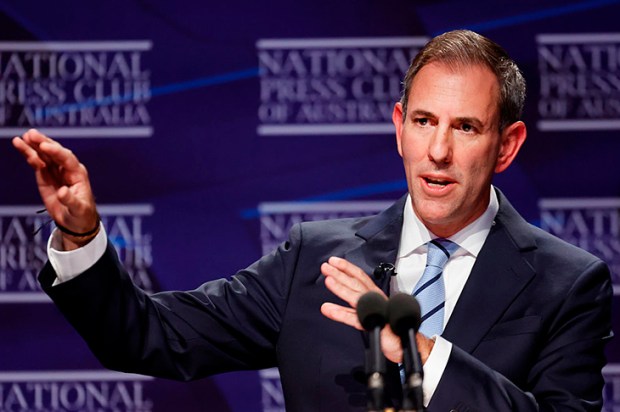
After being toppled by his own MPs in 2018, former Australian prime minister Malcolm Turnbull vowed he would not hang around his successors like a ‘miserable ghost’. He hasn’t kept his promise.
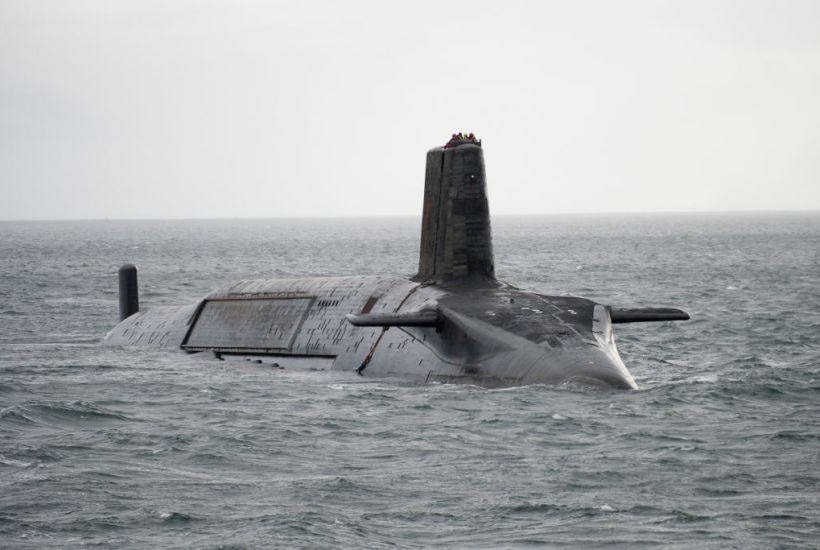
Turnbull has delivered a coruscating critique of the strategic partnership between Australia, the United Kingdom and the United States – known as Aukus. In particular, he has attacked its key feature: the US selling Australia up to three Virginia-class nuclear attack submarines, followed by an Aukus-specific class of nuclear boats developed jointly by Australia and Britain, based on the Royal Navy’s Astute class. Turnbull said that it is ‘stark, raving bonkers’ to presume these submarines will ever be delivered.
Strategically, Aukus is a Good Thing. It deepens cooperation between three close allies; it bolsters Australia’s naval capability to counter China’s growing military threat in the Indo-Pacific region; gives both Britain and the US a stronger Indian Ocean presence; and underpins the provision to Australia, by the US and Britain, of the very latest and best nuclear boats.
Politically, however, Aukus is fraught. The three leaders who created the partnership in 2021 – Boris Johnson, Joe Biden and Scott Morrison – are long out of office, and their political opponents have inherited Aukus with varying degrees of enthusiasm.
The Trump administration is internally conflicted. Having opposed Aukus at its inception, the US Under Secretary of War, Elbridge Colby, has reviewed the partnership, giving it only ambivalent endorsement. In Britain, Aukus has survived multiple changes of prime minister and now rests with Andy Burnham, who is yet to declare his hand on increasing British defence spending. It must be said, however, that Chancellor John Healey was an enthusiastic and committed public supporter of Aukus as Defence Secretary.
In Australia, official opinion remains strongly in favour, but the electorate is conflicted. Opinion polling for the Lowy Institute think tank indicates that half the electorate believes Aukus will make Australia ‘more safe’, but with one in three voters undecided. Polling for Lowy last year by YouGov found, however, that two out of three voters support an Aukus parliamentary inquiry to scrutinise the deal.
Aukus has become a touchstone issue for the Australian left, who oppose the partnership. To his credit, prime minister Anthony Albanese immediately backed Aukus when he was in opposition in 2021. And at the Labor party’s national conference last month, Albanese headed off an anti-Aukus push from the party’s hard left.
But the lack of a parliamentary inquiry gave anti-Aukus activists the brainwave of establishing a ‘public inquiry’ of their own, replete with ‘commissioners’ headed by former Labor cabinet minister, nuclear disarmament activist, and frontman for the protest rock group Midnight Oil, Peter Garrett. His co-commissioners are all impeccably left-credentialled, except for a long-retired former chief of the Royal Australian Navy.
In fairness, the inquiry heard some Aukus-supporting experts, including former Australian defence minister Christopher Pyne. He stressed the benefits of Aukus go far beyond Australia acquiring nuclear submarines. ‘It’s also a new United States base in the Indian Ocean – the US doesn’t have one… For the Americans, being able to have a submarine base in the Indian Ocean is a massive strategic advantage.’
Turnbull, however, is having none of it. ‘If the goal of this project is to acquire nuclear-powered submarines, every indication is we won’t get them’, he told the inquiry. ‘The British shipbuilding industry is in disarray, and the British are more aware of that than anyone… there is every prospect we will end up with no submarines, certainly no American ones, and potentially none of the others for a very, very long time.’
He ridiculed as fantasy official assurances that the boats would be delivered, claiming: ‘There is no Plan B’.
Turnbull has been a consistent critic of Aukus from the outset, and he made similar assertions at a Chatham House meeting in May, where he also dismissed Aukus as a ‘huge wealth transfer from the Australian government to the US and the UK.’
He also has personal axes to grind. It was his successor Morrison – who he accused of treachery in his 2018 deposition – who negotiated Aukus. But going nuclear with Britain and the US meant Australia cancelled Turnbull’s government’s contracts with France for a squadron of conventionally-powered submarines. Having invested considerable personal and political capital in the French boats, Aukus not only overturned his legacy project, but created a partnership he never could have negotiated himself.
Even so, Turnbull’s key claim, that the promised boats will never materialise, can’t simply be waved aside. Currently, The Americans are struggling to complete Virginias to replace ageing US Navy boats, let alone supply the three Australia expects. The delivery rate for Virginia-class submarines is 1.3 a year, although the US Chief of Naval Operations, Admiral Daryl Caudle, recently told Congress it would hit two a year by 2032. Given Colby’s scepticism of the alliance, and President Trump’s America-first politics, there’s no guarantee Australia won’t be dudded if the US deems it necessary.
As for the Anglo-Australian Aukus class boats, the Ministry of Defence dismissed Turnbull’s claims. ‘We are fully committed to Aukus and to delivering the SSN-Aukus submarine programme alongside our Australian and US partners’, said an MoD spokesman. Yet the plans to build up to 12 attack submarines at Barrow-in-Furness can still be altered or cancelled. And the parlous operational state of the Royal Navy – with all five of Britain’s Astute class submarines laid up in June – does not inspire absolute confidence. Additionally, Australia’s training of nuclear submarine crews, and building domestic capacity to co-build Aukus class boats, are still works in progress.
It’s easy for a grandstanding ex-PM like Turnbull to play Cassandra. But if Britain, American and Australian governments don’t stand strongly behind Aukus, defending the huge investments in resources, technology and manpower required to deliver what’s promised, Cassandra may have the last laugh after all. And given the spectre of Chinese expansionism, and the febrile geopolitics of the Indo-Pacific, that would be disastrous for all three countries.