The Fifth Crusade, which was fought between 1217 and 1221, marked a new direction for the crusading movement of the Middle Ages. Instead of invading Palestine, as the first three crusades had done, and the Fourth Crusade might have done, the crusaders decided to attack Egypt. That was not the original idea. The formidable Pope Innocent III, who launched the Fifth Crusade, had envisaged a repeat of the old strategy of marching on Jerusalem from the sea. The invasion of Egypt was decided by the initial wave of forces after they had reached the Levant.
There was a sort of logic behind the decision. The crusading kingdom of Jerusalem had been destroyed in 1187, when its army had suffered a crushing defeat at the hands of Saladin at the Horns of Hattin above the Sea of Galilee. Jerusalem was occupied. Thirteenth-century Palestine became part of the empire of the Ayyubids, a Kurdish dynasty with its capital at Cairo. By 1217, the Christians were reduced to the principality of Antioch in northern Syria and three small coastal enclaves around the cities of Acre, Tyre and Tripoli. None of these territories could sustain a large army for very long.
The crusaders were divided about what they might achieve by invading Egypt. The more ambitious leaders envisaged a permanent occupation of the largest and richest Islamic territory of the Middle East. Others had more modest ideas. They hoped to extract terms from the Ayyubid sultan which might see Jerusalem and at least part of the old crusader kingdom restored to them.
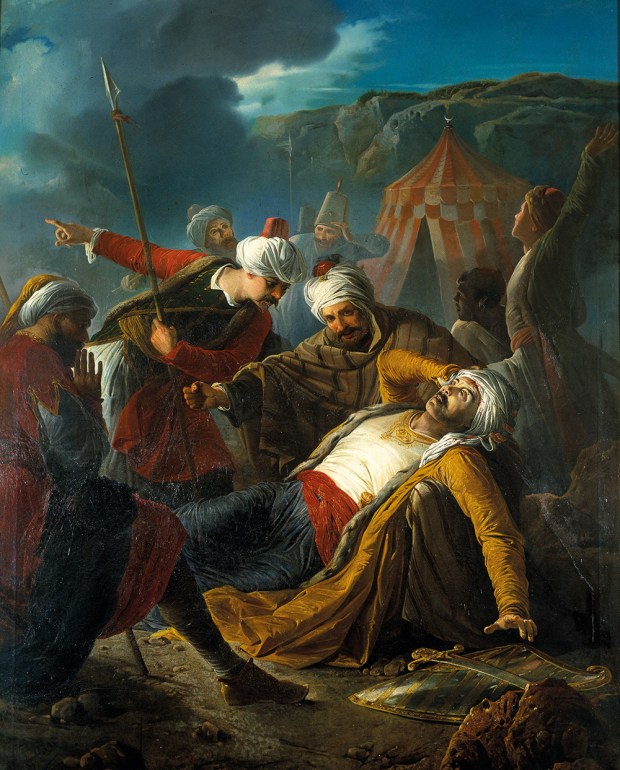
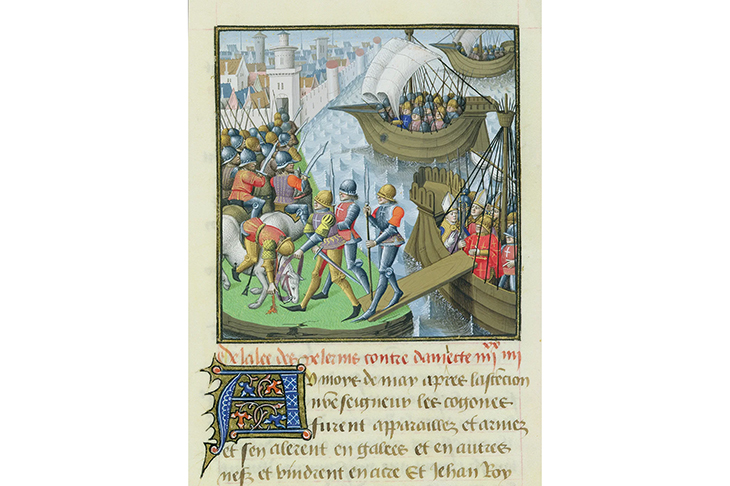
The result was a disaster, like all the crusades after the first two. The troops landed from the sea in May 1218 and besieged Damietta, the principal commercial city of the Nile Delta. The siege lasted for 18 months, until November 1219, when the city was abandoned by its population after most had died of starvation and disease. But the Christians had difficulty in exploiting their victory. In August 1221, as they tried to reach Cairo, they were encircled by the Muslim army near Mansurah and forced to enter into a humiliating treaty, by which they surrendered Damietta and withdrew empty-handed from Egypt.
Thomas Smith has written an excellent account of the war, based mainly on the chronicle of the siege of Damietta by the German schoolmaster and amateur engineer Oliver of Cologne, the newsletters of the French firebrand Jacques de Vitry, both of them witnesses, and the celebrated history by the Kurdish scholar Ibn al-Athir, who was living far away in Mosul but had excellent sources.
Smith’s writing is lively, readable and accurate. But he has been infected by the crusading spirit. He is an admirer of Pelagius, the cardinal-bishop of Albano, papal legate and armchair general, whose aggressive instincts contributed to the capture of Damietta but also to the disaster at Mansurah. The author seems to believe that the conception was sound and that the whole enterprise might have succeeded but for some rotten luck and a few unfortunate mistakes.
In the end, the crusaders were a handful of Christian interlopers in the vast and populous Islamic world
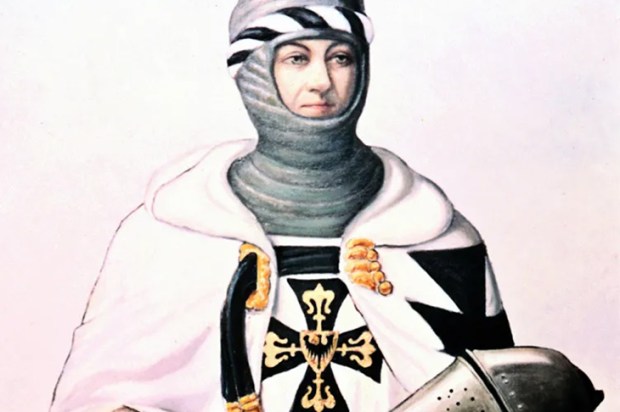
In fact, the project could never have succeeded, even if the crusaders had been agreed about what would count as success. They had the finest troops in the Mediterranean world: the Templars were a remarkable professional army, with a formidable financial network to support them. But in the end, the critical fact was that they were a handful of Christian interlopers in the vast and populous Islamic world, without the decisive technological superiority which would enable Europeans to conquer most of the globe in the 18th and 19th centuries.
The crusaders could never have maintained a permanent occupation of Egypt, let alone colonised it with European Christians. Any concessions that they might have wrung out of the Ayyubids would have been repudiated as soon as the opportunity arose. It is significant that when the Egyptian sultan al-Adil offered at one point to restore the kingdom of Jerusalem if the crusaders would go away, he insisted on retaining some critical fortresses which would have made it indefensible against the inevitable counter-attack. That was why the offer was rejected.
The crusading spirit remained the obsession of the Papacy, the kings of France and a handful of Christian propagandists, but among the populations of Europe it was already waning. Volunteers earned indulgences by participating in these expeditions; but very few of them had any interest in settling in the Holy Land, as the first generation of crusaders had done at the outset of the 12th century. They came for a season and went home.
The tragedy of the crusades was that the remarkable success of the first one, which had conquered much of the Levant, including Jerusalem itself, set a standard of achievement for later generations which they could not match and were increasingly uninterested in trying to.
Conquest has been a basic instinct of human societies throughout history. The crusades were a rather special version of that instinct. The Christian soldiers and settlers who were permanently based in the Levant were hard-headed realists; for the populations of Europe, however, the crusading movement at its height was above all a spiritual phenomenon. The crusaders wanted salvation and the keys to paradise. To criticise them on logistical and strategic grounds is a mug’s game. But if the crusades were a sin, it surely consisted in casting away so many human lives in a venture so utterly misconceived.
Got something to add? Join the discussion and comment below.
You might disagree with half of it, but you’ll enjoy reading all of it. Try your first month for free, then just $2 a week for the remainder of your first year.