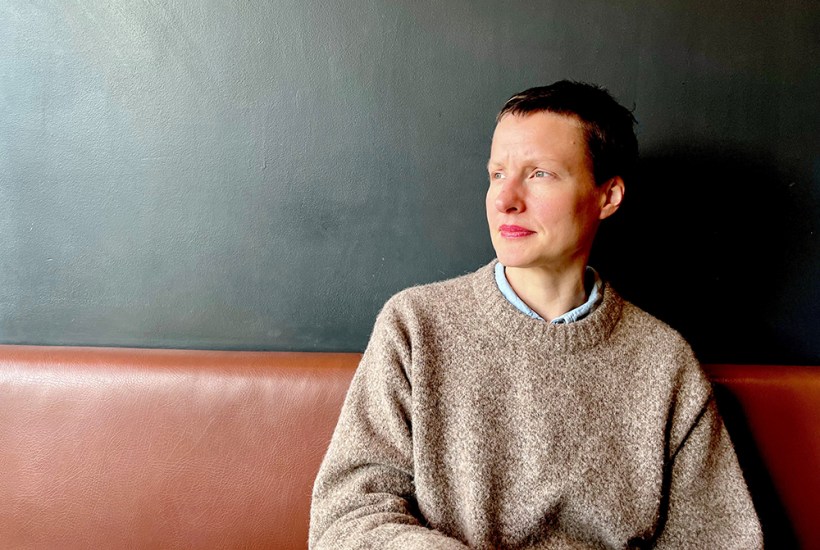
Exhibition, Alex Hyde’s second novel, recounts the intimate, messy, ambiguous and ultimately ill-fated relationship between two fictionalised Young British Artists in the early 1990s.
Rosie ‘Rabble’ Stone, the narrator, is a gifted but grounded Mancunian photographer, newly arrived in London to begin her studies at a prestigious art school. There she meets, and soon moves in with, a beautiful and accomplished (and throughout nameless) figurative artist destined for greatness. They are inspired by, though very different from, Tracey Emin and Sarah Lucas and the works they produced in this period.
The story begins in Brixton, at an ‘upside-down’ house to which Rabble has been directed to find lodgings. She is greeted at the door by the artist (who is addressed as ‘you’ throughout) and is immediately enraptured: ‘You. When you answered the door to the Brixton house, dressing gown and cigarette hand languidly bent back at the wrist, smoke wisping where you stood.’ The young women soon become inseparable – a ‘double act’ – and their artwork increasingly collaborative and inextricable: ‘It was chemistry, something we had, something we made between ourselves, both of us being used.’
It soon becomes clear, however, that one of them is being used rather more than the other. Rabble, who is working class – ‘the real deal: common people, fag ends, trash’ – quickly falls by the wayside as her more privileged friend’s career takes off, helped in no small part by some prints of Rab’s passed off as her own. ‘She doesn’t mind, do you Rab?’, the artist assures an incensed mutual friend. Rabble doesn’t mind, actually, but it still marks a parting of the ways. For the artist, it’s gallery openings in Berlin and sell-out shows in New York; for Rabble, it’s back to Manchester to work part-time in a pub and care for her ailing mother.
Exhibition is, in an intriguing way, a love story. Indeed it reads very much like a love letter, as it recounts how two women, seemingly fated to be together, lose and then find each other again over the years and across continents. It is both sensuous and sordid, and utterly immersive – think of the unmade beds and unguarded self-portraits of Emin and Lucas. If the narrative is somewhat aimless and the denouement a little forced (‘A hurricane. You couldn’t make it up.’), that is more than compensated for by the fineness of observation and surety of tone that bring this period and these characters to life.
Got something to add? Join the discussion and comment below.
You might disagree with half of it, but you’ll enjoy reading all of it. Try your first month for free, then just $2 a week for the remainder of your first year.