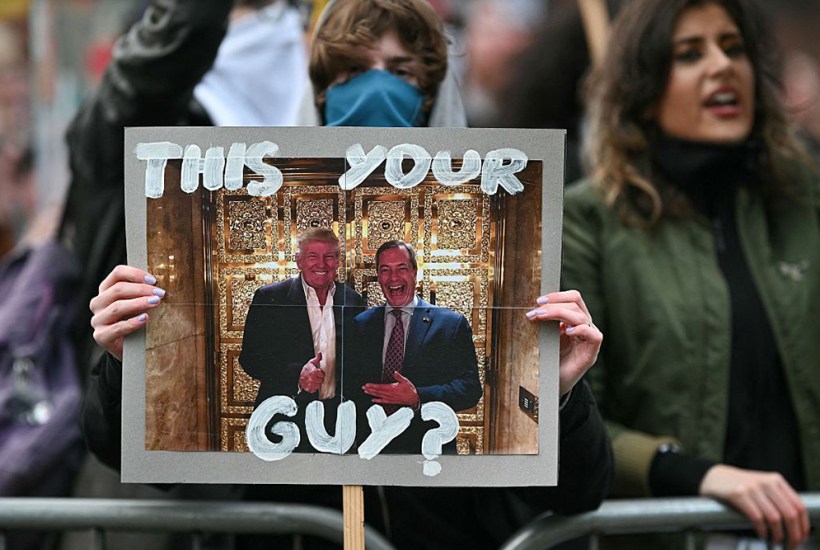
In January this year Dominic Cummings – once of this parish – warned The Spectator’s editor and assistant editor that Whitehall and the establishment parties would ‘stop at nothing’ to prevent Nigel Farage from becoming prime minister. As Cummings told the Quite right! podcast: ‘The people around [Keir] Starmer and all through the upper echelons of the Whitehall system are looking at Donald Trump. They’re looking across Europe, and they’re saying to themselves: “The lesson is to strike early and strike hard and not let these people in… Let’s smash the absolute living shit out of Farage, and make sure that he doesn’t win, by fair means or foul.”’
Cummings may be right about that, but the two most obvious comparisons with the recent hosing of Farage demonstrate how this manoeuvre can just as easily backfire.
Farage is, like Trump, too different from other politicians to be brought down by the usual rules
The ‘anti-Trump playbook’ – as Trump himself has referred to the treatment of Farage – quite obviously did not work with Trump. Nevertheless, there was a period in around 2023 when it looked as if it could do so. Mar-a-Lago had already been raided by the FBI, looking for classified documents that it turned out almost every former official had lying around. And it was the year in which Trump was dragged to court in New York to face 34 felony counts relating to alleged hush-money payments and the falsifying of business records. Then in January 2024 a civil court ordered Trump to pay almost $90 million to a woman who had accused him of assaulting her in the changing rooms of a Manhattan department store three decades earlier.
To many observers it seemed that if only one of these cases had been pursued then the people most eager to keep Trump out of running in the 2024 election might have got their way. But the ‘get-Trump’ movement over-egged it. So relentless were the accusations against him – and so patently absurd in some cases – that all but the most Trump-obsessed voters zoned out. Trump’s opponents threw everything they had at him in the hope that something would stick, only to discover that they had thrown so much at him that nothing stuck. Certainly not in the minds of the voting public who returned him to office the following year in both houses and the popular vote. The other example of something similar is happening in France where the leader of the National Rally, Marine Le Pen, just had her conviction for embezzlement upheld by a Paris court. The accusation against Le Pen was that her party had used millions of euros of EU funds to pay aides who used their time working in French national politics instead of European parliamentary matters. A thing that no other party in the EU parliament has ever done, obviously.
The French courts originally sentenced Le Pen to a four-year prison term and a five-year ban on running for political office. But in France – as in America – the case seems not to have landed with the public. The whole process looks too much like a concerted attempt to stop at nothing in order to prevent Le Pen from being able to run in France’s 2027 presidential election. Despite an appeals court upholding the conviction this week, it now looks as if Le Pen will be allowed to run in the next election, though for a year she will have to do so wearing an ankle monitor.
Which brings us back to Farage. In recent weeks the Reform party leader has looked vulnerable over his acceptance of a £5 million gift from a Thai-based crypto billionaire called Christopher Harborne. Now he is also getting criticism for accepting gifts from a roguish character in his inner circle known as ‘Posh George’ (aka George Cottrell). Farage has responded to this with the uncommon move of resigning his parliamentary seat and vowing to run in a by-election in Clacton in which he promises to give the voters the say on whether or not they think these allegations should matter.
It doesn’t seem the wisest of moves to me. Voters tend not to like endlessly having to return to the polls. And the only precedent I can think of for Farage’s move was that odd moment in 2008 when David Davis stepped down and then stood in a fresh by-election over the issue of how long terrorist suspects could be detained without charge. My memory of that affair was that nobody could quite work out why Davis needed to resign and then fight and win a by-election in the same seat over an issue which he failed to bring any particularly fresh attention to. If he thought the stunt would advance his standing in the Conservative party, then the years since speak for themselves: to date David Davis is just about the only MP of his generation not to lead the Conservative party.
Farage is a different case. Anyone who thinks he might be intimidated into stepping down should remember that this is a man who led the UK Independence party in 2009. A party which, in the wake of the Westminster MPs expenses scandal, saw nothing odd about campaigning in the subsequent elections by knocking on prospective voters’ doors while wearing great big pound signs.
Personally I am not sure that any of the charges being made against Farage are going to stick. He is, like Trump, too different from other politicians to be brought down by the usual rules. It is true that he has needed personal security for many years, and it is obvious that the ways in which these and other expenses will have been paid for may be unorthodox. But the whole point of Farage is to be unorthodox. And, as with Trump, statements or scandals that would bring down any other politician fail to bring him down.
Nevertheless, it’s a fine balance. And a reminder of how much hangs on the often marginal judgment calls that people make. The people who are out to get Farage are presumably hoping to break him. If events across the Atlantic are anything to go by, they could just as easily be the making of him.
Got something to add? Join the discussion and comment below.
You might disagree with half of it, but you’ll enjoy reading all of it. Try your first month for free, then just $2 a week for the remainder of your first year.