A s some readers may recall, I love competitive sports. I played varsity basketball at university in Canada. I represented New Zealand and then Australia in curling at world championships (which, to be fair, is like an Aussie representing Canada in cricket – I’m a B-grade Canadian curler and hence can make southern hemisphere teams). From each September I have a more-than-mild addiction to getting up very early on Monday mornings in Brisbane and watching NFL games live from the US because this is Adam Smith’s specialisation of labour, with dozens of high-level coaches and tons of strategy and the world’s best athletes, on steroids. I love watching rugby and cricket. Generally speaking, if there can be a winner and a loser, then I will watch.
If you’ve played high-level sports, you quickly learn two things. Hard work and practice can take you a long way. But only so far, because not all humans are born equal in terms of talent. In team sports you learn, too, that a well-coached team of good players can beat a poorly coached team of better players. And you learn about how to lose with a modicum of good grace and never to gloat about winning. Best of all, you learn that competitive sport is the truest home of merit. No team wanting to win indulges in, or believes in, DEI, affirmative action or identity politics and the need to have quotas for races or sexes. The best person makes the team or the team won’t win. Full stop. There is no DEI hiring in the NBA or NFL.
That takes me to the world’s most popular game. I grew up in Canada in the mid-1960s and early-1970s calling it soccer. If you live in a chardonnay-sipping, Greens-voting district, you’ll follow the Europeans and call it football (although I believe that soccer was widely used in Britain from the 1880s until maybe the 1960s). Full disclosure. If you grew up where I did in the east end of Toronto and played soccer as a boy after about the age of eight or nine, then you might as well have taken up ballet. It was ice hockey, gridiron football, and basketball, sort of.
So, I have to fight hard not to lump soccer-loving aficionados in with the Lycra-wearing cycling crowd. Oops. I’m revealing another of my sporting prejudices. Much as I love most competitive sports, I confess that rising early to watch some leg of the Tour de France, the peloton zipping along, with a couple of super-fit frontrunners setting the pace as they race up some alp or other, leaves me cold. And let’s be blunt – outside of the ranks of super-fit people, humans were never meant to wear Lycra. Brisbane coffee shops early each morning are full of Lycra-clad cyclists who have obviously decided never to invest in this thing known as a mirror.
But where was I? Ah, the world’s most popular game by far, soccer. Or if you prefer, then football (best pronounced with a slightly continental European accent when in inner-city Melbourne, possibly while protesting in support of Hamas and waving pro-Palestine posters). I remember one of my university professors once speculating that the game was super popular around the world because you could play it nearly anywhere with nothing more than a ball. No expensive equipment. Or ice rink. Or padding. So, a game open to the poor. (This prof gave every indication of being a Marxist, not uncommon back then although today, in a new guise, considerably more common across all our universities – the ones the Libs, to my disgust, did absolutely nothing about fixing or reining in during their nine woeful years in office – although they did, somehow, contrive to pick worse High Court of Australia judges than Labor. And they wonder why a good few long-time supporters have deserted them for One Nation.) I’ll leave it to readers to decide what they think about that Marxist analysis. Does it mesh with the sports that are next most popular, which, at a guess and not picking an order, would be basketball and cricket (due to India’s love affair with the latter)?
Again, back to soccer. You see, once every four years I do watch the World Cup, the most-watched sporting event on earth. It’s run by Fifa, a body that, over the past few decades, has made the IOC look as pure as the driven snow. This year’s tournament is being hosted in North America. That means mostly in the US, with a slice of games in Canada and Mexico. The golden dream of Fifa is to make soccer (or if you earn a six-figure salary and drive an electric car, then ‘football’) super-popular in the US. The last time the Americans hosted this tournament, that didn’t happen. This time seems to be different. Americans are watching in big numbers. Of course, it helps that Fifa expanded the tournament from 32 qualifiers to 48 and then ensured that after all the group matches, two-thirds of the teams would still advance to the elimination round. If you are one inclined to think these sort of bodies will put their thumbs on the scales to get results that they want, then you’d say the US draw was remarkably friendly to them. What no one knows this time round is whether the Americans will keep watching once their team is eliminated.
So, what is it that American sports fans are currently complaining about when it comes to this World Cup? Well, there is the old complaint that soccer players take dives – they deliver Academy Award acting performances in falling to the ground when barely touched and then roll around in seeming agony right up to the point when the referee does, or does not, award a penalty. That’s one regular complaint. Another is that no one knows when the game will end. The ref will add on some time at the end of the game for injuries, and viewers and players know how long that will be. But in that time, the ref will add more. How much more? No one knows. And in one game so far, the play just went on and on, with the losing team seemingly being robbed of a tied goal well after everyone expected the game to be over.
What else? The offside rule has been turned into a legalistic exercise in high-tech pedantry and pettifogging. One toe across the technology-generated line of when the pass is made, and you get a long delay and a sort of Bleak House-type of enforcement that disadvantages the offence. Why? And why not just give each coach two challenges and otherwise leave the calls to the referees on the field? Then there are the newly-imposed ‘hydration breaks’. This is an obvious money-making sop to the advertisers in the US. He who pays the piper does what?
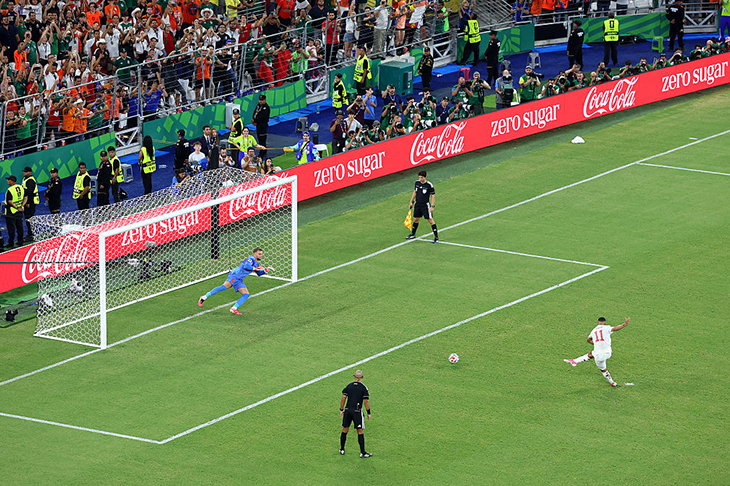
Lastly, how many of you agree with me that a) penalty kicks are the dumbest, least-skilful way to decide a contest and yet also b) that penalty kicks are the most fantastic, tense, pressure-filled TV experience going?
I’ll be watching until this ends and then no soccer for me for another four years. Just another reason to call me a dinosaur.
Got something to add? Join the discussion and comment below.
You might disagree with half of it, but you’ll enjoy reading all of it. Try your first month for free, then just $2 a week for the remainder of your first year.