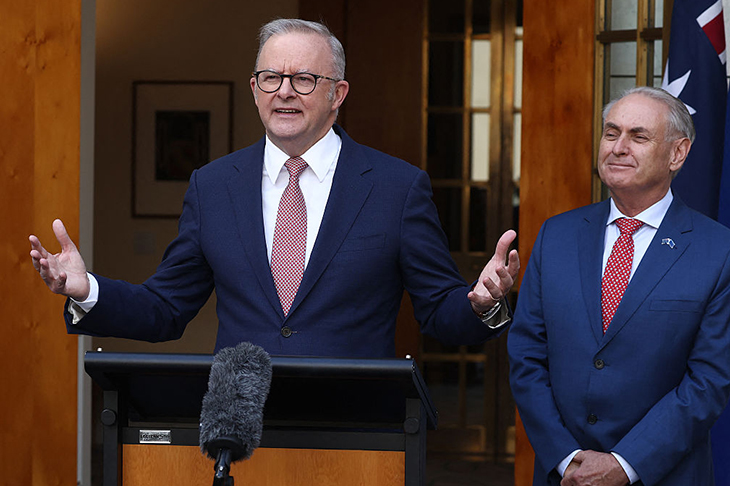
The recent appearance by Labor’s right-wing eminence Don Farrell in the Weekend Australian was a master-class in political theatre. With the practised ease of a veteran machine operative, Farrell offered a seemingly sensible olive branch for the mainstream media: a critique of the ‘woke’ excesses of the far or hard left, lamenting the substitution of the traditional proletariat with the boutique grievances of identity politics. It was an alluring performance, designed to convey the fiction that centrist adults are now in charge.
The performance was pure theatre, even down to a black hat. Farrell’s brief, however, is not to reform the party; it’s to provide cover for it. While the media’s attention is directed towards choreographed skirmishes over cultural distractions, the machinery of the state is quietly being used to execute the most structurally radical far-left agenda in modern Australian history. This is not just Australia’s most far-left government stumbling into economic malaise; it’s also a highly ideological machine achieving exactly what it set out to do. The strategy is simple: signal moderation to the mainstream media, while pushing a radical left agenda that the media probably won’t look at too closely.
With even Beijing accepting that a communist economy is doomed to total failure, Australia’s far or hard-left government is comfortable with that well-established truism of modern political economy: big government and big business can get along extraordinarily well. Often run by overpaid ‘woke’ executives, big business thrives on compliance burdens and heavy regulation because it has the capital to absorb them, while effectively crushing any upstart competition. Labor’s enemy today isn’t corporate Australia; it is anyone daring to be independent of government.
Just as Stalin targeted the kulaks – Russia’s independent, relatively self-sufficient farmers whose very autonomy threatened the totalising vision of the Soviet state – the Albanese government has identified its enemies: small business, ‘tradies’ who have given up on Labor, and especially, the self-funded retirees. Their crime is the same as the kulaks’: the unpardonable sin of trying not to depend on the state.
This explains the government’s vicious, vindictive campaign directed toward the elderly, whether self-funded retirees or pensioners, who have dared struggle to pay for private medical insurance. By stripping them of the Howard government rebate, this hard-left government is not achieving a financial victory; it is actively fracturing the national interest. This won’t save any money; it will drive thousands of self-reliant Australians back onto an already buckling Medicare system, increasing queues, inflating bureaucratic costs, and making healthcare fundamentally more unfair. But fiscal responsibility was never the point. This was to expand Paul Murray’s ‘triangle of dependence’ – a paternalistic trap where citizens are systematically stripped of autonomy until they have no choice but to rely on the state. When a deal was necessary to get the neo-com Greens Senate votes for Labor’s already infamous ‘tax grab’, the government unilaterally changed the superannuation investment rules (not those of the favoured union funds, only those of the hated self-funded retirees), all done without even the façade of a rigged inquiry.
Nowhere is the distance between the government’s curated public image and its structural far-left ruthlessness more obvious than in the housing market. Too many in the mainstream media still treat the current housing crisis as an accidental policy failure – an unintended consequence of supply-chain bottlenecks and planning inertia. This is part of the façade. The administration is fully aware, as the recent policy corrections in both Canada and New Zealand have comprehensively demonstrated, that importing an uncontrollable volume of migration into an already saturated market is the primary driver of the housing shortage.
The crushing of the legitimate aspirations of young students and workers is no oversight. It is the price the Albanese government has decided the young must pay. The strategy relies on a cold electoral calculus: flood the outer suburbs and inner cities of Sydney, Melbourne, and South East Queensland with a vast new cohort of arrivals who, finding themselves priced out of independent ownership, will fall cleanly into the expanding net of state reliance. Cut off from the traditional ladder of middle-class mobility, they are expected to reward their hard-left benefactor by voting for the permanent expansion of the paternalistic state.
It is here that the true nature of this vindictive government is revealed. Beneath a folksy ‘Dagwood Bumstead’ exterior lies a remarkably disciplined Stalinist core. It is an approach to governance that views entire demographics not as citizens with legitimate aspirations, but as units to be manipulated, squeezed, punished, and discarded to secure long-term political hegemony. Whether it is enriching communist China by deliberately running down our own electricity system into the most expensive and unreliable grid in the world, halting development through anti-dam and anti-development postures, or lowering the standards of education to increase institutional propaganda, the destruction is systemic.
For too long, the alternative to this drift has been a Coalition that, as demonstrated during the last federal election, instinctively walks on both sides of the street. Rather than presenting a Menzies-inspired, crisp, principled defence of economic freedom and individual autonomy, the opposition attempted a pale imitation of the centre-left, hoping to appease critics while retaining its base. When the Coalition’s strategy failed catastrophically, it left a vast vacuum in Australian politics.
For these reasons, in the last election, this column suggested voters give their first preference to One Nation. The beginnings of the current One Nation surge actually emerged when voters determined it would be One Nation and not the Coalition who would defeat Labor for the crucial last NSW senate seat. Since then, mainstream Australians have been increasingly waking up to the Coalition’s betrayal. They are recognising that the solution to a compromised political class does not lie with those who vacillate, but with a movement that remains unapologetically consistent. This explains the steady, undeniable rise of Pauline Hanson’s One Nation party. Where the major parties offer theatrical façades or hollow compromises, One Nation has maintained a clear and consistent stance on national sovereignty, energy security, and the protection of Menzies’ ‘forgotten people’.
As the squeeze tightens, the flight from the shifting sands of the political centre toward a principled alternative is no longer just a protest; it is becoming an act of national survival.
Got something to add? Join the discussion and comment below.
You might disagree with half of it, but you’ll enjoy reading all of it. Try your first month for free, then just $2 a week for the remainder of your first year.