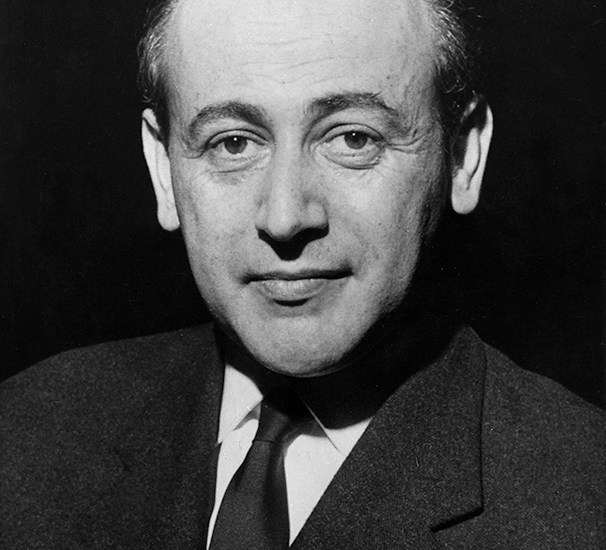
Some time in the late 1950s, Jacques Derrida and other intellectual luminaries at the École Normale Supérieure in Paris were surprised to be told that the excruciatingly introverted German-language instructor they had been avoiding in the corridors for several years was ‘the greatest living poet in the German language’.
Paul Celan was reputed to be as ‘difficult’ as his poetry – rebarbative, then intriguing and finally unforgettable. His best known poem is ‘Todesfuge’ (‘Death Fugue’), which may refer to Jewish musicians in a Nazi death camp: ‘Black milk of dawn, we drink you at night…’ He can be heard online reciting the poem in a rising tone of suppressed hysteria. According to Anna Arno in her comprehensive biography, translated from the Polish, ‘many experts consider it to be the most important poem of the 20th century’.
Celan was born in 1920 in the city of Chernivtsi, which is now in western Ukraine but was then in Romania. Before the second world war, it had 70 synagogues; now it has only two. The Temple was burned down in 1941, but the Soviets resurrected it as a cinema which still operates as ‘the Cinegogue’. At birth, his name was Paul Antschel. The Romanian form is Ancel, which he anagrammatised as the no longer obviously Jewish ‘Celan’ (pronounced ‘say-lahn’).
He grew up speaking High German with smatterings of Polish and Ukrainian. He had only a passive knowledge of Yiddish. At school, he was obliged to use Romanian until the Red Army made Ukrainian the official language and employed him as a ‘cleaner’, or collector of pornographic, arty, popular or politically subversive books to be burned. His parents were deported by the Nazis and never returned. By chance or ‘premonition’, he survived to work in a labour camp on the road from Berlin to the Caucasus. After the war, he had himself smuggled across the border, hid in Budapest and then spent six months in Vienna among the creepy, crime-infested ruins familiar from Carol Reed’s film of The Third Man.
He reached Paris in July 1948 with one suitcase and a German-French dictionary. Someone gave him a leatherbound volume of Faust, which his uncle had left behind for him in Paris before beginning the train journey that ended at Auschwitz. As a stateless Jew, Celan was distressed by the postwar spirit of positivity, the non-prosecution of civilian Nazi collaborators and the ineradicable plague of anti-Semitism. As knowledge of the Nazi death camps spread, it seemed to be swiftly processed and drained off into wilful oblivion.
Postwar anti-Semitism is a leitmotif of this rivetingly depressing book, as it was of Celan’s adult life. In the late 1950s, a stranger in a Paris street handed him a pamphlet which called for Jews to leave France or be killed. His books were sometimes snidely reviewed by men he knew to have served in the SS. Certain strains of the ever-evolving virus became more virulent with time. In the 1960s, Celan noticed that polite, left-leaning people were avoiding the word ‘Jew’ in conversation. He called this silent ethnic cleansing ‘liberal anti-Semitism’.
In Paris, before the École Normale, he taught at a Berlitz school and translated Russian texts. His selection of Osip Mandelstam’s poetry was the first to be published abroad. He wrote seven or eight poems a year. The photographs of Celan in this biography show the tense smile of a man who has just had to swallow an insult. ‘He joked’ and ‘he quipped’ are appended to quite a few not very funny remarks. Two years after marrying a French woman, he was still under surveillance as an alien. Intimate police investigations found no evidence of disloyalty to France other than the fact that he wrote poems in German. ‘No one in his surroundings can pin down his views or even confirm if he has any,’ said one report.
When he finally became a French citizen in 1955, he was not allowed to change his official name to Celan. Some of his sinisterly allusive, punning poems give the impression that he expected to be spied on by his readers. Recurring words are used as doubly-coded cryptonyms – ‘sand’ apparently stands for ‘ashes’ and the ashes for the Holocaust, which he never explicitly mentioned in verse.
It is a peculiarity of this biography that, with only 34 of 400 pages to go, we discover that Celan had been having not just the odd fling with other women but energetic affairs, some lasting more than a decade. As a ‘narcissistically arrogant’ schoolboy, he had ‘pawed the girls’. To two young women who dodged his lunges, he explained: ‘I treat women like cigarettes. I smoke them and cast them aside.’ (Something may have been lost in translation here.)
A stranger in Paris handed Celan a pamphlet which called for Jews to leave France or be killed
The last ten years of his life were a gathering storm. The demented widow of the French-German poet Yvan Goll, who was 30 years Celan’s senior, publicly accused him falsely of plagiarism and of trying to rape her while her husband lay dying. Clinical paranoia then dipped its brush in that poisonous black paint and spread it everywhere. Celan seemed to be trapped in one of his allusive poems in which every detail is saturated with evil significance – car number plates, a man taking snapshots of the Seine, his wife’s scarf, which he tore from her neck because it was yellow like the Nazis’ obligatory Jewish badge. Anti-psychotics failed to help. On the night of 19-20 April 1970 he jumped or waded into the Seine somewhere near the Pont Mirabeau.
This English version of Arno’s admirable biography deserved a firmer editorial hand. The index is lacunary, which is especially regrettable in such a well-researched study, and the translation has many moments of flowery awkwardness. A scholarly book published by Harvard University Press could surely have included some quotations of Celan’s own writing, yet the German language is almost entirely absent. Trudging through the rhythmless versions by Pierre Joris, I found I had constantly to revert to the original texts. There are enough English-German cognates to justify at least a few samples of the idiom which Celan forged from the mother tongue that was also the language of his mother’s murderers – the Muttersprach and the Mördersprache.
Got something to add? Join the discussion and comment below.
You might disagree with half of it, but you’ll enjoy reading all of it. Try your first month for free, then just $2 a week for the remainder of your first year.