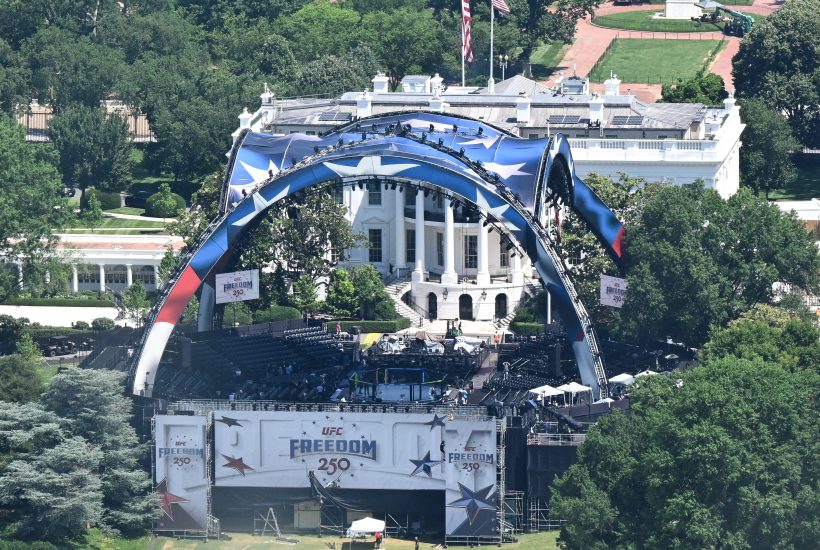
The UFC event today at the White House has been widely dismissed as an absurdity. Inevitably, the administration’s critics have portrayed the event — officially part of America’s 250th celebrations but curiously taking place on Donald Trump’s 80th birthday — as an odious example of Trumpian excess. Supporters, meanwhile, celebrate it as evidence that Trump is uniquely in touch with ordinary Americans.
Politicians are increasingly asked to function as cultural icons
But what media commentators think of the UFC event is beside the point. The significance of this event lies not in the UFC itself, but in what it shows us about the changing nature of political authority. Beneath the headlines and Reddit threads, American politics is undergoing a profound change. Politicians, especially leaders, are increasingly asked to function not merely as officeholders, but as cultural icons.
For most of American history, Presidents derived authority from their actions in office: how they navigated crises, and what legislation they spearheaded. The president did not need to vie for the public’s attention.
Today, governance remains a component of the job, but good governance is no longer sufficient to retain the engagement of the public. Like anybody else, the Commander-in-Chief must compete against the endless stream of entertainment and media floating around the internet. The modern President must have a ‘personal brand’ under which they can build a ‘community’. The UFC event and similar commercial-political alliances should thus come as no surprise. It is the logical culmination of a trend that has been developing now for decades.
This is not to suggest that image did not matter in the past. American politics has always been a spectacle to some degree. John F. Kennedy benefitted enormously from television, and Franklin Roosevelt carefully cultivated his image through his ‘fireside chats’ on the radio.
The main distinction is that, back then, cultivating an image was seen primarily as a tool to enhance political leadership and credibility rather than replacing it. The presidency remained fundamentally political.
Leaders shied away from division and emphasized unity. Now the distinction between building a personal brand and assuming the brand of the presidency has been all but lost entirely.
The internet alone does not explain this transformation. Politicians are not behaving more like influencers simply because they can, but because institutions which once conferred authority have seen their public legitimacy steadily erode. Confidence in media, higher education, corporations and religion has decayed. Americans feel more comfortable placing their trust in personalities over institutions.
In the past, politicians derived prestige from the organizations they represented. Today the reverse is increasingly true. Politicians are not only expected, but practically required, to bring their ‘community’ with them into office. Legitimacy is now earned from audiences and conveyed through direct feedback rather than inherited as a perk of the role.
At the same time, the internet is perhaps the most important catalyst of this trend. Americans no longer consume the same media. They do not participate in the same cultural conversations, and the shared identity formerly occupied by Americans is gradually being eroded. Politics now exists within a media environment saturated by the noise of influencers, athletes, streamers and celebrities.
Politicians aren’t competing against one another; they are competing against everyone. In such an environment, cultural relevance is the key to maintaining success.
Barack Obama recognized this shift early. His presidency was the first to truly embrace the rise of celebrity politics and social media. Appearances on late night TV became regular. Endorsements from figures such as Oprah Winfrey became political events in their own right. Hollywood celebrities increasingly acted as informal ambassadors for the administration. The iconic ‘Hope’ poster functioned less like a piece of campaign literature and more like a commercial logo, transforming the President into a cultural icon that could easily be disseminated online and reproduced on merchandise. Obama understood that political leaders increasingly needed to occupy the same cultural spaces as their supporters.
Trump inherited this environment and expanded upon the concept. He understood the mechanics of attention long before entering politics, and that a polished, Obama-esque campaign would be detrimental to his image. By the time of his 2024 campaign, rallies had become live performances tailored to their location. Drill rappers joined him at the podium in the Bronx, tech leaders like Elon Musk spoke to audiences about freedom of speech and Kid Rock was frequently by the Trump family’s side on the trail in the south.
Trump’s opponents, in contrast, were frequently ridiculed for their use of celebrity endorsements. When Hillary Clinton deployed Beyoncé, or Kamala Harris hired Megan Thee Stallion, it came across as pandering, unnatural and ‘cringe’.
Part of the reason for this difference is that Trump’s cultural allies are often perceived as emerging organically from this coalition rather than being imported. Figures such as Joe Rogan, Dana White, Musk and numerous other personalities already occupy the same cultural ecosystem as many of Trump’s present supporters, while also possessing the reach to attract new ones. These figures aren’t simply endorsing their chosen candidate; they are representatives of the communities in which Trump’s base resides.
Celebrity endorsements seem superficial when they are perceived as being detached from the everyday experiences of the voters they seek to influence. Trump’s endorsements differ in that they reinforce the sense that he is part of the culture itself, belonging to the same world as his supporters.
It’s tempting to dismiss the UFC as an uncouth sporting promotion. This would be reductive, since the UFC has become far more than a sports league. It is a defining cultural institutions among an important American constituency. Its audience skews more male and more anti-establishment. It is overwhelmingly skeptical of anything ‘elite’. The UFC ecosystem overlaps heavily with podcasting, self-improvement culture and more masculine internet-native media.
Hosting a UFC event at the White House therefore sends a message that cultural icons representative of Trump-era conservatism are worthy of national recognition. Trump is not hosting the NFL or MLB, two institutions long established in American life. He is elevating a cultural movement that spent years outside the mainstream, a movement that rose to the chagrin of cultural and political elites.
That’s why a cage fight on the White House lawn represents a seminal moment in American politics. Trump is signalling to his supporters that their values, tastes and identities not only matter, but deserve to be at the center of American life.
This sets the precedent for a trend that is unlikely to disappear with the end of Trump’s time in office. Future presidents will adopt the cultural language and norms of their constituents. As this occurs, the distinction between politician and influencer will continue to erode.
Future presidents will need to consider how they can integrate their audience, community and personal brand into the office, and to what degree they wish to cater to their primary audience at the expense of potentially alienating other demographics.