I read recently about new Australian Research Council-funded research that proposes to ‘reimagine’ the Australian public toilet. The academics leading the research look upon the existing public toilet as a place of ‘discomfort and shame’ and envision a redesign which is less a public convenience than an all-purpose centre for excretions. They say it will accommodate breastfeeding, menstruation and incontinence, and will cater for all faith-based and cultural needs.
The first problem with this, it seems to me, is that it is being imposed upon us by ideologists who think their own dispatches do not stink. Upon reading their project outline, my initial impression was that this new toilet complex would be an inner-city amenity, one for the elite to call into after too many lattes or almond croissants. Only when I read further did I grasp the scale of their presumption. It would also be introduced in regional towns and throughout rural Australia. This reimagined public toilet is part of a left-wing movement to sanitise every last remnant of the Australia we once knew.
I reached out to my cousin, an architect. Occasionally over the years, he and I have spoken about the role of the Australian toilet in shaping a distinctive national character. In his view, the designer of any new public toilet needs to be well-versed in the history of this genre of waste management in our country.
First and foremost, the designer is to be mindful of indigenous traditions. The early Australians, men and women together, would walk a few steps away from camp, answer the call, then kick the matter over with sand or dirt. It was a practice that continued with no discomfort or shame for more than 60,000 years, and it is fair to surmise that, through that span of time, hardly a patch of our continent did not at some point serve as a receptacle. This is the golden soil on which we toil, my cousin pointed out, and any overly elaborate toilet facility built upon it would be an architectural incongruity.
The designer must also credit the pragmatism of the colonisers. Upon arrival, finding the land to be toilet nullius, the British did not seek to introduce the fashionable English pan closet, whereby the user, sometimes on a cushioned seat, would discharge on to a hinged metal pan then pull a lever to cause the pan to tilt and the emissions to slip-slide into an unseen pail.
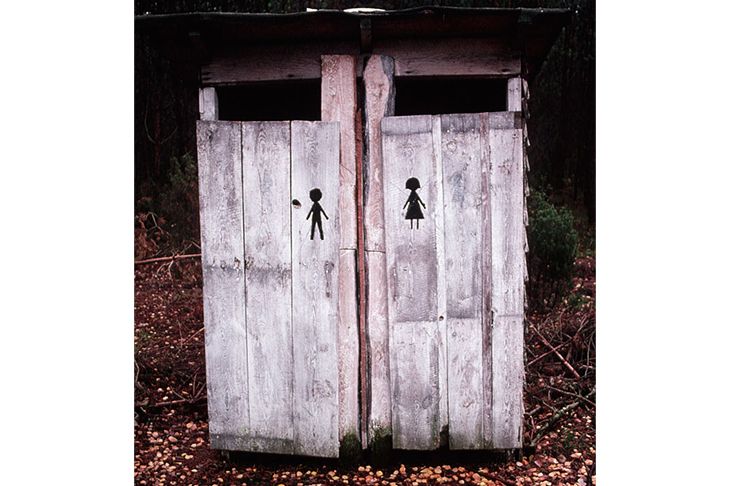
Instead, they maintained the indigenous practice save for a few variations: a patch of land was designated; a hole was dug to provide a deeper repository; a purpose-made seat was placed on top and the whole thing was enclosed within a box-like shanty made of rubble or assorted scraps. It was a toilet that was devoid of architecture altogether and over the next two hundred-plus years, from engineering and materials perspectives, it improved only marginally.
On every page and through every stage of our history, users of these toilets have been accompanied by the sounds of Australia as they grunt and groan in symphony with barking dogs or shrieking galahs, the air inside the shanty thick with stench, heat and flies. As my cousin and I observed, no other country offers such an immersive experience, and it is not limited to toilets in the public realm. Some of our most treasured childhood memories are heading out to the long-drop at his Dad’s farmhouse after Sunday roast to send one whistling down towards the centre of the earth, or mopping and scrubbing after a septic overflow at Uncle Doug’s shack on the Murray.
Nor was the Australian toilet, whether rural or urban, without safety hazards, such as the one related by Slim Newton in ‘Redback on the Toilet Seat’. This song did not win three gold records in 1973 for nothing. It told a story that resonated through the generations.
In recent decades, Australia has contributed to advances in the modern toilet. The dual flush system, with half-water for number ones and full-water for number twos, was an Australian invention of the early-1980s that has been adopted in many countries. Also pioneered in a few Australian national parks has been the composting toilet, continuing our tradition of replenishing the food cycle. But as Douglass Baglin asserts, this country has made no greater contribution to this chapter of history than its colonial toilet.
We are forever in debt to Douglass Baglin. Whilst our applications for these toilets to be heritage-listed go unanswered, my cousin and I find solace in the fact that some of them have been recorded in his books, Ladies and Gentlemen, co-authored with John O’Grady in 1966, and his 1971 masterpiece compiled with Barbara Mullins, Dinkum Dunnies.
Yet, all of this is now under threat from the cultural Marxists, whose march will not be complete without the capture of this final institution. I can only assume that the complex they are imagining is a mega-toilet, one with a designated cubicle for every conceivable combination of gender, culture, and faith: ‘male−child-bearing−Muslim’, ‘non-binary−intersex’, ‘female−incontinent−Christian’, ‘male-indigenous-agnostic’, and so on to infinity so that no one feels excluded. This is impractical. If someone is busting to go, by the time they find their appointed toilet, it will be too late.
Allow me to present an alternative. Some will see this as a brave new world in toileting but it is one which ticks all of the boxes for decolonisation and Marxism. Throughout parts of the Roman Empire as well as in ancient China, the public was provided with a communal latrine, which was a long wooden bench with multiple holes and no stand-up urinals. Users could choose their hole, irrespective of gender, and anecdotal evidence suggests that friendships were formed whilst people undertook their exertions. With everyone on a level, and as a nod to traditional indigenous liberties, my proposal is that this be introduced here, with people required to give an Acknowledgement of Country upon entry. It would serve as an authentic cultural melting-pot, one where we are truly one and free.
Got something to add? Join the discussion and comment below.
You might disagree with half of it, but you’ll enjoy reading all of it. Try your first month for free, then just $2 a week for the remainder of your first year.