Nigel Farage will seek to make Britain a ‘great power once again’, Danny Kruger announced today. Reform’s head of preparing for government pledged to upgrade the country from its ‘regional heavyweight’ status to that of a ‘leading economic, technical, diplomatic and security power’ in Europe.
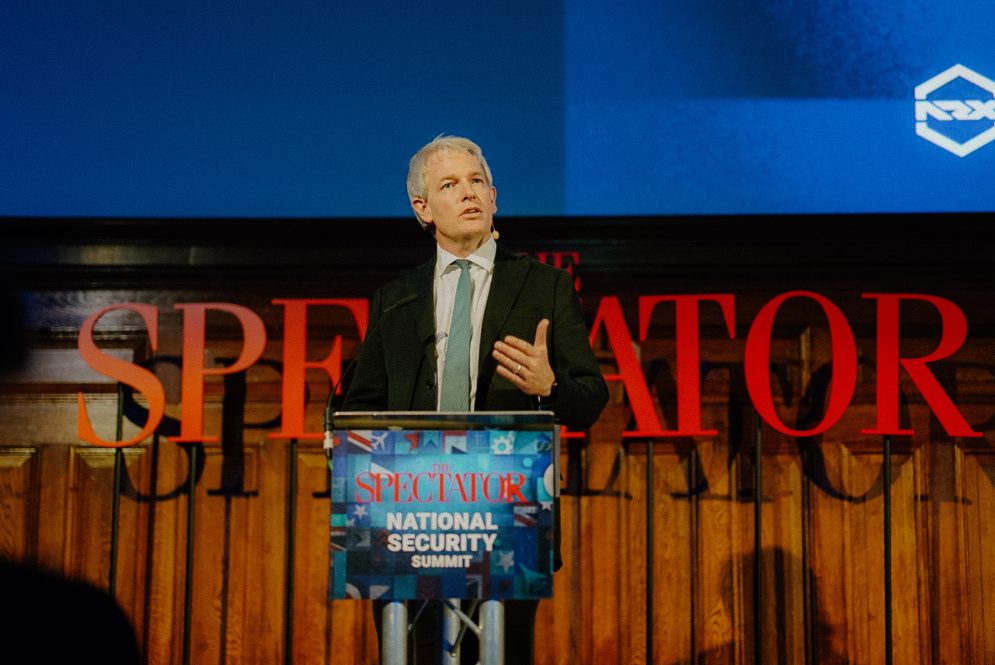
Kruger set out the foundations of his party’s approach to defence for the first time in a keynote address at The Spectator’s National Security Summit. The intervention comes as the government faces mounting pressure to agree and publish its long-delayed defence investment plan, which is intended to explain how Britain will meet rising threats and address a £28 billion funding shortfall in its depleted defence base. The delay has become increasingly conspicuous in the context of a more volatile global arena.
While Kruger’s speech was light on concrete policies, it offered an insight into the direction in which Reform wants to take the Ministry of Defence and armed forces. Should Farage become prime minister, he declared, policies would be built around making the country a rival to the US and China in military might and influence. The ambition is not one of ‘national self-esteem’ but ‘what the national interest demands’. The Reform MP argued that prosperity and security will not materialise unless Britain builds power on the global stage.
Kruger expressed confidence that Britain retains the ingredients of a superpower. We have tier-one special forces, world-leading intelligence services and universities at the forefront of global research. What is lacking, Reform believes, is a ‘conductor to orchestrate existing capabilities’.
Kruger went on to say that, by becoming a great power, Britain could deploy a doctrine of ‘active deterrence’. The aim is to build enough strength, resilience and retaliatory capacity that enemies decide Britain is too difficult and costly to attack or coerce. The doctrine would not only apply to military force, but also involve hardening the country across cyber, AI, energy, food, borders, industry and infrastructure. It implies a more assertive response to hostile activity below the threshold of war, with Britain actively pushing back rather than merely absorbing threats.
On the issue of defence spending, Kruger argued that the new Nato target of 3.5 per cent of GDP by 2035 would be a minimum under a Reform government. ‘That’s a floor not a ceiling and it may have to rise further,’ he said. The head of the party’s preparation for government department went on to declare that defence spending should not be viewed solely as a vehicle for economic growth. Rather, it is a necessity in and of itself. However, the knock-on effects for the economy should be positive and could help, for instance, with the Neets crisis. Also in attendance at the summit, Andrew Kinnburgh, who leads Make UK Defence, decried the fact that the British defence firm Babcock currently employs 300 Filipino welders at its Rosyth facility. He said that if Britain moves towards defence spending of 3.5 per cent of GDP, it could open up 50,000 jobs for young people currently out of work.
Kruger’s intervention on defence will be welcomed by industry and those voters concerned by Reform’s lack of discourse on the topic when compared with other issues. The party still has not appointed a defence spokesman to its so-called ‘shadow cabinet’, though Kruger insisted this is not a job vacancy to rush and, as things stand, Farage fills the role. Of course, the speech was far from a comprehensive plan and set of policies, which will need to be revealed in time for the next general election. But it reassured audiences at the summit that this is an issue being taken seriously by Farage and one that has the attention of one of his chief policy formulators.