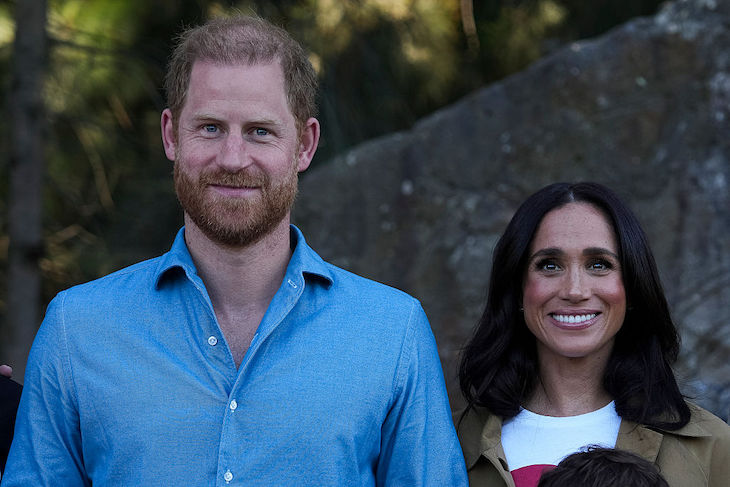
Prince Harry has called for Britain to stand against both anti-Semitism and anti-Muslim hate. In an essay for the New Statesman, he voices his fears for our ‘divided kingdom’. We ‘cannot answer injustice with more injustice’, the Duke of Montecito tells us.
How could Harry truly understand the realities of what the Jewish community faces in the United Kingdom?
There is no doubt that the Prince has respect for our country. Perhaps he even feels a certain sort of longing for the green and pleasant land he once called home. But reading his lecturing and posturing article left me with a bitter sense of disappointment. With all due respect, sir, I think you need to sit this one out. Harry, if you were so worried about Britain, why did you leave?
Don’t get me wrong: I’ve always felt warmly towards the Sussexes. Meghan Markle, in particular, gets a harder time than she deserves. When Andrew Mountbatten-Windsor was arrested on suspicion of misconduct in public office earlier this year, the criticism directed his way felt far less severe than that aimed at Meghan. It has been striking watching the tidal wave of hate when Meghan was simply trying to make a living selling teas, jams and candles. Such was the venom, one would have thought people were watching the devil incarnate instead of an aspiring food content creator and lifestyle curator on Netflix.
But pieces like Harry’s article this week highlight just how out of touch the Sussexes can truly be. The Jewish community continues to face violent assaults, as we have seen in Stamford Hill last weekend, where a group of Jewish women were whipped with a belt. In Britain’s Jewish community, the walls of protection continue to be raised higher and higher as the threat of arson attacks remains ever present. Previously fringe opinions are being brought to the mainstream on social media. Many in the Jewish community are trying to decide if they still even have a future in this country. Meanwhile, Prince Harry is living in multimillion-dollar luxury in California. He works as a Chief Impact Officer for a Silicon Valley start-up and finds time to play polo. It’s not exactly a hard life.
It’s true that Harry promotes some worthy causes, not least the Invictus Games foundation which supports the recovery of wounded and injured military service personnel.
Harry is doing work that seems to be fulfilling for him personally, but it comes from a place of faraway privilege, both figuratively and literally.
In the opening paragraphs of his essay, Harry speaks about how values are being tested, how we have a duty to speak out when necessary and that we have a “responsibility to stand against injustice whenever we see it, and to do so in defence of our shared humanity.” He adds: “That belief does not change with geography, nor does it yield to discomfort.”
The belief might not change, but the Jewish community wants and needs more than words. In the face of active discrimination and threats to our existence in our country we need practical solutions. Words written from the comfort of a £20 million mansion will not help in any meaningful way, nor will they calm any sort of tension. Empty posturing rhetoric does little to reassure Jews who increasingly fear for their safety. Instead, it feels like another moral lecture delivered from a soap box 5,500 miles away.
For all Harry’s talk of moral responsibility, it is the institution he left behind that has shown the instinct for practical solidarity and meaningful action, especially from what we have seen from His Majesty the King. Charles has become a patron of the CST (Community Security Trust), a vital organisation for the protection of the Jewish community across the country. Yesterday, he was warmly greeted by residents of Golders Green as he listened and took note of concerns by Jewish community leaders. When Prince Harry is writing hollow words thousands of miles away, the very institution he turned his back on is actually taking action to reassure British Jews they are wanted in their home country. Living in the protected suburbs of Montecito surrounded by sweeping hills and hired security, how could Harry truly understand the realities of what the Jewish community faces in the United Kingdom?
British Jews do not need, or want, lectures from a multimillionaire across the pond. Instead, we need solutions to the rise of extremism, practical protection and people actually willing to stand beside us here at home. Actions speak louder than words. Harry, of all people, should know that.