The dogs, horses, diamonds, furs, full-length evening gowns of lace and pearls; private jets and limousines; the ever-present jostling retinue; the push and shove of photographers and the clamour of crowds – Elizabeth Taylor and Elizabeth II had a lot in common, each taking themselves very seriously and needing to be seen to be believed.
Whereas the Hollywood actress was majestic mainly in her vulgarity and brashness, however, the late Queen, as is evident in this pair of biographies, did her level best to be reticent, even non-existent. The best known of her few recorded utterances are ‘Oh really?’ and ‘Are you sure?’. She had a tendency to stare at a person with ‘absolutely no expression’, or at best ‘an expression of controlled irritation’.
She would never have thought it odd to change clothes six times a day at Balmoral
Her speeches were platitudinous: ‘We shall remember our past, but we will no longer allow our past to ensnare our future’ – the sentiment expressed whether she was in Ireland, France or America. If people she knew had died, she’d say nothing; but a labrador killed by rat poison or the death of a corgi might result in reams of commiseration.
When Margaret Thatcher fainted at a diplomatic function, the Queen said with remarkable lack of sympathy: ‘Oh look, she’s keeled over again.’ When Princess Anne was shot at and nearly kidnapped in the Mall, the monarch ‘continued with her state visit in Jakarta the following day as if nothing had happened’. During the time of the many collapsing royal marriages, she’d be ‘absolutely transformed ferreting for rabbits’. You feel she was barely aware of being a mother. Returning from some lengthy Antipodean tour, she’d rush off not to see her children but her racehorses. She missed Charles’s first three Christmases.
This sense of human distancing is what makes such biographies difficult and is why royal books are mainly a rubbish genre, since there’s so little to go on. Bricks have to be made with little straw. Hence the space devoted to the fact that Elizabeth did the washing up after picnics, visited a pub in Stevenage in 1959 and first wore glasses in 1977.
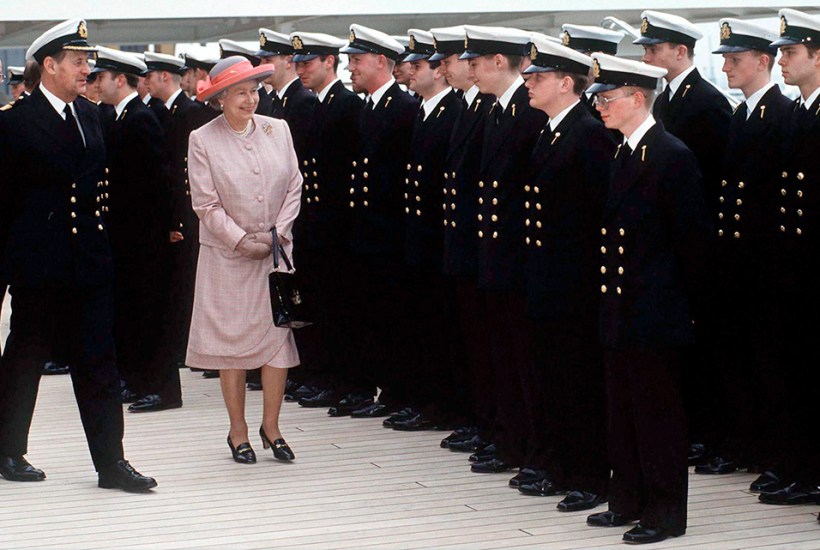
It was, on the whole, an extremely boring life – an endless round of lunches, dinners and receptions; launching ships; taking salutes; standing in the rain for hours. Protocol – who sits where at a banquet – mattered hugely. ‘I spend most of my time conversing with strangers,’ Elizabeth admitted, as medals were pinned on civic worthies and officials and ambassadors came and went, ‘kissing hands upon appointment’. She had a spiffing knowledge of cap badges and regimental buttons. She would never have thought it odd to change clothes six times a day at Balmoral.
Robert Hardman and Hugo Vickers emphasise her sense of duty, her ‘faultless neutrality’, as well as her courage, refusing to dodge potential bombings and assassins. ‘I’m not afraid of being killed,’ she declared. ‘I just don’t want to be maimed.’ It is remarkable how little power she had, how little say, especially when dispatched on state visits to remote spots by governments wanting to sweeten trade deals. ‘They are sending me all over the place at the moment,’ she was heard to sigh.
When abroad, blood supplies were stocked in refrigerators at airports and foreign cooks were subjected to stool examinations to ‘minimise the likelihood of amoebic and worm infections’. At home, Elizabeth was compelled to entertain tyrants such as Idi Amin and Nicolae Ceausescu. (On a visit in 1978, the latter frantically searched under floorboards at Buckingham Palace for bugging devices.) But she ‘took a real shine to Yeltsin’, whom she thought might have been an ideal BBC head of light entertainment.
Her history is overfamiliar: the carefree childhood (‘Lilibet was a hitter, Margaret more of a biter’) interrupted by the Abdication crisis, which propelled her father to the throne; George VI’s early death from cancer, or what was euphemistically called ‘catarrhal inflammation’; becoming the new sovereign while up a tree in Africa; the Coronation (conducted ‘entirely by elderly Christian white men’), which encouraged more than three million people to buy tele-vision sets.
On and on it goes, like the 60-odd episodes of The Crown, until we encompass Charles and Diana (‘He’s opera, she’s Phantom of the Opera’); Fergie and Andrew, a pair of stage villains; the Sussexes, with Meghan mistaking royalty as an opportunity for celebrity endorsements; the Cambridges, William often seen not wearing a tie; and the state funeral in 2022. ‘The final curtain had fallen on a golden age,’ intones Vickers, sounding like A.L. Rowse mourning Elizabeth I.
I always like hearing about George V, ‘a caricature of a curmudgeonly squire, devoting his days to shooting and stamp collecting’, like Ronnie Barker in Futtock’s End. When he fell ill, get-well telegrams were received from Hitler, Mussolini and Emperor Hirohito. I didn’t know that the Royal Train had a saloon decked out by Harrods as a fairy dell for the children; or that Lord Harewood was ostracised by Queen Mary for marrying the Viennese Marion Stein because she was Jewish; or that the worst thing about the fabled annus horribilis was not Windsor Castle in flames but the Queen having to sit through Cannon and Ball at the Royal Variety Performance.
Neither Hardman nor Vickers succeed in making Prince Philip likeable. His father having died in Monte Carlo ‘in the arms of his mistress in a hotel room’, Philip was touchy, insecure and as snappish as a crocodile. ‘What is the grouse news this year?’ someone once ventured. ‘I don’t know and I don’t give a fuck,’ Philip replied. (His manner was inherited in full measure by the egregious Andrew.) When Philip and Princess Elizabeth were married in 1947, the Girl Guides of Australia sent sugar for the cake. There were 2,583 gifts. The groom’s sisters were not invited to the wedding as they’d married Nazis.
Philip was to make many ‘solo excursions’, and the Queen appeared to be ‘more relaxed when he was not around’. Though he was stalwart, reliably walking two paces behind her, Elizabeth could not be entirely sure of his affections. One of his early girlfriends, says Vickers, was Corbina Wright. ‘Later she became an alcoholic, though recovered.’ Towards the end, leaving the Queen at Windsor, Philip retired to Wood Farm on the Sandringham estate, where he went carriage driving with Penny Romsey. ‘It was not a separation,’ writes Hardman. ‘In a sense they separated,’ writes Vickers.
At Buckingham Palace she was compelled to entertain tyrants such as Idi Amin and Nicolae Ceausescu
Elizabeth blossomed in her last decades, particularly when Hardy Amies died and she started to wear less dumpy clothes. The departure of the Queen Mother in 2001 also meant that she was no longer overshadowed by all that gush and charm which made her seem sullen in comparison. Though no one would condone his murder by the IRA, Dickie Mountbatten was another nuisance. He took ‘a considerable interest’ in Charles’s love life, infiltrated important gatherings, invited himself aboard Britannia and came to Buckingham Palace to use the crested writing paper.
Much better than the usual guff, Hardman’s book is a model of clarity and expertise as we whizz through the jubilees and state visits (‘No one looks forward to going to Uganda’) undertaken by a monarch whom he keeps calling a ‘pragmatist’. Vickers’s book is more of a love story. He had done his best to bob in the royal wake, serving on committees, handing out hymn sheets at St George’s Chapel and watching processions. ‘He turns up all over the place,’ remarked the Queen when she spotted her stalker on the quayside in Valletta.
Vickers began his research early, at the age of seven. His knowledge of the Court Circular, genealogy and abstruse personages (Sir Grismond Philipps, Barbadee Knight) is more than encyclopaedic: it’s bonkers. Who else could tell us that Lady Mary Cambridge was placed in a nursing home in Stogumber or that a childhood friend of Elizabeth, Sonia Graham-Hodgkinson, was ‘kissed by a man in a car’? I relish the trivia – can’t get enough of it. Vickers is the Tolstoy of royal biography, creating a vast and detailed panorama, the eccentric footnotes a glorious satire of scholarship.
Got something to add? Join the discussion and comment below.
You might disagree with half of it, but you’ll enjoy reading all of it. Try your first month for free, then just $2 a week for the remainder of your first year.