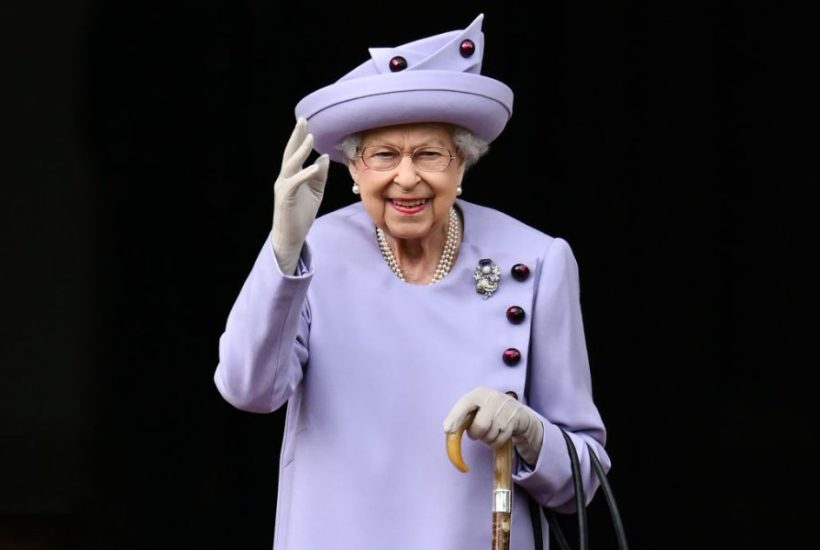
Today marks the centenary of Elizabeth II’s birth. Less than four years after she died, Britain’s longest-reigning monarch is still regarded with both veneration and genuine fondness by the people that she ruled over.
It has been announced that the controversial memorial dedicated to the Queen in London’s St. James’s park will include a statue of her in her Garter robes – along with Prince Philip in naval uniform. A new charity, the Queen Elizabeth Trust (patron: King Charles) is also being launched today alongside a so-called ‘digital memorial’ that will allow members of the public to share their memories of her. Our beleaguered Prime Minister Keir Starmer bleated that:
As our longest‑serving monarch, Queen Elizabeth II devoted her life to public service. The nation will commemorate her extraordinary reign with a memorial that offers a place of reflection for generations to come.
Certainly, Britain continues to be interested in her. Two high-profile new biographies of her, one by Robert Hardman and the other by Hugo Vickers, were both Sunday Times bestsellers this week, helped by wall-to-wall newspaper coverage. Meanwhile, King Charles has picked none other than the excellent Anna Keay, author of The Restless Republic: Britain Without a Crown, as his mother’s authorised biographer. This news suggests that, when Keay finally publishes what is sure to be a highly awaited book, it, too, will soar to the top of the bestseller charts.
The Queen’s refusal to throw Andrew to the wolves has cast a stain over her long reign
Quite what Keay will find in her visits to the royal archives and conversations with courtiers remains to be seen. During her lifetime, Queen Elizabeth epitomised the Firm’s motto ‘never complain, never explain’. This phrase arose during the Victorian era but became synonymous with ‘Brenda’, as Private Eye irreverently dubbed her. One reason for the late monarch’s status as a much-loved mother, grandmother and, eventually, great-grandmother to the nation was that, in lieu of revealing public statements, her subjects were free to impose whatever opinions and hopes they had onto her. After a fashion, she lived up to them.
It was somehow unsurprising that the last thing of any note Elizabeth did in her reign was to appear in a televised skit opposite that other British icon of universality, Paddington Bear. Although Paddington has been accused of being either tweeness personified or, in some circles, a marmalade sandwich-toting harbinger of death, he remains a furry, inoffensive figure. Would that the same might always be said of his co-star. The Oxford Dictionary of National Biography (DNB) has updated its entry about Elizabeth II to observe that:
During the course of her reign, the United Kingdom ceased to be a great power in the world, and evolved into a multi-cultural, multi-faith multi-ethnic society, and the country in which she died was very different from that in which she had been born.
It went on to observe that ‘to all this she adapted, slowly and not always enthusiastically, but on the whole wisely and well.’
This is hardly damning – although it’s unflattering enough for the editor of Majesty magazine to call it ‘rather mean-spirited and begrudging’. Nevertheless, it is also a reminder that, with the pageantry of the Queen’s funeral and, especially, the well-choreographed lying in state – complete with epic queue – long concluded, she might now be judged as a flawed human being, rather than simply a national symbol.
The DNB also observed, correctly, that ‘she made some missteps (particularly in relation to her family)’. The greatest of these missteps, of course, was in relation to her favourite child, the former Prince Andrew, who she openly lavished greater interest and indulgence on than the other three.
Quite why Elizabeth was so besotted with a charmless and bullying figure is inexplicable. He was horrible, by all accounts, as a child and has been similarly vile ever since, even before the revelations of the crimes he has been accused of (and continues to deny). It suggests that, especially when it came to those around the Queen, she was unable to exercise any kind of impartial judgement. The revelation that she paid most, if not all, of the hush-money settlement that Andrew agreed with the late Virginia Giuffre in February 2022 – just a few months before she died – was a particularly dismal example of noblesse oblige.
That her son, King Charles, and his wife issued statements after Andrew was stripped of his titles, suggesting that their ‘thoughts and utmost sympathies have been, and will remain with, the victims and survivors of any and all forms of abuse’ is an implicit rebuke to the late monarch. Elizabeth personally gave Andrew many of them and allowed him to behave with impunity in roles largely created to indulge him. Her refusal to throw Andrew to the wolves – which Charles has been only too happy to – might be personally commendable but has cast a stain over her long reign.
I doubt that Elizabeth’s reputation will ever truly decline – unless Keay finds some sensationally revealing documents in the archives, but it is surely time that her mistakes are examined as honestly as her strengths. Her famous remarks made after Meghan and Harry’s Oprah-led denunciation of the Royal Family’s supposed racism – ‘recollections may vary’ – won her approval and plaudits from many quarters, and also, far from coincidentally, marked the point at which the Montecito refugees went from being broadly believed to figures of scepticism.
Now, similar scrutiny must be applied to the late Queen and her legacy, robustly and forensically. I expect that her reputation will survive such examination, but her missteps and mistakes – especially when it came to Andrew – will, in time, come to define her as surely as her triumphs and successes did.