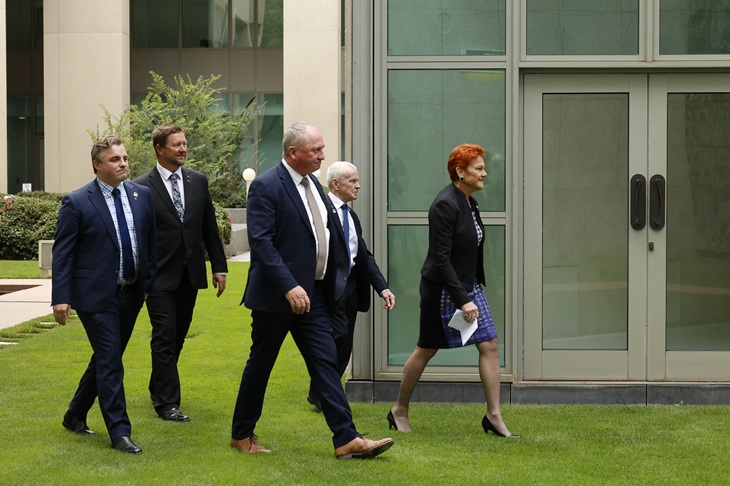
When I wrote about One Nation’s rise earlier this year, the polling was startling. The question was whether it would hold. It has. Now a harder question is being asked: Is Australia experiencing its own populist insurgency, and can the Liberal Party survive it, or is it being structurally replaced?
In February, I noted that One Nation was leading among Australian women and polling ahead of Labor in Victoria, and the reaction from the political class to these polls was a familiar mix of surprise and dismissal. The numbers were real, the commentariat conceded, but surely temporary. A protest vote. A polling quirk. A moment of voter anger that would recede once the issues were addressed and the adults in the room reasserted themselves.
It has not receded. It has deepened.
The most recent Sky News Pulse polling by YouGov finds One Nation sitting at 27 per cent nationally, one point shy of Labor on 28 per cent, with the Coalition trailing at 23 per cent. The South Australian election in March told a more dramatic story still. One Nation surged in a state where it historically returned primary votes around 4 per cent, cannibalising Liberal seats in regional areas and forcing a reckoning that the Liberals could no longer defer. The Liberal Party has now had four leaders in four years in South Australia. Angus Taylor replaced Sussan Ley as federal leader in February after a 34-17 spill vote, becoming the Coalition’s newest change of direction since Peter Dutton’s defeat at the 2025 federal election. The churn itself is a message.
The question that is now being asked seriously, is whether this is a cyclical correction or a structural replacement. The distinction matters. A cyclical correction means the Liberals regroup, move forward with a credible leader, sharpen their policy offer, and recover their traditional voter base in time for the next election. A structural replacement means the voter base has genuinely shifted allegiance, and the party that once held it has been permanently displaced on the right by a force it cannot out-flank, out-authenticate, or absorb.
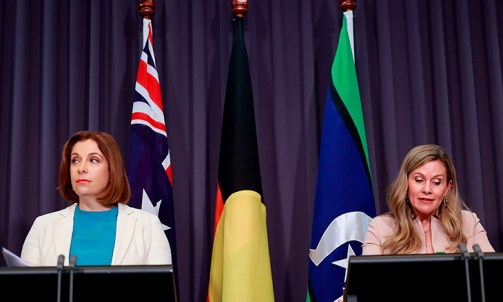
The evidence increasingly points toward the latter. Taylor’s pitch to One Nation voters upon taking the leadership was candid to the point of being arresting. ‘We understand you’re disappointed with us,’ he told them. It was an honest assessment. It was also an admission that the Liberal Party no longer regards One Nation’s supporters as strays who wandered off, they are a constituency the Liberals have lost and are unsure how to win back. Former Prime Minister Malcolm Turnbull, watching from the moderate wing, argues the Liberals must retake the political centre to survive. Taylor, heading the other direction, is betting that a harder line on immigration and a clean break from ‘Net Zero ideology’ will bring voters home. Both cannot be right, and in the meantime, Pauline Hanson is polling 23 per cent in the preferred Prime Minister question, while Angus Taylor sits at 14 per cent.
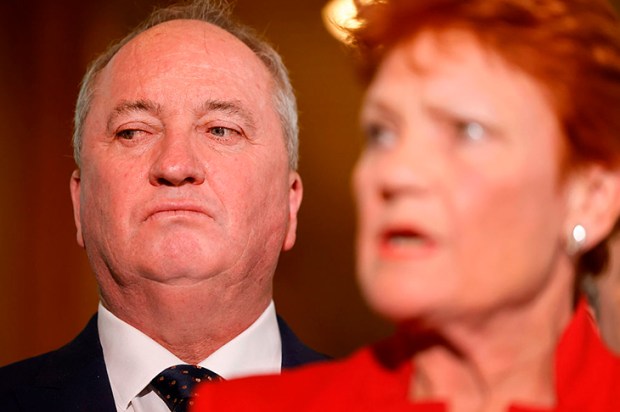
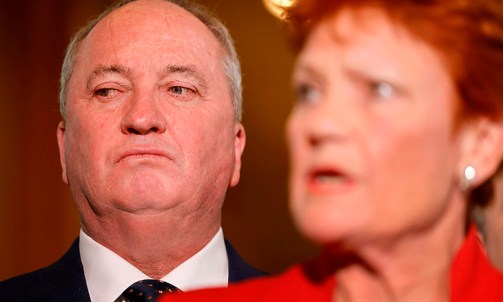
The Farrer by-election on May 9 is being watched as the first genuine electoral test of whether One Nation’s polling translates to Lower House seats. Farrer was a safe Liberal seat. Barnaby Joyce, who quit the Nationals for the crossbench before joining One Nation, has given the party its first presence in the House of Representatives since 1998. A DemosAU projection from earlier this year estimated One Nation could win between 46 and 55 federal seats at the next election. Even a fraction of that would make it the official opposition, supplanting the Liberals entirely. That projection may be optimistic for Hanson, but the fact that analysts are running those numbers at all tells you something has fundamentally changed.
One event accelerated what had already been building. The December 2025 Bondi terrorist attack was the catalyst that took One Nation from a significant polling presence to a dominant one. The government’s response was judged, by a wide cross-section of voters well beyond the traditional One Nation base, as inadequate. The gap between the language used in official statements and the lived experience and plain anxieties of ordinary Australians was visible and felt. Pauline Hanson, whatever one thinks of her policy prescriptions or her rhetoric, did not speak in that gap-filling official language. She spoke plainly. That plainness, once again, is not incidental. It is the product.
The immigration debate that followed illustrates the bind the major parties now find themselves in. Taylor’s Liberals moved hard on immigration cuts as their primary point of differentiation from the Albanese government. The politics of that move are understandable: it is the issue on which One Nation leads most decisively. But Hanson’s immediate response was to raise the specificity bar, demanding to know whether Taylor would target migrants from ‘fundamentalist Islamic countries’ by name. He had not. She had. The dynamic reveals something important: on the issues that define One Nation’s appeal, Hanson will always be able to go further than a mainstream party leader can. The Liberals can adopt One-Nation-adjacent policy positions. They cannot out-Hanson Hanson. The voters who are animated by those issues already know who speaks their language, and it is not Angus Taylor.
Can the Liberals survive it? The honest answer is not in their current form, and not without a degree of reinvention that may be beyond a party in the condition the Liberals are presently in. The party is losing voters in two directions simultaneously. On the right, to One Nation in regional and outer-suburban seats. On the left, to Teal independents in the wealthier urban and inner-suburban seats the Liberals once held safely. The electoral map that once made the Liberals a viable national governing party has been carved apart from both ends. Outside of Queensland, they currently hold only a handful of urban seats.
The two corrective strategies available to the Liberals are in direct tension with each other. Moving right to reclaim the One Nation base alienates the moderate urban voters and Teal-adjacent constituencies the party needs if it is ever to form government again. Moving to the centre to win back those urban seats hands the right flank permanently to Hanson. Turnbull is correct that there is no electoral path to government through outbidding One Nation. Taylor’s instinct to sharpen the conservative offer may arrest the bleeding on one side. Neither strategy addresses both problems at once, and the Liberals almost certainly do not have the time or the unity to execute either cleanly before 2028.
There is a third possibility that sits outside the binary of recovery or replacement, and it is the one the political class finds most uncomfortable to contemplate: managed decline into a permanent third-party status, somewhere to the right of the Teal independents and to the left of One Nation, holding a rump of seats in coalition arrangements that give neither major party a clear mandate.
None of this is inevitable. Polling at this stage of a political cycle is not destiny. Antony Green has identified 25 federal seats where One Nation performed strongly in 2025 as genuine battlegrounds, but winning those seats in a federal election requires ground organisation, candidate depth, and a sustained funding base that One Nation has not yet demonstrated at scale. The party has peaked before. The question is whether this time the structural conditions are different enough that the peak holds.
When I wrote earlier this year that the political class had badly misread the One Nation phenomenon by treating it as a joke, I was describing a failure of analysis. What is now becoming clear is that the failure was deeper than that. The same institutions that laughed at Hanson 30 years ago, that confidently predicted her party’s irrelevance at every subsequent election cycle, that treated her voters as an embarrassment to be managed rather than a constituency to be understood, created the very conditions in which she could become the country’s most significant political force. The mockery was not just wrong. It was wildly expensive.