Dante’s Beach, Ravenna
I was at the wheel of our Land Rover Defender on Wednesday with my middle daughter Magdalena (18) en route to her weekly driving lesson, and I asked her: ‘How English do you feel?’
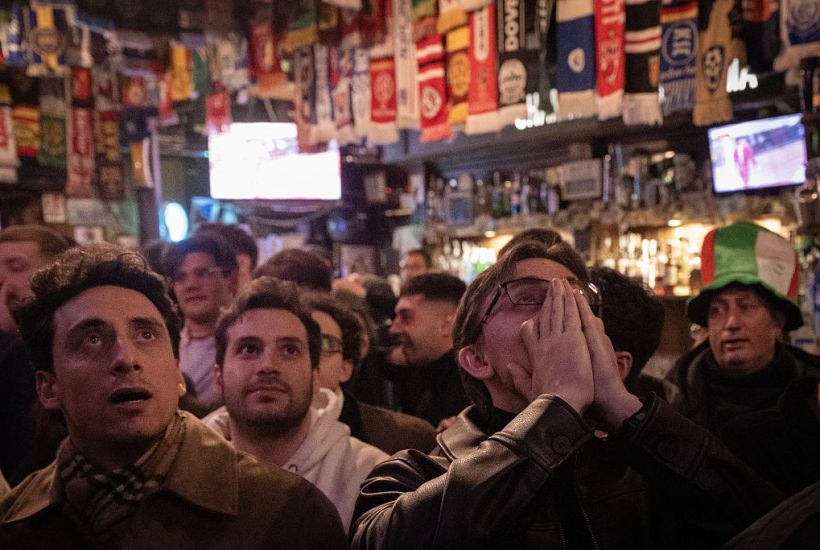
Carla, her mother, is Italian and Italy had just failed to qualify for the world cup this summer for the third time in a row, knocked out by – it pains Carla even to utter the wretched word – Bosnia.
Such national sporting catastrophes always make me wonder about nations and what part in defining your nationality the blood in your veins plays, and what part your presence in a place plays
Italy has won the world cup four times – the same number as Germany – and that’s more than any other country except Brazil. Two of those times, it must be said, were in the 1930s when the fascist dictator, Benito Mussolini, was in charge but Giorgia Meloni is no Duce, regardless of what the global media tell you.
The last time Italy managed to play in the finals of the world cup was 2014.
‘Am I beautiful?’ said Magdalena by way of a reply. She had been doing her make-up with the help of a small hand-held mirror. I took my eyes off the road and glanced at her honey blond hair and jade green eyes and neatly applied lipstick whose colour was, I later found out, ‘mattone’ (brick).
‘Bellissima!’ I said astonished as ever that I had helped create such a creature.
‘Well everyone says I look English at school,’ she added.
Italy’s daily newspaper that is dedicated entirely to sport – La Gazzetta dello Sport – described the situation of this proud nation after the debacle in Bosnia as so bad it was beyond Biblical. ‘The Third Apocalypse, the worst of them all: Italy’s absence from the world cup is becoming normal’, proclaimed the front page editorial.
‘We’ve said it so many times, with a mixture of delusion, rage, and indignation: we must rebuild the system from scratch,’ said the author, ‘Otherwise, the generations of young people who have never seen Italy at the world cup will multiply.’
Such national sporting catastrophes always make me wonder about nations and what part in defining your nationality the blood in your veins plays, and what part your presence in a place plays. And thus which nation you will support in sport – and in war.
The Encyclopaedia Britannica says: ‘A nation is a group of people with a common language, history, culture, and (usually) geographic territory.’ But that sounds far too bland a definition to explain the drums and the songs, the pride and the patriotism, the wars, or the passions aroused by the world cup. It is far too rational.
Our six children aged ten to 22, were born, and have lived, only in Italy. They have Italian passports but could get British ones if they wanted. So will they now support England, I wonder, at the world cup with the sincere passion of an Englishman like their father? You’d probably answer: no, nay never, no more. Well, having observed my children in action, I’m not so sure.
Obviously Carla, who is a devout Catholic who communes with an image of the Virgin Mary attached to the fridge door, and is an equally devout Italian, could never do such a thing. Nor could I support Italy with honest passion. I’ve lived in Italy for 30 years and still find it funny, not sad, when the Azzurri lose.
I love the Italians (up to a point) and their way of life and I am sure I prefer Italy for most things to what Britain has become. But I still feel British, not Italian.
Magdalena, however, and her brothers and sisters, are half-and-half and although they have only ever visited Britain I made a remarkable discovery about them during the Euro 24 championships when England made it to the final in Berlin against Spain.
They really, genuinely did support England – I was able to see first-hand – even though we were surrounded by the enemy. There was nothing phony about it. They weren’t just trying to make poor old papà feel better.
Four of them watched the game with Carla and I on the big screen in the open-air restaurant at the village campsite: in addition to Magdalena, Rita, Giovanni-Maria and Giuseppe (now 16, 14 and ten). This being the Mediterranean, everyone else there that night, it seemed, wanted the inglesi to lose.
When Spain took the lead the restaurant erupted with joy. Carla? She was giggling. ‘I’m sorry, Nick,’ she said, ‘Really’. But our four children, I noticed, were sad.
As I wrote at the time:
‘Then, when England scored a spectacular equaliser, Giovanni-Maria, Giuseppe and I all high-fived each other. Forgetting myself, I leapt out of my chair and grabbed Carla by her shoulders and rocked her from side to side. Magdalena and Rita bounced to their feet and hugged me. Everywhere else in the restaurant, I suddenly became aware, there was glum silence. So I sat down. Carla now made the sign of the cross at me. Spain soon scored the winner.’
This was in sharp contrast to Carla’s behaviour during Euro 20 (which took place in 2021 because of Covid) when Italy beat England in the final at Wembley on penalties. When England took an early lead she went off to wash her hair then pray to the image of the Virgin Mary on the fridge door. When Italy equalised she came back until the final whistle but returned to the fridge during penalties. Then, once Italy had won, she exploded with joy and led the children on a wild and noisy conga around the house and out into the garden causing the dogs to howl and the donkey to bray. I remained seated, an Englishman in Italy, slumped in front of the TV.
‘Even though I find the inglesi a little antipatici (disagreeable), I’m half inglese thanks to you, and metto la mano sul fuoco (I put my hand on the fire), I really felt so bad when England lost to Spain,’ said Magdalena. She does know the words to ‘Rule Britannia’, as it happens and chants such as ‘Two world wars and one world cup!’ and ‘Come and have a go if you think you’re hard enough!’
As for me, I’ve obviously failed the Italian version of the late Norman Tebbit’s famous cricket test which he dreamt up in 1990 to expose the refusal by many Asian and Caribbean immigrants to integrate into British society. If they continued to support, say, the West Indies, India, Pakistan and Bangladesh when they played cricket against England – Lord Tebbit argued – this was proof that they did not feel truly British or that Britain was their home. But at least I have married out!<//>