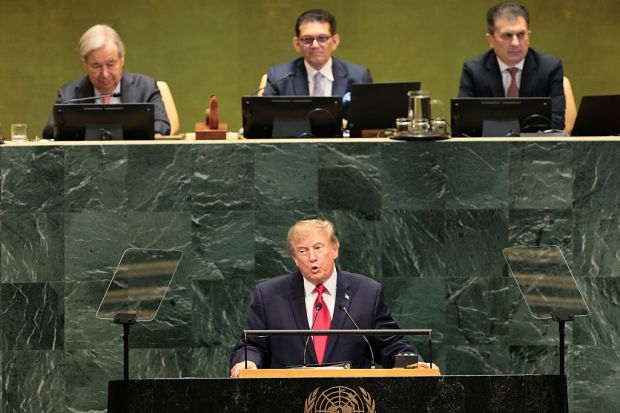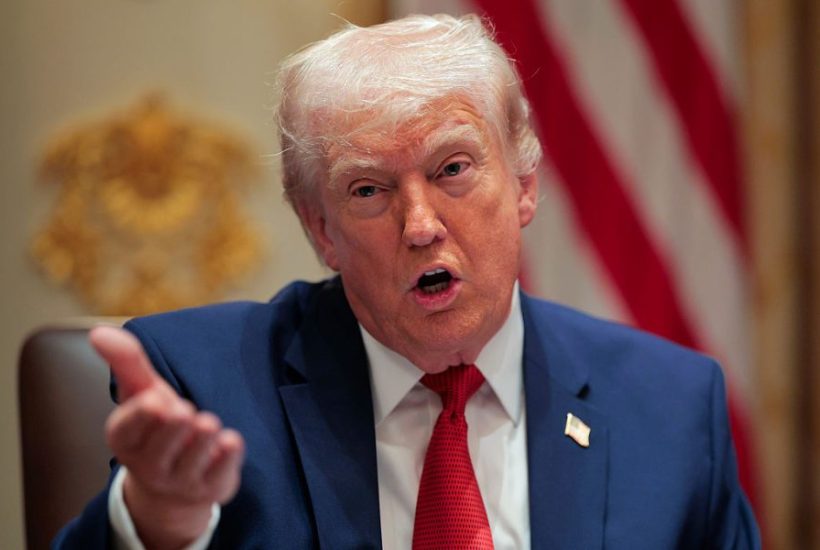
Donald Trump likes to use the phrase ‘go big or go home’ to describe his political strategy. It looks as though the US President is about to stress test its efficacy as he weighs dispatching another 10,000 troops to the Middle East, a move that would further embroil him in the widely unpopular war in Iran. According to a recent Quinnipiac poll, 74 per cent of Americans are opposed to a ground war against Iran.
Small wonder. The prospect of an American Gallipoli is hardly calculated to inspire support for the fresh war of choice in the Middle East, one that Trump embarked upon without inspiring any backing in the first place. Instead, he sailed into it without congressional approval. Now he’s running aground. As Curt Mills, the executive director of the American Conservative, a citadel of Maga followers, told me: ‘If James Mattis, Stanley McCrystal and David Petraeus are leery of this war, then I think you should be too.’
Senator Lisa Murkowski of Alaska is talking about forcing a vote in Congress on formal authorisation for the war, which is the last thing many of her Republican colleagues want to take an official stand on. But as Trump toggles back and forth between repeatedly extending the deadline for bombing Iran’s energy facilities and mulling sending more troops, congressional Republicans are starting to become apprehensive.
Trump fancies himself a great negotiator, but he has not delivered the goods
South Carolina Representative Nancy Mace indicated that she would support a war powers resolution, stating that she has seen no sign that the Trump administration has an ‘exit strategy’. The real question might be whether it has any strategy at all other than lining the pockets of Trump and his entourage. Even as Trump officials exhort Americans to accept the sacrifice of higher gas prices, they themselves seems to be profiting from the war. It has not escaped the notice of investors and financial journalists – Axios referred to an ‘epidemic’ of suspicious manoeuvres – that hundreds of millions of dollars have regularly been traded just before Trump’s latest pronouncements on the war.
Trump continues to tout a golden age, but the goodies and laurels seem to be largely reserved for himself. On Wednesday night, he received a glittering gold ‘America First’ statue from House speaker Mike Johnson and the next day the Treasury Department announced that his signature will soon appear on American currency, a first for a sitting president. At the same time, his Interior Secretary Doug Burgum announced that he had helped convey $100 million (£75 million) in gold from Venezuela to the United States, as though this represented some great feat of fiscal wizardry.
Alas, the cost of the Iran war has already reached $25 billion (£19 billion) at a moment when the overall federal deficit is close to $40 trillion (£30 trillion). Inflation is up. Jobs and the stock market are down. Goldman Sachs now estimates that the Iran war is costing the American economy around 10,000 positions a month.
The fiscal implications for Europe and Asia of a prolonged conflict are scarcely less dire. Russian oil is not going to come to the rescue – Ukraine keeps scoring big hits on Vladimir Putin’s export facilities. In the past several days, it has demolished at least 40 per cent of Russia’s export capacity with Baltic drone strikes even as a feckless Trump tries to pressure Kyiv into surrendering the Donbass to the tender mercies of Putin.
Trump fancies himself a great negotiator, but he has not delivered the goods, whether in Ukraine or Iran. In a social media post on Thursday, the President claimed, on the one hand, that Iran was ‘begging’ for negotiations, while proclaiming, on the other, that it ‘better get serious soon’. Which is it?
As Trump enmeshes himself further in the Middle East, he may well become a historic president – but not for the reasons he hopes. Writing in the New York Times, Lydia Polgreen alluded to the famous 1952 essay in Harper’s by the Scottish political scientist D.W. Brogan, who travelled around America during the Korean war and chronicled what he called the country’s ‘illusion of omnipotence’. That illusion has withstood repeated buffetings, but Trump may have finally shattered it with his ‘excursion’ – as he is wont to call it – into Iran.
If he expands the conflict with a ground invasion, Trump will have sabotaged not only his presidency, but also American power and influence for decades to come. A golden age indeed.