The energy price surge caused by war in the Middle East has sent shockwaves through Westminster. It has pushed up inflation and the cost of borrowing, causing panic in the cabinet and the recognition that government intervention could be needed on a vast scale to support the cost of living.
The Prime Minister told a private audience: ‘The assumption that the growth of the developed countries can proceed steadily on the basis of cheap energy has been shattered almost overnight.’ He further observed: ‘The problem is not simply one of inflation. It is the whole structure of the economy.’
In the Treasury there is something approaching a siege mentality. The Chancellor has ‘to spend [her] time firefighting’. When considering the realities of the UK’s economic situation, the guardian of the public finances said: ‘My predecessor left me an economy on the brink of catastrophe; my task was continually obstructed by events outside Britain over which I had no control… The Chancellor of the Exchequer’s is a lonely job, particularly when he is obliged to disappoint the hopes of his party. Without the support of the prime minister it is impossible.’
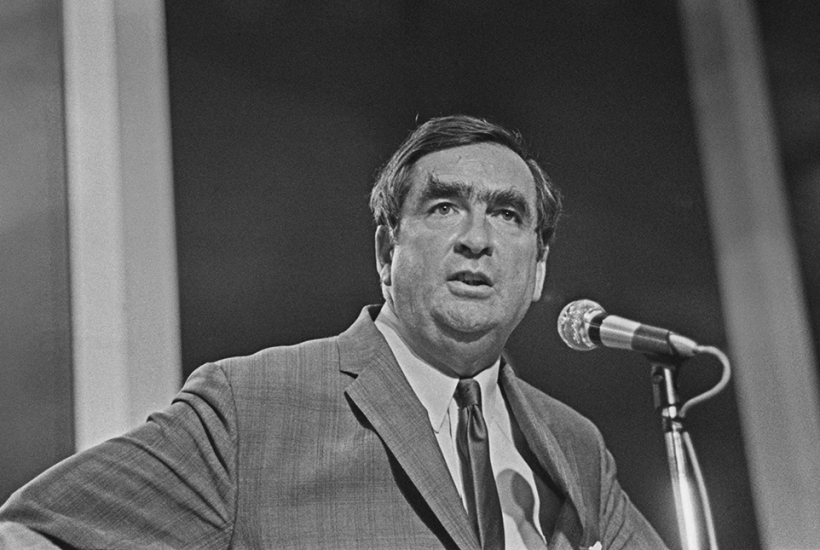
The ‘he’ is the giveaway. Those were the words of Denis Healey, who inherited a gargantuan financial mess the year after the Opec price shock of 1973 and whose memoir is one of the best by a leading politician. ‘We’re into Opec 1973 territory now,’ remarks one cabinet minister.
The Cobra emergency committee met on Monday to make plans to deal with the impact of an energy price shock. The government’s estimate is that if Iran succeeds in keeping the Strait of Hormuz closed – the bottleneck through which much of the world’s oil flows – the price of oil will stabilise on a central estimate of $150 a barrel but could go as high as $200. On Wednesday morning, the price of Brent Crude was around $96 a barrel.
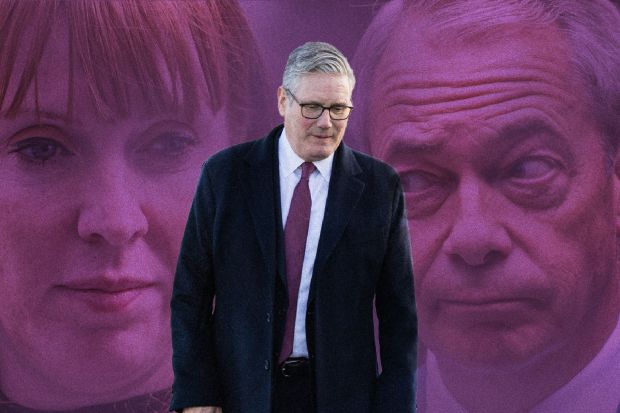
‘We’re looking at the economic impact,’ Keir Starmer said. ‘I am asking for every lever that’s available to the government to deal with the cost of living to be discussed.’ In a statement to the Commons on Tuesday, Reeves made clear she plans an intervention to alleviate the costs of rising energy prices, with the household cap due to rise by £332 in July.
Her focus is on not repeating what she sees as the mistakes of the Liz Truss government, which issued an unfunded, untargeted pledge of £60 billion, and of Rishi Sunak at the start of the pandemic, who issued a ‘whatever it takes’ pledge with regard to furlough support.
At the start of the Iran war, Reeves set up a board to handle the economic fallout and, at its second meeting, demanded contingency plans which would allow her to target help at the neediest – an option that was not available to Jeremy Hunt when he inherited Truss’s mess. ‘We’ve got to learn the lessons of the last crisis, where Andrew Mountbatten-Windsor got more help than most people in Windsor,’ a source says.
An ally adds: ‘Rachel is of the mindset that we’ve got to learn from Liz Truss, we’ve got to learn from Covid. She wants to define a response to this crisis which is credible and responsive rather than stumble into a soundbite about doing everything possible. Her instinct is that this is a crisis. Debt is massively high, borrowing is high and the markets are looking at us. It’s not always about spending money.’ That is a line delivered as much at the Labour party as it is voters.
Labour historians will remember only a few sitting western governments were re-elected after 1973 or Covid
Reeves reads widely and she is acutely aware of the situation after 1973, which culminated in Healey and James Callaghan traipsing ‘cap in hand’, as the cliché has it, to the IMF in 1976 for a bailout. You wonder if Starmer is as well versed. The Prime Minister once said Harold Wilson was his favourite Labour leader, but he cannot name his favourite book. It is hard to shake the image from the recent update to Gabriel Pogrund and Patrick Maguire’s book of Starmer spending hours reading papers in the Thatcher study in No. 10 only to emerge with nothing to say to his staff.
In one regard, the situation is worse than in 1973. This time there is a US President who seems to be acting in the interests of his own political standing and financial benefit, rather than as a leader of the western world. A senior civil servant says: ‘It’s mad how Donald Trump is saying stuff to tweak the oil price.’ In the Cabinet Office there is a genuine belief that the President announced the possibility of a peace deal to drive down oil prices and drive up the stock market to feather his own investments.
Economically, so far at least, 2026 is nothing like as bad as 1973-76. Inflation is 3 per cent. In the 1970s it peaked at 24 per cent. Then there was mass industrial unrest, a coal strike which compelled Edward Heath to bring in a three-day week to save electricity and warn: ‘We shall have a harder Christmas than we have known since the war.’
Britain is also better prepared, since the Cobra secretariat, which has absorbed the old Civil Contingencies Secretariat, has access to the extensive no deal Brexit planning, from 2018 and 2019, to deal with shortages of fuel and the knock-on effects of high transport prices on food and medicines. (‘Hurrah! A Brexit benefit at last,’ a Labour aide says.)
But Labour historians will remember that only a few sitting western governments were re-elected after 1973 or after Covid. The only time the Blair government trailed in the polls was in late 2000 when soaring petrol prices led to panic buying at the pumps.
What is most striking about the late 1970s is that while Margaret Thatcher enacted a political revolution to change the country, to slash union power and exploit domestic energy sources in the North Sea, it was the Callaghan government which first spoke the blunt truth to voters that things could not go on as they had been. Most famously, Callaghan told the 1976 Labour party conference: ‘We used to think that you could spend your way out of a recession… I tell you in all candour that that option no longer exists.’
Contrast that with a government that has banned North Sea drilling and retreated into its usual cycle of tax and spend. Reeves’s statement this week suggests she understands all this, but Starmer is a captive of soft-left MPs who show no sign of having learned the lessons of the 1970s.
Got something to add? Join the discussion and comment below.
You might disagree with half of it, but you’ll enjoy reading all of it. Try your first month for free, then just $2 a week for the remainder of your first year.