‘What this country needs now more than ever is for these disparate right-of-centre parties and individuals to work together to hold the balance of power after the next election. A glorious coalition of conservatives without which the future looks bleak indeed.’
Other than regular Spectator Australia readers, most non-left voters would assume these sensible words to have been written in the aftermath of last week’s South Australian election, in which the Malinauskas Labor government was easily returned, but One Nation’s vote eclipsed the Coalition and – more importantly – a combined One Nation/Coalition primary vote could have beaten Labor.
Yet astute Speccie readers will recall this demand for a ‘glorious coalition’ of the right is nothing new. ‘A glorious coalition of conservatives’ was the headline on this page on 20 November 2021, nearly five years and two federal elections ago.As feared in that editorial, at the following election six months later, the cowardly, climate-embracing Morrison government was defeated and the miserable Albanese ascendancy began.
Since then, the One Nation vote has surged for the very reasons we outlined five years ago: because the Coalition under Scott Morrison, and then inexplicably under Peter Dutton, attempted to win power by moving ever further to the left. Embracing net zero at Cop 26 in Glasgow was Mr Morrison’s genius move that cost the Coalition the 2022 election, and the pusillanimity of Mr Dutton in refusing to embrace an anti-woke/pro-Trump agenda, committing to staying in Paris and refusing to take bold steps on immigration (or indeed on anything at all) saw the Coalition’s vote plummet to an all-time low.
So what are the lessons to be learned from the South Australian result?
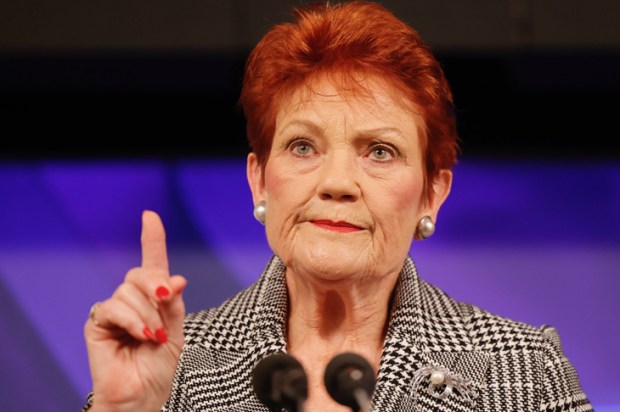
Both Liberal leader Angus Taylor and National leader Matt Canavan have been insisting that ‘a vote for One Nation is a vote for Labor’, on the basis that splitting the conservative vote only ever helps the left. To a degree that is true, but by the very same mathematical logic Pauline Hanson (whose party now polls ahead of the Coalition) can equally claim that ‘a vote for the Coalition is a vote for Labor’. In other words, if everyone who is thinking of either voting for the Coalition or for One Nation all voted the same way, then, yes, Labor would be defeated. So either everyone on the right side of politics agrees to vote for the Coalition, or everyone on the right side of politics agrees to vote for One Nation. Which will it be?
The answer of course is neither. Many of those who have deserted the Liberals or the Nationals for One Nation have done so because they are fed up with being let down by the post-Turnbull Labor-lite bedwetters. They won’t be returning. Conversely, many Liberals of the so-called ‘broad church’ Alexander Downer/Dave Sharma variety view Pauline Hanson’s party as ‘populist’ riff-raff. So persuading those types of ‘moderates’ to abandon the Coalition won’t happen – although in reality they actually belong with the Teals.
Which means, as former Liberal minister Bronwyn Bishop has argued on Sky News, there must be an ‘accommodation’ between the three centre-right/right parties before the next election. That accommodation would need to include preference deals and agreed principles on key policies such as immigration and energy, as well as possible portfolio allocations.
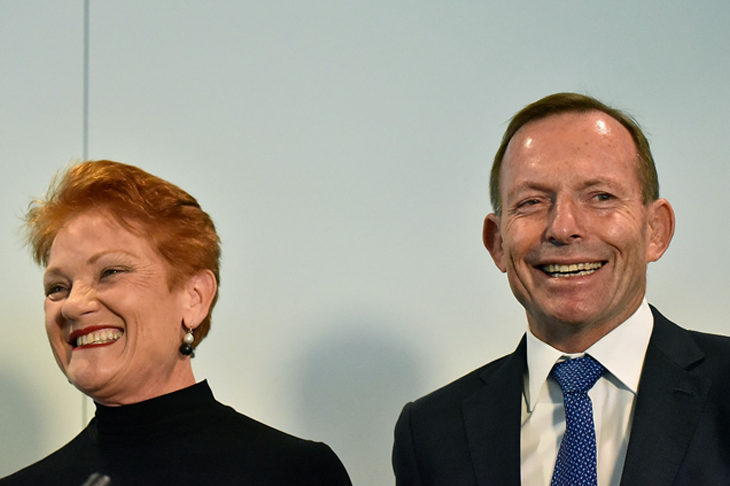
Pauline Hanson, who has said she is not interested in chasing the prime ministership, has already indicated a readiness for such discussions after an election, assuming One Nation poll as well as expected. Mr Taylor and his deputy Jane Hume have made ambiguous noises about ‘working with anyone’ after the election, and, despite attacking One Nation in his first speech as leader, Mr Canavan is now (post-SA) considering a preference deal with One Nation.
Good.
A majority of Australians do not like this Labor government and fervently wish to be rid of it. Our compulsory preferential voting system is unique, as Louise Clegg explains in this week’s issue, but that cannot be allowed to be an excuse for entrenching Labor power. However much it pains them, the Liberals, the Nationals and One Nation must ensure they find a formula to maximise every single conservative vote at the next federal election.
For conservative leaders to simply shrug off the role of preferences and leave it to the local party machine is a disgraceful dereliction of duty. We have a compulsory preferential voting system that overrides the popular vote. Voters have a right to know who to preference in order to increase the likelihood of their chosen candidate helping form government.
Writing on Flat White this week, Stuart Ballantyne echoes Professor Ian Plimer’s call for a ‘Coalition of Three’.
A Taylor government that included Ms Hanson as Immigration Minister, Mr Canavan as Energy Minister, James Paterson as Foreign Minister and Alex Antic, Sarah Henderson, Claire Chandler, Bridget McKenzie, Barnaby Joyce, Jacinta Price, Malcolm Roberts, Andrew Hastie and other notable conservatives in key portfolios is one that this magazine and most Australians would heartily welcome.
A ‘glorious coalition’, ‘unite the right’, a ‘Coalition of Three’ or whatever you wish to call it. But the alternative is the Coalition and One Nation go to war and slug it out and that means yet more years of Labor in power. And that in turn spells unmitigated economic and cultural disaster for us all.
Got something to add? Join the discussion and comment below.
You might disagree with half of it, but you’ll enjoy reading all of it. Try your first month for free, then just $2 a week for the remainder of your first year.