The left achieved a rare success in Paris on Sunday with the victory of Emmanuel Grégoire in the capital’s mayoral election. The Socialist candidate saw off the challenge of the centre-right candidate Rachida Dati in the second round. Grégoire is the third consecutive Socialist mayor of the French capital, a run that stretches back to the election of Bertrand Delanoe in 2001.
‘Paris has decided to stay true to its history,’ exclaimed Grégoire in his victory speech. ‘Paris will be the heart of the resistance against this alliance of the right, which seeks to take away what we hold most precious and fragile: the simple joy of living together.’
But is it the right in France that seeks to divide people or the alliance of Socialists, Communists, Greens and, in particular, Jean-Luc Melenchon’s la France Insoumise (LFI)?
Grégoire was one of the few Socialist candidates who refused to form a coalition with LFI after last-week’s first-round of voting in municipal elections across France. So, too, did the candidates in Marseille and Pau – and their principled stand was also rewarded with victory. In Pau, the Socialist Jérôme Marbot defeated the former centrist prime minister Francois Bayrou, who had ruled the southern city since 2014.
But where Socialist candidates did ally with LFI – the party that sends a shudder down the spine of French Jews – they lost. In the cities of Limoges, Toulouse, Brest and Clermont-Ferrand, the left lost to the centre-right as voters rejected the aggression and division of LFI.
Brest has been controlled by the left for 37 years and Clermont – famous for its manufacture of Michelin tyres – since 1919. Toulouse is home to Airbus, and traditionally votes centre-right. But after last week’s first round, the Socialists and LFI announced a ‘fusion’ in the expectation of winning the city.
The prospect of the far-left running Toulouse terrified Airbus so much that they mooted the possibility of relocating. Prominent figures connected to the city’s rugby club – the French champions – urged people to vote for Jean-Luc Moudenc, the centre-right candidate.
It is not just the economic policy of the far-left that alarms voters. Like the Green Party in Britain, LFI are the party of immigration. Last year Jordan Bardella, the president of the National Rally, even suggested the party should be renamed La France Islamist.
Melenchon has for several years talked of building ‘a New France’ of immigrants to replace the Old France, what he appeared to mock in a speech last week as ‘white and ugly’.
This ‘New France’ was referenced last week when LFI achieved a rare mayoral victory in Seine-Denis, the sprawling area north of Paris.
Seine-Denis was once a white working-class heartland. In 1968, only ten per cent of children in the department were non-European. As of 2017 (the most recent statistics) this figure is now 66 per cent.
The supporters of Bally Bagayoko celebrated his becoming mayor of Seine-Denis by chanting: ‘We are all the children of Gaza’.
The only other notable success of LFI was the second round victory of David Guiraud in Roubaix, a city that in recent years has been tainted by rumours of Islamist infiltration. Guiraud gained notoriety in 2024 when he was filmed in the National Assembly shouting ‘pig’ at a Jewish MP.
It is victories in areas such as Roubaix and Seine-Denis that will console Melenchon and his party this morning. They have achieved little this time around, but the demographics are tilted heavily in their favour; the ‘New France’ remains a work in progress, a dream that could be realised in a generation or two.
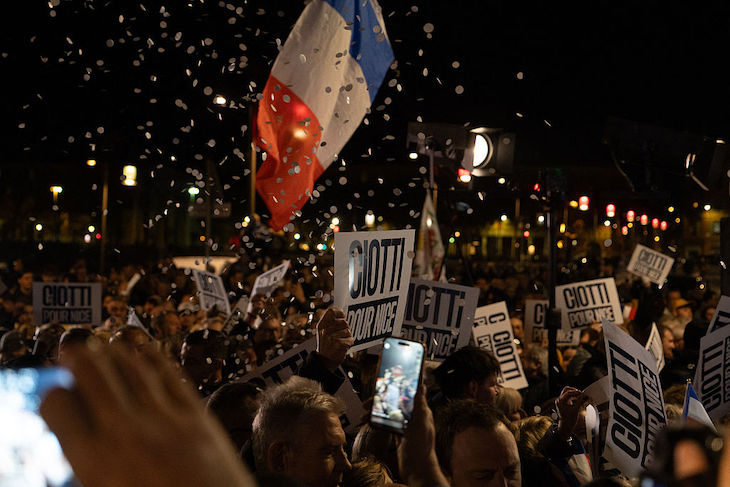
‘Old France’, as personified by Marine Le Pen’s National Rally and the centre-right Republicans, enjoyed much more success. The National Rally were thwarted in their attempt to win the Mediterranean cities of Nimes, Marseille and Toulon, but their ally, Eric Ciotti, is the new mayor of Nice and they also took control of Carcassonne, Castres and Montauban, to go with their victory in Perpignan last week.
The Republicans won the cities of Besançon, Brest, Limoges, Cherbourg and Clermont-Ferrand and a host of villages and towns across the country. Their leader, Bruno Retailleau, attributed the party’s success not just to the strength of their candidates but also the ‘shameful alliances’ concocted on the left.
‘We remain the leading local political force in France,’ added Retailleau.
Retailleau, who will run for president next year, declared on Sunday evening that his party’s strong showing demonstrates that there is another option for voters.
Describing it as a ‘demanding path’, Retailleau said it was for those voters who ‘want neither the social chaos towards which LFI is leading us, nor the fiscal disorder into which the RN’s economic programme would plunge us’.
The problem for the Republicans nationally is their reputation. Like the Tories in Britain, they ran France for years (from 1995 to 2012) and in that time immigration, insecurity and deindustrialisation become institutionalised. Emmanuel Macron has failed to tackle any of these issues.
That is why future elections in the Republic are less likely to be between left and right and more a confrontation between LFI’s ‘New France’ and the National Rally’s Old France.