For some years now Private Eye’s ‘Dumb Britain’ section has been regaling its readers with examples of contestants giving ridiculous and risible answers to questions on television quiz shows. You know the kind of thing, the fabulously stupid things people say when asked, say, who succeeded Henry VIII as the king of England – with David Lammy on his 2008 Mastermind appearance responding ‘Henry VII’.
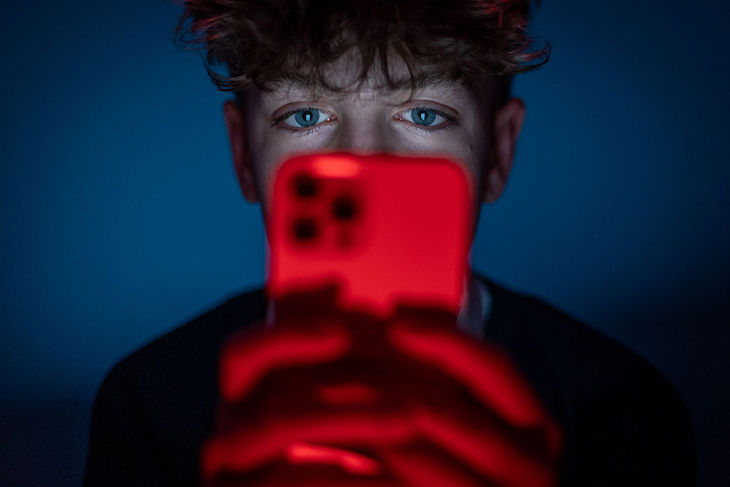
It’s no wonder you see people neurotically clutching these devices all hours of the day
Yet we might not be laughing for much longer, and Private Eye might be forced to jettison that column altogether, if we are to believe Jeremy Vine. Writing in the new edition of Radio Times, the former Eggheads presenter warns that the television quiz show’s days are numbered, because the smartphone is killing off our willingness or capacity to retain information and store general knowledge.
The forthcoming demise of the TV quiz show format, cautions Vine, will be symptomatic of a far greater and graver malaise. ‘The more we lean on smartphones, the dumber we become,’ he writes. ‘For people born after 1990, the idea of knowing something is the same as knowing where to find it. Extend the analogy, and someone with a mobile needs to know nothing at all.’
He is right of course. It’s obvious, because we have seen what has happens when we outsource our brains to technology. In the wake of the pocket calculator having become commonplace in the 1970s, more than one generation of human beings has become functionally innumerate. With the subsequent dawn of contactless payments in a virtually cashless society, many today have barely any concept of numbers.
After calculators came computer spellcheckers or other writing aids. The upshot of that development is that most of us never have to look up ‘narcissism’ or ‘liaison’ or know intuitively the difference between ‘principle’ with ‘principal’. Thanks to ChatGPT and even newer advances in AI technology, many people are hardly composing essays or articles by themselves at all. The result is a colloquial English that is becoming more bland and more homogenous. Lazy methods, unsurprisingly, are begetting lazy prose.
The advent of the smartphone has accelerated the whole trend. In the name of convenience, in bestowing our cognitive processes to machines, we have rendered ourselves both more stupid and more dependent. What with the use of paper maps having plummeted, and the custom of planning long journeys in advance also having disappeared, many have no sense of direction, no feeling for the topography of where they live, or indeed any notion of where they happen to be.
This was brought home to me when an acquaintance recently came to my town on the East Kent coast while house-hunting. He seemed to like the place, and other places he had visited nearby, yet it soon became apparent that he had little idea whereabouts in England he actually was. His whole journey had been enabled and performed by his Satnav and his smartphone.
The same goes for those who travel abroad, taking them from one identikit airport to another, having had their whole schedule prepared for them by electronic proxy. The consequence is that, presented with a globe, most wouldn’t be able to point to where they had just been. This new reality is made abundantly clear on Richard Osman’s House of Games, a television quiz for global-trotting celebrities who invariably haven’t the faintest idea where to identify on a map Cyprus or Stockholm or even Leicestershire (let alone know how to spell it).
Smartphones have had a similar effect on foreign language learning, with many travellers assuming they can by-pass the laborious method altogether. Google Translate has become the first and last resort for most. Thanks to this invention, and thanks to other advances in technology over recent decades, a growing swathe of the population are not only innumerate, illiterate, ignorant, uninformed about the world around them and unaware as to where they actually are, but can’t even say ‘good afternoon’ in Spanish.
This dumbing down process is not only depressing and concerning, given that ours has already been dubbed the first ‘post-literate’ society, the temptation to outsource the human brain is also one fraught with peril. The ultimate problem is that once this surrogate technology is removed from your hands, once you misplace or break your smartphone, you are rendered dangerously vulnerable. You won’t be able to find your way home if you’re lost, speak to a local if you need urgent help in a country where not everyone speaks English. You won’t be able to phone home because no-one knows any telephone numbers by heart anymore.
It’s no wonder you see people neurotically clutching these devices all hours of the day. One of the few remaining autonomous, fully-functioning parts of their brain is constantly telling these people that they would be lost without them – literally.