The Farrer by-election is more interesting than we first thought. Triggered by the resignation of former Liberal Leader, Sussan Ley, the regional area is stuck in a broadly conservative race (with Labor abstaining) between the Nationals, Liberals, One Nation, and a Climate 200-backed independent. No, we are not going to bother talking about the Greens.
Farrer is a New South Wales electorate which includes Albury, Corowa, Griffith, Wentworth, Leeton, Narrandera, Hay, Balranald, and Deniliquin and has long been considered a ‘safe’ conservative seat held by Ley since 2001.
Normally, that would mean a copy-paste by-election for the Liberals against perfunctory rival campaigns. This time, there are significant complications.
The first is the natural leaning of the seat toward the independent candidate whose political message might broadly be included in the ‘Teal’ phenomenon. For this, and other reasons, there was a 10 per cent swing against Ley at the previous May 2025 federal election. How much this had to do with fatigue from Ley being in the role for long is debatable. Prior to Ley, the seat was reliably held by the Nationals.
This swing is dangerously recent history for the Liberals. Since then, the Coalition has split twice while both parties have new leaders. Did this civil unrest create concern or relief at a community level?
Nobody knows.
Indeed, the entire vote split of the last election could be unusually irrelevant due to the rise of One Nation displacing major party dominance and collecting other conservative minor parties into its fold. This looming orange voting bloc could also harden the preference discipline of left-leaning voters who, at least according to one poll, say they will put One Nation last (64.1 per cent of those polled). This means One Nation may end up being the most popular party on election day and still lose out on the preference count.
When it comes to preselecting their replacement for Sussan Ley, the Liberals have dragged their feet. It wasn’t until Sunday, March 15, that they announced Albury councillor and senior lawyer Raissa Butkowski. Ms Butkowski managed to fend off Ley’s former staffer, Lachlan McIntyre (who had been a favourite) with the numbers 36-27.
The Albury City council says of Ms Butkowski:
‘As a community lawyer, Raissa has dedicated her career to advocating for disadvantaged people and communities, particularly in the areas of family violence and civil law, to ensure timely access to services and justice. Raissa believes in the power of community and that every voice, regardless of background or circumstance, matters.’
When it comes to the Nationals, they are trying a different approach with their candidate Brad Robertson. He is a former military commander with decades in the service who seems handpicked to court the farming areas with a focus on healthcare and water management. It is also reported that he is a board member of the Albury Wodonga Regional Cancer Centre Trust Fund.
‘We want to protect our food and fibre industries. If you go out and you tell people what to think, you’re not engaging in a proper conversation. This region especially will see through that.’
There’s even a bit of ‘returning to form’ vibe with the Nationals reminding the area that they did a great job governing the seat before the Liberals came along. Even though Taylor and Canavan appear to be a better match for Coalition leaders than Ley and Littleproud ever were, we can expect the Nationals to put up a fight for these areas against their parliamentary partner.
The hope here is obvious. A Liberal candidate pitched at the towns and a Nationals candidate pitched at the rural areas with strict preference flows between the two. No doubt they hope to out-compete both One Nation and the independent. The obvious problem with this plan is that neither candidate, on their own, appeals to the region broadly.
Which brings us to the Independent and One Nation.
Michelle Milthorpe is often casually referred to as a ‘Teal’ because she is backed, in part, by Climate 200 which is famously associated with the rise of the Teal movement that devoured wealthy city Liberal seats during the height of Net Zero moral panic.
This doesn’t fit as well with Milthorpe and she has dismissed the association.
No doubt conscious of the fact regional areas have far less love for the Renewable Empire, you won’t find any Teal shirts on the ground. Milthorpe’s supporters wear orange, which is a bit confusing with One Nation in the mix. A spokesperson defended this colour choice as having being ‘used by independents in the past’. The colour was also used by them at the previous election and is part of the dark-teal/orange colouring of their site. Will it confuse those who intend to vote One Nation? Probably not. One Nation has more than colour recognition – it has brand recognition – and let’s not forget, confusing colours can go both ways. A few Teal-leaning voters might be put off.
Thanks to the fabulous supporters from Albury who came out for my launch and thank you barbecue a the river today. I have been blessed with the most fabulous people to spend time with!
If you want to join the crew:https://t.co/zmjIkOZnRf pic.twitter.com/4MSTX5gDmJ— Michelle Milthorpe (@michelle4farrer) April 6, 2025
When asked by Region if it the ‘Teal’ comparison was ‘fair’, Milthorpe replied:
‘I think it’s unfair. I don’t have one donor. There are about 33,000 people who donate to Climate 200. It’s essentially a GoFundMe page that happens to have a name people don’t like. Everyone can see what was spent on my campaign last time. I think it would be good if people reported that the Liberal Party spent, on average, $1.3 million per electorate, and the Labor Party more than a million. I’d like to see people scrutinise where every candidate gets their funding, not just me.’
As for a point of difference with the city Teals, she added:
‘Our region and electorate are completely different to those inner-city seats .. our thinking wouldn’t align on some things. They don’t recognise the burden renewable energy places on regional areas, or that stripping productive use and putting it into the environment without safeguards is harming our communities.’
That said, the renewable policy plan clearly states a transition to renewables which will, whether it is Farrer or a different seat, require the regions to suffer the burden.
Many of the mission statements are vaguely progressive. Her position on regional health, education, funding, and transport compete almost indistinguishably with the Coalition, with the main difference coming under the banner of immigration. The policy directly encourages targeted immigration to regional communities. ‘Strong protections for migrant workers’ and ‘clear pathways to permanent residency’ are two pitches likely to raise alarm bells if the other candidates manage to point them out.
The point of weakness for the independent is renewable energy. Where this is a strength in rich inner-city enclaves, people in Farrer are facing the prospect of renewable energy ruining their farms, land value, safety, and peace. Softening the blow with the promise of extra community benefits and the illusion of having a ‘voice’ may flip those voters who feel they have no choice and this will give them the best chance at getting something out of the nightmare.
Mind you, it might be hard for Milthorpe to run the line: ‘Opposing new fossil fuel projects that are inconsistent with Australia’s emissions reduction goals!’ when regional areas have been given a clear demonstration that Australia must immediately expand fossil fuel capacity to ensure national security and self-sufficiency. The timing could not be worse for an anti-fossil fuel message.
That just leaves One Nation and their substantial (though unproven) poll position of 28.7 per cent position under candidate David Farley.
This is not a perfect poll, not least because the 9 per cent from Labor has to go somewhere…
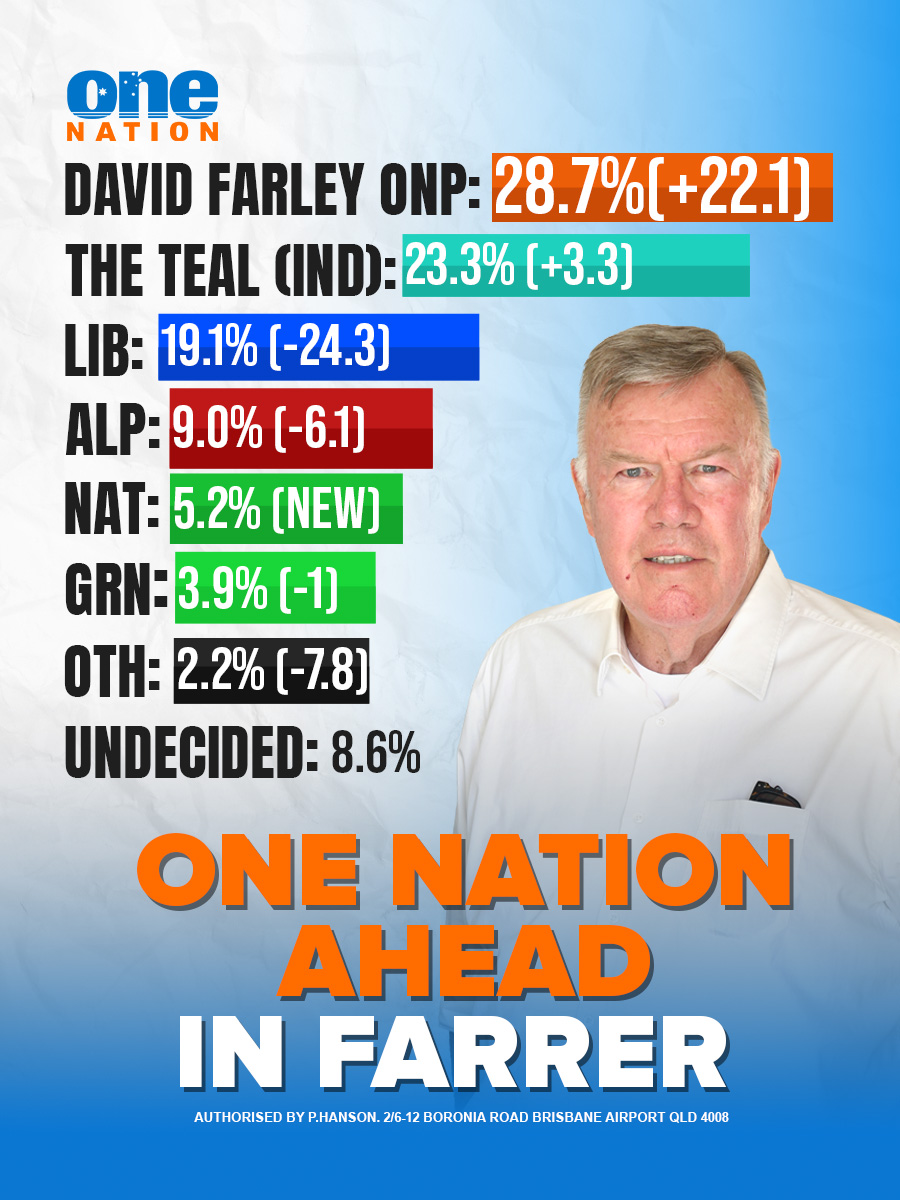
David Farley defeated two other One Nation candidates and was announced flanked by Pauline Hanson and Barnaby Joyce.
One Nation have a lot to prove, or perhaps test, in this by-election as it will be a proof-of-concept against wild polling.
Farley is an agricultural businessman and, like Joyce, a former National. This instantly gives him a leg-up in a nostalgic, former Nationals seat.
‘It’s going to give our electorate in particular, which is so important to the nation of Australia, a chance to focus on what’s good for Farrer is ultimately good for Australia.’
His profession allows Farley to have one foot in town and the other on the farm. This may help overcome the ‘Never Nationers’ pledging to put him last.
He will be helped by his focus on water security and rebuilding public services, including the hospital. ‘I think the first thing is we have to change the narrative [of water] out of an environmental asset to a sovereign asset, and then the other thing is we must address reality.’
While the independent’s anti-fossil fuel message is badly timed, the One Nation self-sufficiency and care with natural resources is perfectly placed.
Is it a war election? No. But it is an election where the state of war has direct consequences for the community. There has been a subtle change in people’s mindsets from carefree to critical of government mismanagement of resources.
Climate Change trepidation is being replaced by the coveting of natural resources.
No one can tell you what’s going to happen in this election because they do not know.
Farrer is a test case. The entire conservative movement is holding its breath.