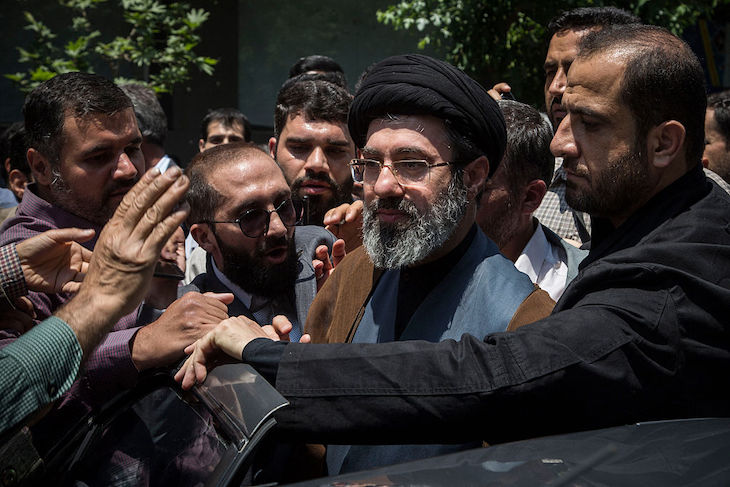
The announcement of Mojtaba Khamenei as the next supreme leader of Iran represents not only continuity in the Islamic Republic’s bloodstained rule but also an even darker turn for the Iranian establishment. Mojtaba Khamenei, the son of the late Supreme Leader Ali Khamenei, has long been associated with radical currents in Tehran. His supreme leadership, for however long it lasts, underscores that the Iranian regime will continue to be a thorn in the side of US interests.
This mythmaking and symbolism are important in the Islamic Republic
Mojtaba, who was born in 1969 in Mashhad, resembles his father physically but also experientially. His earliest memories from his childhood were of Ali Khamenei being arrested by the SAVAK intelligence service under the Pahlavi monarchy for his revolutionary activities.
During the Iran-Iraq War, the new supreme leader served in the Habib Battalion, where he developed close associations with men who would go on to play leading roles in the Islamic Republic’s military and security services. They include Hossein Taeb, who became the head of the Islamic Revolutionary Guard Corps (IRGC) Intelligence Organisation and whose residence was reportedly bombed by Israel last week; Hossein Nejat, who went onto lead the Sarallah Headquarters and commanded the IRGC’s Vali Amr Protection Unit that guarded Mojtaba’s father; Alireza Panahian, who led the supreme leader’s think tank for universities, and Hassan Mohaghegh, the late deputy commander of the IRGC’s Intelligence Organisation. This enabled Mojtaba to form his own patronage network later on, when he became ensconced in behind-the-scenes political manoeuvring in his father’s office.
In addition to this military-security network that Mojtaba built, as the son of the president turned supreme leader, he had access to not only his father but also leading clerics who would guide his religious education. They include hardline figures like Ayatollah Mohammad Taqi Mesbah Yazdi. Mesbah Yazdi believed in the absolute rule of the guardianship of the jurist (velayat-e faqih), and had no patience for the ostensibly republican aspects of the Islamic Republic’s institutions.
Mesbah Yazdi was also deeply immersed in Mahdism, with one of his publications arguing in October 2005 that “superiority of Islam over other religions is stressed in Qur’an, which calls on believers to wage war against unbelievers and prepare the way for the advent of the Mahdi and conquering world.” Mesbah Yazdi even argued Iran has the right to possess nuclear weapons. Mojtaba marinated in these ideas in his clerical education.
For decades, Mojtaba served in the shadows in his father’s office, making controversial interventions in the Islamic Republic’s electoral contests in 2005 and 2009 which sparked backlash. He also liaised with the IRGC domestically and internationally, particularly the Basij to repress Iranian political opponents and the IRGC’s Quds Force to further his father’s grand strategy to eradicate Israel and push the United States out of the Middle East. Indeed, the US government believed in 2019 that Ali Khamenei had “delegated a part of his leadership responsibilities” to Mojtaba, when it sanctioned him. Such a revelation was prescient in the grooming of Mojtaba for this role.
Through the years, Mojtaba made enemies in Iran’s system. Leaked documents in 2023 depicted the IRGC’s commander in Fars Province complaining about his intervention in state affairs. More recently, reports circulated that the Secretary of the Supreme National Security Council (SNSC) Ali Larijani, who has long been considered a more pragmatic, administrative mainstay of the Islamic Republic, was lobbying against Mojtaba’s selection as supreme leader, with an eye on his brother, the chairman of the Expediency Council Sadegh Amoli Larijani, as a potential supreme leader himself.
But the Habib Circle, filled with influential Islamic Republic players, provided Mojtaba with a base of support that spearheaded his rise as supreme leader. At times, with certain IRGC commanders complaining about him, Habib Circle members like Hossein Nejat defended him as being a master troubleshooter. The late commander of the IRGC’s Aerospace Force Amir Ali Hajizadeh allegedly bolstered Mojtaba during a tense meeting, saying: “I personally appreciate the help of Haj Agha Mojtaba’s office in overcoming the problems of the air force, both in the supply sector and also…in obtaining better results.”
Actors like Speaker of Parliament and former IRGC commander Mohammad Bagher Ghalibaf, with whom Mojtaba was close and once secretly supported for president in 2005, have also advocated for him to assume the supreme leadership. Ghalibaf has been protected by the Office of the Supreme Leader for years, especially by Mojtaba. Ghalibaf, as an ambitious actor in Iran, thus stands to gain with Mojtaba ascending to the supreme leadership.
With Mojtaba becoming the third supreme leader of the Islamic Republic, his rise mirrors his father’s. In June 1981, Ali Khamenei was injured in a bomb blast. Soon after, his supporters began referring to Khamenei as a “living martyr.” That propelled his elevation as president which then gave him a platform to become the second supreme leader. Fast forward to 2026, Mojtaba is also assuming the office with a reported injury and after losing his father, mother, sister, wife, and other relatives to a US strike on the Supreme Leader’s compound in Tehran. This mythmaking and symbolism are important in the Islamic Republic.
Mojtaba has maintained a low profile
Mojtaba represents continuity in ensuring his father’s bloodthirsty legacy lives on. His appointment being aggressively pushed by elements of the IRGC may make him beholden to them; yet unlike others, Mojtaba’s patronage network cultivated over years of his father’s rule provided him an independent power base that could allow him to consolidate power more quickly than other contenders. Publicly, Mojtaba has maintained a low profile. Apart from photos of him appearing at state parades, he has not been a feature on Iranian television, with only one video clip of him speaking first surfacing in 2024.
In the end, Mojtaba’s tenure will be shaped by the early experiences absorbing conservative theology and governance coupled with later traumas soaked in grievance and revenge. This toxic mix, coupled with his youth, positions him as a dangerous actor in Tehran.