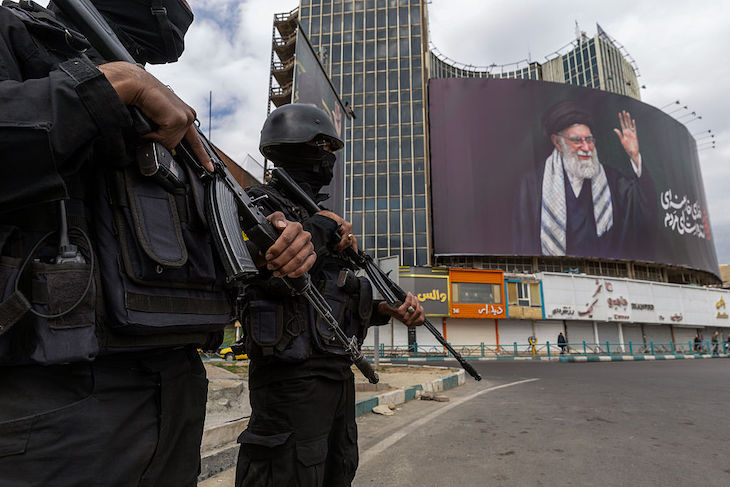
According to the old Farsi proverb, if you want a peacock, you must suffer the hardships of travelling to India. In other words, be careful what you wish for. This is good Persian wisdom that Donald Trump and Benjamin Netanyahu should remember before they declare job done and crown themselves the liberators of Iran.
Most Western military action since World War Two has involved hubris followed by nemesis
This might end up a fabulously judged operation, a clinical set of strikes that decapitated the regime, allowed the Iranian people to rise up, and ushered in a new era of peace and democracy. This would be a fabulous result, and if it happens then Trump deserves all the Nobel prizes he wants.
But it would be unwise to assume this benign outcome is inevitable, and plan only on that basis. Most Western military action since World War Two has involved hubris followed by nemesis. There are a few examples of the opposite, and one – though it is too early to tell for sure – may be the recent US action in Venezuela. The risk is that Trump may have drawn the wrong lesson from his success there, allowing a President who was wisely shy of military adventures in his first term to stumble into the mother of all military adventures in his second.
The mishaps often occur when the military action is taken on the basis of false assumptions about the adversary. And Trump has said much to suggest at best a partial understanding of the Iranian regime.
First, this is a regime focussed entirely on its own survival. It lives in constant fear of regime change, long convinced that the US and Israel were plotting its overthrow. Throughout my time in Tehran, I struggled to understand and anticipate the regime’s decisions, until I put them all through the prism of regime survival. Then it all came into focus – this is, of course, a theocratic regime, and an ideological one, but these and everything else is subordinate to ensuring the regime stays in power.
Almost anything can be jettisoned for this goal – numerous shibboleths have been toppled already. The regime’s continuing claim to be the champion of the poor is laughable. Khomeini’s foreign policy dictum of ‘neither east nor west’ is long dead. So is his characterisation of the House of Saud as Iran’s ‘eternal enemy’.
Only two of the core tenets of the revolution remain in place – the concept of ‘velayat-e Faqih’, the idea of a leadership that combines both religious and political authority; and the absolute opposition towards Israel, ‘the Zionist entity’. Both were embodied in Khamenei, who made up for his relative lack of religious credentials (he was not even a proper Ayatollah when he inherited the role from Khomenei) with an unyielding hatred of Israel. With Khamenei dead, we might find even these two eternal revolutionary axioms less immutable than before.
Because the regime is ultimately about its own survival, it is also basically rational in its decision-making. Characterisations of them as evil or mad serve a rhetorical purpose, but risk misunderstanding their motivation.
This doesn’t mean their decisions are smart, or the ones we would make. One example of this is their doctrine of defence in depth. What looks to us like support for terrorism is to them an investment in leverage and deterrence. Until Israel’s remarkable take-down of Hezbollah, the Iranians thought they had a dagger at the Israel’s throat.
With Khamanei gone, the Revolutionary Guard might decide that they will run the country themselves
Now that Hezbollah is defanged, Hamas is down if not out, and Assad is both down and out, the Iranians were already feeling exposed. Add to that assassinations in the heart of Tehran, last June’s air strikes, huge street protests stopped only through tens of thousands of protesters being shot, and now these strikes and the death of the Supreme Leader, and the needle on the ‘under threat’ dial is off the scale.
Under extreme pressure their behaviour gets less predictable – as recent days have shown, they can sometimes choose to lash out and escalate. The greater the pressure, the more internal tensions lead to bad decisions, like spraying rockets around the region in response to the US and Israeli strikes.
Part of this is because ‘the regime’ is not a homogenous group taking decisions in an orderly way. It is far more organic and chaotic than that, with complex, fraught internal regime politics playing a huge role. There are clerics, bureaucrats, elected politicians and the IRGC (Islamic Revolutionary Guard Corps). Within each there are factions and groups. And their interactions are hard for them to understand, let alone us.
Decision-making in the Islamic Regime was once described to me as ‘groups of old men with beards drinking tea in each other’s houses’. Less situation room, more sitting room, but with more chaos, paranoia and back-stabbing. The levels of internal conflict have gone up over recent years and with each wave of popular protest, and as a consequence the quality of regime decision-making has gone down.
Khamenei’s death obviously throws all this up in the air. But despite being Supreme Leader for 36 years, Khamenei was less all-powerful than the title suggested, and the regime will not just shut up shop without him. Its every instinct will be to find a successor and carry on.
The hope – so vividly expressed by Trump and Netanyahu – is that a restive and angry population will rise up and stop them. Given the choice, a healthy majority would definitely sweep the regime away, which makes the post-Khamenei situation deeply unstable. But it is only weeks since the streets ran with the blood of protestors, and they know that the regime will not have got any less ruthless in its determination to stay in power.
Despite being Supreme Leader for 36 years, Khamenei was less all-powerful than his title suggested
The real challenge is that the Revolutionary Guards, and the huge paramilitary Basij force that report to them, are heavily incentivised to stay loyal. They control vast chunks of the economy and make huge profits from sanctions-busting. They have a near monopoly on coercive force inside the country, and so their interest lies in supporting the status quo.
In time, it might be possible to find a negotiated way forward, between the US and the leadership of the post-Khamenei regime. President Trump is already hinting at this possibility. Both sides would need to tread with care – the Iranian side will start from a position of huge mistrust in US intentions; the US would need to secure a watertight deal that did not sell the Iranian people down the river, and not accidentally give the Iranian regime a new lease of life. But it might save a lot of bloodshed, and could just set Iran on a better course.
If there is a change in regime, it might not be for the better. With Khamanei gone, the Revolutionary Guard might decide that they will run the country themselves. We could end up with an even-more militarised version of the Islamic Republic, no more democratic or peace-loving in its world-view, and potentially even harder to dislodge.
I earnestly hope this is not the case. I loved my years in Iran, and pray that the Iranian people finally get the government they deserve. But if they do not, then either we will be leaving them to the next incarnation of their current rulers, or we will need to do more than just bomb the regime from above. And both of those are terrible options.