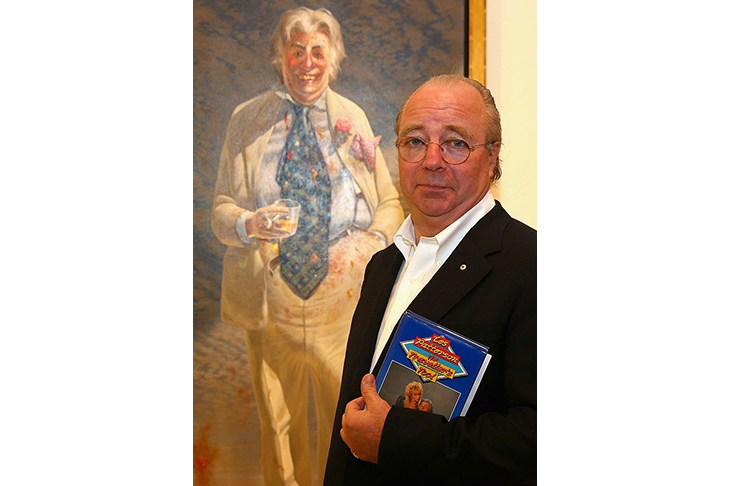
In a recent speech, artist Tim Storrier made a powerful attack on the current state of arts administrators in Australia, arguing that Australian intellectual life and forms of artistic expression are increasingly dominated by ‘a shift away from aesthetic judgement and towards ideological alignment’. This shift ‘has not occurred in isolation. It reflects the growing influence of ideological frameworks that prioritise identity grievance and power relations as the primary lens through which culture is interpreted’.
Tim’s main focus was the rise in antisemitism partly due to the influence of Marxist or radical left-wing thought among arts administrators. But Storrier also noted that the Australian cultural circles have been heavily influenced by the growing representation of women in the arts community and identity issues within the indigenous community. While his main concern was the decline in standards within the artistic community, his comments apply to almost every aspect of intellectual debate within Australia. We see this in the way that Australian governments at all levels are singing from the same song sheet when it comes to, not only arts grants, but to all forms of cultural expression.
According to this view, what is acceptable art must conform to the prevailing view of Australian history. This entails a firm belief that a rich culture which had existed peacefully for 65,000 years was destroyed by the sudden arrival of rapacious white men. The idea that the ‘world’s oldest continuous culture’ is here today and is still thriving is the sort of nonsensical claim that rivals the distortions that are routinely spouted by the North Korean government about the achievements of their beloved leader. The parallels are not only to be found in the banality of such claims but in the unthinking acceptance of this nonsense due to the overwhelming ideological unity of the various branches of the North Korean and Australian governments. Thus the Australian education systems, the major government broadcast systems, and numerous quasi-government bodies such as the arts grants mafia, stifle any genuine debate about the nature of contemporary life in Australia.
Consider the claim that the people who first walked to Australia around 65,000 years ago, before it became isolated due to rising sea levels, have a direct connection to the current indigenous population. We hear this nonsense spouted on a daily basis and no one has the temerity to question it or even to explore in detail some of the issues which are central to this idea.
Instead, all government and quasi-government organisations support this claim. A fairly typical example is that of the Aboriginal Heritage Office, an award-winning partnership of five local Sydney councils working to protect Aboriginal sites and promote Aboriginal history and heritage in each council’s area. The description of pre contact Aboriginal groups around Sydney is infantile and paints a picture of a prelapsarian utopia. We are told that ‘resources about them were so abundant, and trade with other tribal groups was well established. Moving throughout their country in accordance with the seasons, people only needed to spend about four to five hours per day working to ensure their survival. With such a large amount of leisure time available, they developed a rich and complex ritual life – language, customs, spirituality and the law – the heart of which was connection to the land.’
There are thousands of equally tendentious presentations of pre-contact Aboriginal lifestyles online which all make no effort to seriously examine who the people who made the journey from South East Asia into northern Australia were, and why they came.
A similar migratory pattern occurred in the Americas. It began approximately 35,000 years after people first arrived in Australia but it had a somewhat different history. The people who populated the western hemisphere walked across the Bering Strait which formed a land bridge between Siberia and Alaska. As with the first Australians, no one knows who they were and why they made such a hazardous journey. But, by 1492, when Columbus arrived in the Americas, the population of the western hemisphere was about 50 times that of Australia, despite their ancestors having arrived on the continent 30,000 years after the first Australians.
Presenting a completely fictitious account of pre-contact Aboriginal society serves no useful purpose. The first Australians had been here for 65,000 years when Captain Cook arrived. The Americans had, in less than half that time, created great civilisations such as the Inca and Aztec societies. Interestingly, the population of North America around 1492 is estimated at 20 million while that of South America is estimated at 30 million. Because the migration was from the north downwards, North America must have been populated thousands of years before South America. So why did great civilisations arise in the south while the north American Indian tribes remained (with several exceptions) mainly nomadic hunter-gatherers? The inescapable conclusion is that some populations thrive while others don’t.
The inconsistencies in rates of population growth between the Americas and Australia can probably be explained by the relevant food resources but that only goes part of the way. If we are to believe the Aboriginal Heritage Office claim of ‘abundant resources’ then why were there so few of them and why did their numbers grow so slowly?
The Malthusian correctives of ‘war, pestilence and famine’ were what must have prevented the growth of the Australian population. Far from being a utopian paradise full of well-fed, deeply spiritual citizens, pre-contact Australian society was populated by a malnourished people with a high infant mortality rate who, according to the paleoanthropological evidence, were frequently at war with one another.
The problems that Storrier identified in the arts are just as prevalent in every branch of government. He asks what can be done and concludes ‘very little in the current political environment’. I share his pessimism but believe that the Voice debacle suggests the majority of Australians are sceptical of this woke ideology. Common sense will prevail.
Got something to add? Join the discussion and comment below.
You might disagree with half of it, but you’ll enjoy reading all of it. Try your first month for free, then just $2 a week for the remainder of your first year.