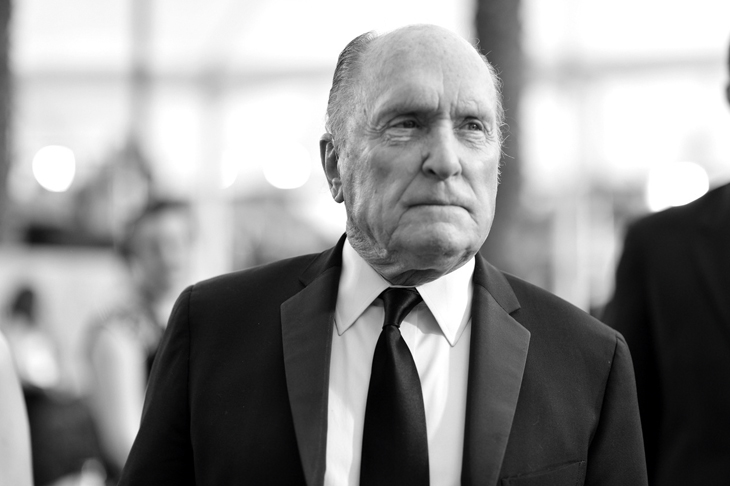
The death of Robert Duvall the other week was a reminder of how long ago some of our cultural landmarks are. It’s easy to forget that Duvall made his screen debut in that extraordinary non-speaking role of Boo Radley in To Kill a Mockingbird and he captures (with a full head of hair) the sublime innocence of the figure he plays in a performance which in a minor key is as crucial to the impact of the picture as Gregory Peck’s Atticus Finch who looks like the embodiment of the Lincolnian America which has tried to abide by a belief in justice and mercy. But Robert Duvall is in everything. He has a fistfight with John Wayne in True Grit which is a bit like Jacob in the Hebrew Bible wrestling with the Angel who is the emissary of God. And it’s Duvall’s voice that recites in the presence of the imminence of a young man’s death in his old cracked voice those words which are a new-world equivalent to Virgil’s Arma virumque cano (Arms and the man I sing). What could be more like an anthem by way of preamble than Duvall reciting the start of Moby Dick, ‘Call me Ishmael’ in Deep Impact. And what could be more of a depiction of the quest, the perdition and the transfiguration than that glimpse of grandeur.
We associate Robert Duvall with the dark side of the American genius. It’s a long time since The Godfather films changed our sense of what was possible in American cinema. For some people, including the great champion of Bob Dylan Christopher Ricks (the quickest literary critical intellect I have ever encountered, the defender of Milton, the editor of the that great shaggy-dog story, Sterne’s Tristram Shandy), The Godfather films represent the glamour of evil (or as an older translation of the baptismal vow has it) ‘the seductions of iniquity’. The very great dramatic masterpieces of Webster, such as The Duchess of Malfi, seem to fall into this category for Ricks.
And this tallies with the fact that Robert Duvall plays the consigliere in the first two of Coppola’s films, the initial one with Marlon Brando as Don Corleone and Al Pacino as the reluctant Michael Corleone, and the The Godfather Part 2 which backtracks to present Robert De Niro as the young Don. Duvall is the legal wise guy, intimate with the family, complicit with it, but not himself a mafioso of the blood. It’s a wonderful performance, so cool as it treads the waters of iniquity. Duvall is not in The Godfather Part 3, which is almost an autumnal footnote to the first two films though it has an abundant richness all of its own as the world of opera, the art of Visconti and Zeffirelli, dovetails with the magnificence of this coda. Duvall has been replaced – very elegantly – by George Hamilton. The shift in casting works but it is not steeped in blood the same way. In any case The Godfather films – of which the critic Pauline Kael thought Part 2 was the greatest – are cinema classics that still speak to us intimately, however operatic their efflorescence may be.
There are extraordinary reports of EPiC: Elvis Presley in Concert which Baz Luhrmann has put together by co-ordinating unseen footage with appropriately dynamic sound. It’s easy to forget what an extraordinary singer Elvis Presley was and the particular caressing magic he brought to so many classic songs which have become part of the air we breathe. Luhrmann has performed an extraordinary feat of reanimating the spirit of Elvis at the height of his powers. Gone is the sweaty overweight has-been. This is documentary restitution at a level of recreative art. And it reminds us of how terrific the music and the performances were.
The great Elvis songs are myriad and multifaceted. You can be in a supermarket and be suddenly and unexpectedly transfixed by that voice singing ‘Love Me Tender’ or ‘Wooden Heart’. It’s just too easy to reduce him to the stumbling figure of his decline. Someone – was it the poet Robert Lowell? – said that Bob Dylan had a Caruso voice and if he meant singularity and unique expressiveness he was right but with Presley it’s as if the world of music, the world of performance was simply there waiting for him. And if the films can seem corny – Jailhouse Rock and Blue Hawaii and the rest of them – that’s because they were frames on which to hang the dazzling beauty of the singing. And it’s interesting to put Elvis alongside another supreme cult figure of the 1950s. Recently we watched Giant the Texan epic from the Edna Ferber novel with Rock Hudson and Elizabeth Taylor. Certainly big stars who do everything they need to. But the extraordinary moment is when the young guy with his hat pulled down pulls it up and we realise this is the revelation of James Dean. It’s as distinctive a moment as the one when the unheard-of Brad Pitt appears in Thelma and Louise and we have eyes – momentarily – only for him. James Dean is also in East of Eden, Elia Kazan’s film of the last movement of Steinbeck’s novel which has the great Raymond Massey as the patriarch. Kazan got into trouble in the Fifties for naming names in the McCarthyite period of anti-communist purges and – in quite recent memory – there were actors like Nick Nolte who would not get to their feet when he was honoured by the Academy. His granddaughter Zoe Kazan is producing a streamer of the whole of East of Eden which is to feature the staggeringly talented Florence Pugh who in the television version of The Little Drummer Girl ensured that her performance would rank with the greatest feats of acting in the le Carré canon – up there with Hugh Laurie and with a more difficult vehicle.
It’s funny, though, the way a great film can burn in the mind, sometimes more than the original that inspired it. David Stratton’s favourite film was the John Ford/Henry Fonda version of Steinbeck’s Grapes of Wrath.
But the thought of Elvis as integral to music recalls the Omega Ensemble’s Starburst concert on February 18 at Melbourne Recital Centre with pianist Vace Jambazian giving a virtuoso rendition of Shostakovich’s Concerto in C minor for Piano, Trumpet and Strings, together with David Elton (of the SSO) on trumpet. In a superlative auditorium you knew you were listening to some of the better musicians in the world.
Got something to add? Join the discussion and comment below.
You might disagree with half of it, but you’ll enjoy reading all of it. Try your first month for free, then just $2 a week for the remainder of your first year.