My libel nightmare all started in a little Oslo bookshop – but amid the whirlwind of horrible scandals and atrocious wars that is our world today, this is a very small but troubling manifestation of our crazy times. A day ago, my attention was drawn to a photograph posted on X that showed a Norwegian bookstore of the Norli Bokhandel chain, where the staff had organised a display entitled ‘Epstein Island Guest List.’ I was horrified to see that one of my books was included. I have never been to Jeffrey Epstein’s island, never flown on his planes, never visited any of his properties, and – most crucially – never even met him or communicated with him. When alerted, the book chain immediately removed my book before legal action was required and apologised in person and online: ‘We realise this was defamatory and libellous. Simon Montefiore never met and never communicated with Epstein, never flew in his planes nor stayed in his houses. We apologise unreservedly.’
I would have never known about this if it had not been posted on social media, but because we live in a lawless arena of algorithmic provocation, perpetual conflict, self-confirmation and moral hysteria amid a wild and irresponsible digital vortex, the picture went viral and had been seen by many people. As the great Mark Twain supposedly wrote, ‘a lie travels round the world before the truth can even get its boots on’, and these days, it seems that a lie can circumnavigate the planet if not transcend the galaxy many times before we even know it, yet alone stop it. For a terrifying moment I was lightly touched by the poisonous tentacles of Epstein. For a second I sensed the flitting of that sinister shadow.
The origin of the libel was that I was listed in Ghislaine Maxwell’s address book that she supposedly shared with Epstein. I knew her decades ago – though, as I say, I never met or communicated with Epstein. But the story has a bizarre tale within it that is itself as preposterous, unlikely and moronic, even farcical and clownish, as it is vicious and malignant. It all started not in Oslo, not in a bookshop, and not in the labyrinthine Epstein conspiracies of Manhattan plutocracy.
It started in the life of Josef Stalin.
It is, in its way, like the X postings of the bookshop display, a manifestation of this age of self-righteous witch-hunts, online bullying, digital illiteracy and historical ignorance, where intolerant neo-Marxist ideologies are resurgent.
To explain, I need to go back a bit.
When I started writing history books, I first wrote about Catherine the Great and Potemkin, the two titanic 18th century Russian leaders who were lovers but also effective imperialist rulers. After it achieved some success, Catherine and Potemkin temporarily won me the favour of the new, supposedly reformist president of Russia, Vladimir Putin, who – as we now know – had a special interest in how Catherine and Potemkin conquered Crimea and Ukraine. I was offered the chance to be one of the first to work on Stalin’s own papers, and I wrote Stalin: The Court of the Red Tsar, an account of his tyrannical court during the height of his dictatorship starting in 1929 and ending in his death. While I was in the archives, I noticed that there was fascinating material on the youth of Stalin that no one had shown much interest in. Trotsky had famously called Stalin ‘the preeminent mediocrity in the Communist party’, and others called him a ‘grey blur’, but now I realised that his conspiratorial career in Georgia and afterwards in Russia itself was anything but mediocre. I resolved to write Young Stalin, but Putin, who had now emerged as an autocrat himself, hated my portrait of Stalin as a murderous red tsar. Falling out of Kremlin favour after a very short period, I lost my access to the Communist party archives. Fortunately, I had collected most of the material, and I was able to add to it by accessing the Georgian archives too.
Anyway, the result, Young Stalin, was published in 2007. It revealed Stalin’s life as a fanatical Marxist and underground activist, based on much new material that among other things showed his early ruthlessness and acumen, selfishness and egotism, Marxist conversion and Leninist devotion, his prolific love life and careless abandonment of family and children and his role in the most famous bank robbery in pre-WW1 Europe: the 1907 Tiflis heist that won Lenin massive funds but also killed over 40 passersby. (In fact, much went wrong. Such was the outcry that Stalin had to leave Georgia forever. It also turned out half the banknotes were marked, which led to many arrests.)
Lenin divided his Bolsheviks into ‘tea-drinkers’ (bloviators and intellectuals who sat in cafes and wrote articles) and ‘practicals’ (who could lead demonstrations and assassinate enemies). Stalin impressed him because he was both. That was unusual. When Lenin was told that Stalin used violence, he said: ‘He’s exactly the type we need.’ Born in 1878 as Iosef Djugashviili in Gori, Georgia, Stalin was a brilliant organiser and master of the clandestine life. He constantly changed his name and location. Among all this fascinating material was the story of his many exiles to Siberia, his escapes, feuds with comrades and his relationships – one of which particularly attracted the attention of Marxist internet trolls in around 2019…
In St Petersburg in February 1913, just before the first world war, Stalin, 34, was on the run. He had escaped from Siberian exile and was in disguise at a gala ball to raise money for the Bolsheviks given by posh sympathisers. There, Okhrana agents arrested him. He was sent back to Siberia, in particular to a tiny hamlet called Kureika, just south of the Arctic Circle, where he would spend most of coming world war in desperate obscurity and impecunious isolation amid bleak landbound vastness. He was accompanied by another Bolshevik leader, Yakov Sverdlov, who later became the first Soviet head of state, and their two Gendarme (political police) guards. The village contained just 67 people: 38 men and 29 women packed into eight ramshackle izbas (wooden peasant bungalows). They were members of three families, and among them were the Pereprygin orphans: five brothers and two girls, the youngest of whom, Lidia, was 13. Stalin and Sverdlov hated each other and feuded. In the village, where there was hard partying and heavy drinking, Stalin boozed, danced, fished and hunted. He read Marxist pamphlets and French novels, and fought with his assigned policeman, whom he hated.
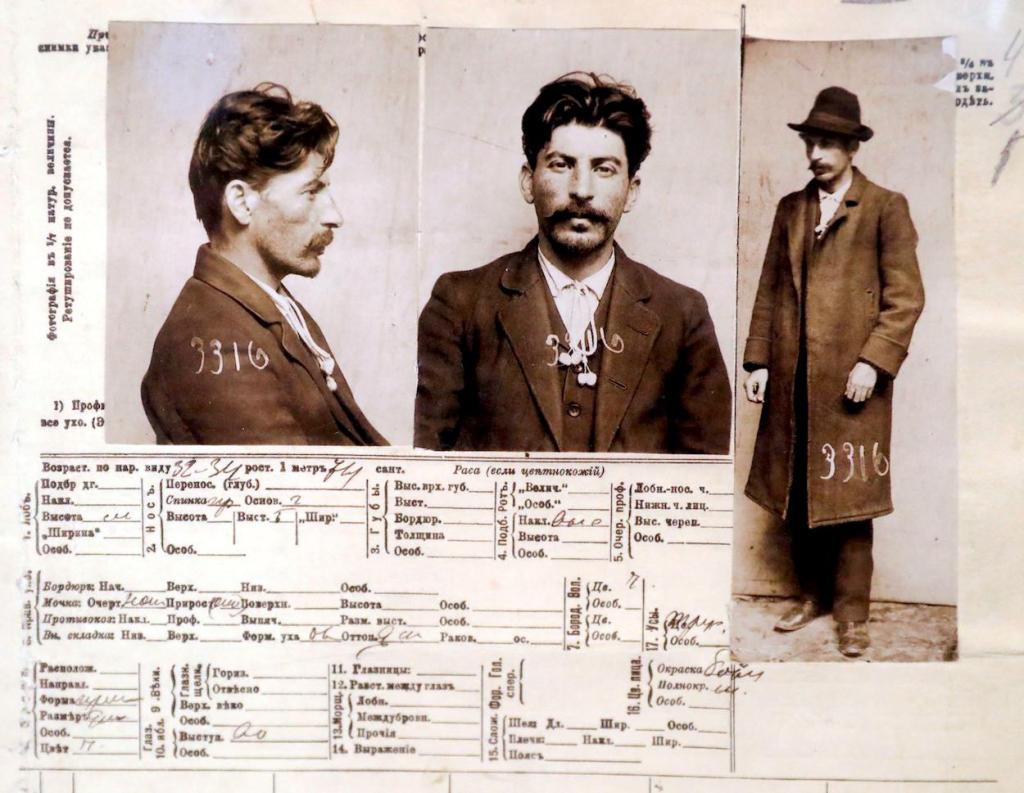 Joseph Stalin, from files of Tsarist secret police (Alamy)
At some point in the next year, he seduced Lidia. We would regard this as statutory rape. Whatever the circumstances of how this had begun, the two started to live together. On one occasion it seems that Stalin’s policeman caught them together, perhaps in flagrante. A furious Stalin chased the policeman around the village; the policeman drew his sword. There is some evidence that Lidia’s brothers disapproved of this behaviour, and no doubt so did Comrade Sverdlov… Then Lidia, 14, fell pregnant. At this, the gendarme threatened to start criminal case against Stalin for living with an underage girl, but the law in Siberia was informal: 14 was the age of consent in European Russia, but it was not specified in Siberia (nor enforced) and furthermore there was no legal concept of statutory rape. Instead, there was the concept of a crime ‘against female honour’ in the sense of a violation of a father’s patriarchal family propriety. A promise to marry was regarded as the required mitigation for this, so Stalin promised to marry Lidia and they became engaged.
Stalin came to enjoy living in Kureika. He became popular among its peasants who nicknamed him Pockmarked Oska, and he talked all his life about his hunting exploits and adventures. Sverdlov was moved to another village, and Stalin was joined by another comrade, Lev Kamenev, with whom he was at the time very friendly (in 1936, he had Kamenev tried and executed). In December 1914, Lidia gave birth to a child who died, but during 1916 she became pregnant again. Stalin prided himself on his many escapes – he called himself ‘a doctor of escapology’ and once he even escaped in a sleigh pulled by reindeer. Now he managed to escape to other villages, probably avoiding having to marry pregnant Lidia.
In February 1917, the tsar was overthrown and Stalin, along with Kamenev, was liberated. The pair headed to Petrograd, where they were soon to meet Lenin and seize power. Without ceremony, Stalin abandoned the pregnant Lidia, now 16, who gave birth in April 1917 to a son Alexander. She never told Stalin, who had vanished, and Stalin never inquired, unfettered by either sentimentality or curiosity. (He did, however, hear about the birth, and boasted to friends he had fathered a son or two in exile. He had already fathered and abandoned another son in another exile.) Lidia then married a peasant fisherman, Yakov Davydov, who adopted Alexander. As Stalin rose to power, Lidia remained in Siberia and became a hairdresser and had eight more children. Alexander Davydov became a postman, and when he learned who his father was, he was summoned by the NKVD (Soviet secret police) who made him sign a promise of secrecy. He fought in the second world war and died in 1987. His son Yuri still lives in Siberia. Years late, in 2016, DNA tests proved he was Stalin’s grandson. That is the history.
The book appeared and I went on to write other things. Then, I think around 2019, I was on Twitter after publishing my book The Romanovs, and I posted about the murder of Nicholas II. To my amazement, this sparked my first online lynching. It was a terrifying shock. A large number of Twitter accounts, usually faceless with strange names that often involved ‘Bolshevik’ or ‘Communist’ (they might have been something like ‘Bolshiebro’; they were overwhelmingly male) and had very few followers, suddenly accused me of supporting the mass-murderer Nicholas II. To my even greater amazement, they suddenly all accused me of inventing the lie that ‘Stalin was a paedophile’, which in their telling was all the more appalling because they claimed I was myself a ‘friend of the paedophile Epstein’, someone who I did not even know. The ‘evidence’ for this was that I was apparently in his ‘address-book’, which had been published somewhere. There are thousands of people in this supposed address book, including presidents and grandees, but many of the names like me had probably never met him. But that did not stop the malicious attacks. Each post featured a photocopy of my appearance in the address book with my wife Santa – my name misspelt and my telephone number wrong. Most likely, as stated above, it belonged to Ghislaine Maxwell. Anyway, message after message accused me of accusing Stalin of being a paedophile because I was myself an associate of a paedophile.
I know many of the people who retweeted this defamation were not malicious but carelessly callous
I immediately consulted media lawyers, who said I had a perfect libel case – if we could find the perpetrators. But none of the Bolshiebros had real names or jobs or addresses. We could not find anyone to sue. I was also astonished by the illiterate moronism of the entire accusation. The accusers had clearly never even bothered to read my book. If they had, they would have known that Stalin’s relations with Lidia were not the subject of prosecution, that he had become engaged to her, and that the word ‘paedophilia’ does not appear in the book. The informal rule of the land at that time was that such behaviour could be condoned if the man married the girl. I did not say this was a good law or a bad law; just that it was the practice in Siberia during the first world war. Stalin kept his illegitimate children secret and never met them and the story was only revealed in an investigation by the KGB Chairman General Ivan Serov ordered after Stalin’s death by the new leader Nikita Khrushchev. Nor was this story exclusively mine – it appears in all the post 1991 biographies of Stalin, and the DNA tests were in the newspapers in 2016. The materials, of course, are also in the archives.
My lawyer was ready to sue, but we could not locate a single malignant. The lawyer wisely advised me to block them but never to answer these trolls because any attention would help them and taint me and expand the story. Sometimes they attacked me, but more often they just discussed this imbecilic nonsense amongst themselves. The pile-on died down, years passed, but periodically it exploded again.
I once talked to a British intelligence office who believed some of these accounts were never people at all. He thought they were bots controlled by Russia, North Korea or Iran, created to sow hatred and insecurity and loathing. If so, that certainly worked with me. As the Epstein scandal has intensified in. recent months, the defamations have resurged. After the 7 October Hamas attack, the address book was used not just by Stalinist trolls but also by pro-Hamas extremists to libel me more. That is why a bookshop assistant, who had clearly seen one of these defamatory posts, decided to include my book in their ghoulish and frankly disgraceful shop display in Oslo last week. Not only was it in bad taste and poisoned the serenity of a bookshop, it included other people like me who had nothing to do with this case.
Even though in the nightmare of the last two days I have at times felt desperate, I feel liberated to be able to write this. After all these years of malignant, hurtful and libellous posts by a swarm of vicious political extremists, I am able finally to confront an actual entity – the bookshop – and they have apologised and admitted the libel. I can now finally tell his bizarre tale.
I don’t for a minute compare this storm in a teacup to the suffering of the actual victims and survivors in this case. Far from it. But it has been a long, frightening Kafka-esque ordeal over five years. A certain amount of damage is done even when things are taken down. It just shows how easy it is for innocent people to have their names traduced. The bookshop has asked many people to remove the libel, and some have done so, but many have not because very few people bother to correct falsehoods online. There is no practical remedy except the law.
I know many of the people who retweeted this defamation were not malicious but carelessly callous. I not longer use the word ‘virtual’ for what happens online: I prefer the word ‘visceral’. It makes me realise that I myself – and all of us – need to be careful: this visceral reality of the propagation of lies, contempt for truth and human insensitivity is a real danger for individuals and societies. As AI delivers better and more diabolical deepfakery, the peril is only going to get worse. This nasty little tale of libel and history also illustrates that we live in an age of internet-stoked, mob-frenzied public panics, self-righteous witch hunts and moral hysterias which, rightfully, expose the guilty but also the innocent.
A lesson I have drawn from this weekend is that I myself spend too much time on social media. I should now just get back to what I love doing: writing the books which I hope one day will appear on the shelves of a certain Oslo bookshop.