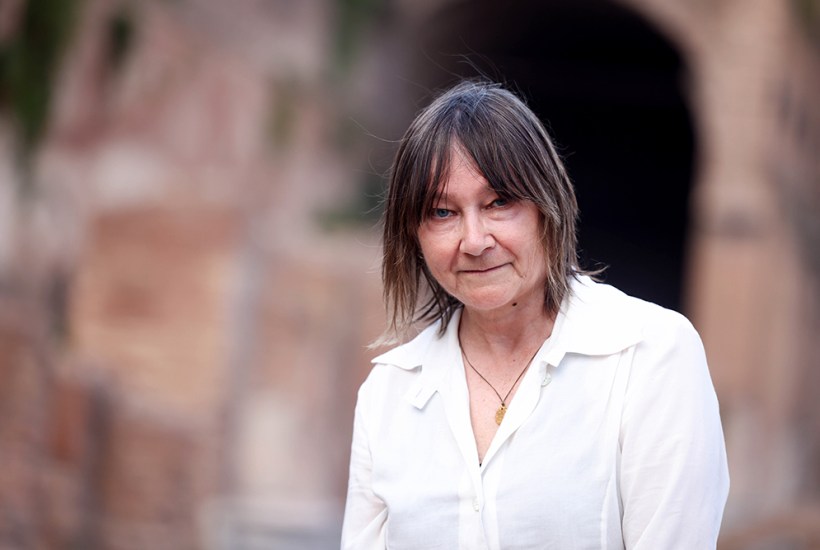
Glyph (whose sibling, Gliff, was published last year) is Ali Smith’s 14th novel and her fifth since 2016, when her ‘Seasonal Quartet’ saw the beginning of her project to use fiction to comment on contemporary events. It takes as its subject two sisters. Petra and Patricia (‘Patch’) negotiate their difficult childhood by retreating into a story world. Not that their escape is all unicorns and rainbows. The two stories they most often return to involve a horse blinded in the Great War and a man’s corpse flattened towards the end of the second world war. They call this flattened man ‘Glyph’: it’s ‘the sound he makes when he breathes out’.
We soon skate from this grim past to the grim present. The adult sisters are estranged (no reason is given) and both have recently lost their jobs – one to the advance of artificial intelligence, the other because her clothing company ‘folded’. Smith herself calls these characters ‘flat literary devices’. She is open about the fact that they exist mainly to invite commentary on the horror of Gaza, the proscription of Palestine Action and the St George’s flags ‘up on the lampposts’. Much of the novel’s political critique comes from Bill, Patricia’s adopted daughter –a 16-year-old who goes on pro-Palestine marches but declares she doesn’t know what the words ‘faecal’ or ‘colossus’ mean.
Glyph is stuffed with knowing references to Gliff – which both sisters and Bill have read. Petra declares it ‘too on the nose, politically’, while Bill likes how ‘blatant’ it is. If anything, Glyph seems to nod towards being a prequel to Gliff – a novel about the declining state of the world, before we reach the earlier book’s dystopian future. Bill rails against ‘Glyphosate’ – the pesticide which has caused ecological collapse in Gliff – and, at the denouement, a horse appears in Petra’s flat. A mysterious horse also named ‘Gliff’ stalks the pages of the earlier novel.
I reviewed Gliff when it came out and thought it fell flat: it seemed to fail to sketch its dystopian world in detail and to rely on the obfuscation of dreamlike sequences. Now I wonder if I was too harsh, as it was at least far better than Smith’s current offering. It actually attempted a plot and tried to provide interest for its readers.
Glyph does neither of these things. The story is nothing but a repeating sequence of recollections told only to make the reader nod in righteous disapproval; and the characters, if they exist as such, are as flattened as poor ‘Glyph’. Even the vaunted wordplay feels like a tired piece of ornamentation that Smith feels she must include. The novel opens with a seemingly random riff on the many meanings of ‘stanchion’, before descending into puns on song titles: Bowie’s ‘stanchion to stanchion’; the Jam’s ‘Down in the Tube Stanchion at Midnight’.
If there is any message it seems to be about paying attention; about noticing the world’s horrors around us and using fiction to hold the moment to account. It’s a worthwhile aim for literature. But I can’t help thinking that Ali Smith is no longer the person to write it.
Got something to add? Join the discussion and comment below.
You might disagree with half of it, but you’ll enjoy reading all of it. Try your first month for free, then just $2 a week for the remainder of your first year.