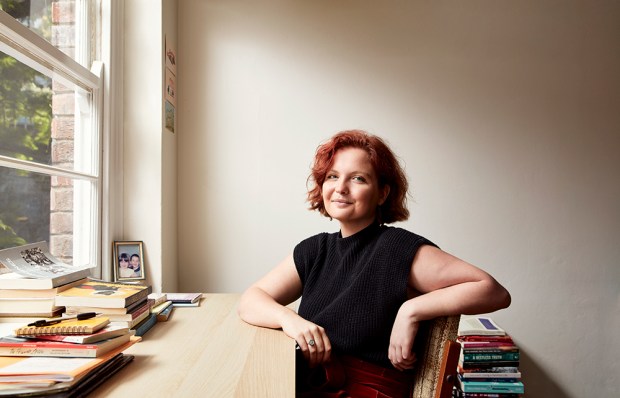
Madeleine Gray’s first novel, Green Dot (2023), was a witty account of a messy office affair, whose fans included Nigella Lawson and Gillian Anderson. Her follow-up, Chosen Family, is an altogether more expansive book. She has described it as
the result of years of thinking obsessively about two things for a long time. First, why is it that every queer person I know (including me) has a story about having an intense friendship breakup in high school that years later they realise was probably their queer root? […] Two, why do more people not choose to have children with their platonic best friends? Surely raising a child with someone you trust implicitly and don’t have sex with makes more sense than the other way round?
The novel is set in Sydney and has a dual timeline, spanning 18 years between the schooldays of Eve and Nell and their becoming parents in adulthood. In 2006, Nell
does not enjoy being 12 years old. Adults around her are always telling her that she’s too smart for her age. Nell often finds it difficult to tell these adults that they are too old to be so stupid.
Her parents are uninterested in her and she is friendless at school, since she ‘does not care for boys, or make-up, or competing to see who can eat the least’, as her peers do. Eve – who is short-haired and self-possessed – arrives at the school and Nell is fascinated by her.
In 2024, Eve is raising Lake, the seven-year-old daughter she shares with Nell, as a single parent, unsure where Nell is or even if she is alive. Eve had been bullied at school for her queerness, but now even a gay dad at the school gates considers her ‘queen dyke’. There is plenty of raunch in the novel, and no one could begrudge Eve her sexual self-actualisation; but the weakest part is the protracted middle section, when she settles into her queer lifestyle.
There is a betrayal in both timelines. As teenagers, Nell was complicit in Eve’s humiliation and withdrew her friendship. The narrative builds to revealing the betrayal in adulthood, which has led to Eve bringing up Lake alone. There is more than a nod to Armistead Maupin here; yet how satisfyingly complicated the central relationship is in this lively exploration of female attachment.
Got something to add? Join the discussion and comment below.
You might disagree with half of it, but you’ll enjoy reading all of it. Try your first month for free, then just $2 a week for the remainder of your first year.