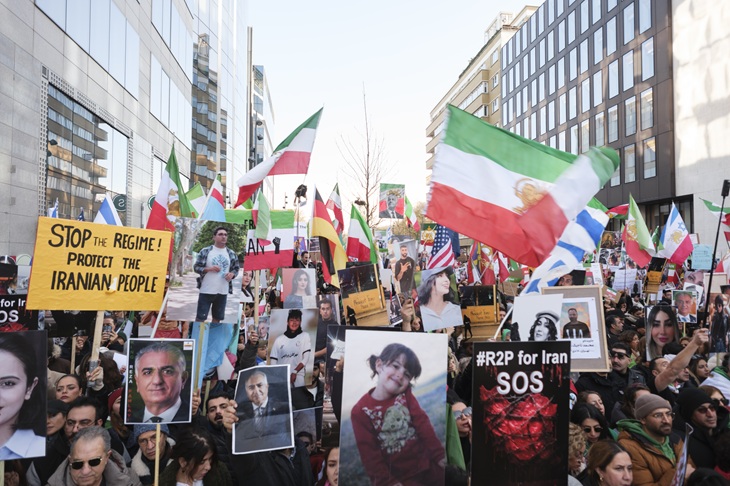
The year 2026 has marked a grim milestone in Iranian history. The recent report by The Times, estimating a staggering death toll of 30,000 protesters, is not just a statistic; it is the death certificate of ‘politics’ and the beginning of a brutal struggle for survival.
Yet, in the corridors of power in Washington, Brussels, and Canberra, the prevailing wisdom remains stubbornly attached to the doctrine of ‘non-intervention’.
The argument for inaction is seductive: ‘Avoid another Middle Eastern war’, ‘preserve infrastructure’, and ‘learn to solve it themselves’.
However, based on the bloody reality on the ground, this pacifist approach is a strategic hallucination. Today, Iran stands at a terrifying crossroads: either a targeted external intervention to sever the arm of repression, or a slide into a long, agonising civil war. Contrary to popular belief, it is ‘non-intervention’ that makes the global spillover inevitable.
The Fallacy of the ‘South Africa Model’
Advocates of non-intervention often cling to the ‘South Africa Model’ – a hope for a negotiated, peaceful transition akin to the end of Apartheid. This comparison is dangerously flawed. While the Apartheid regime was brutal, it did not execute an industrial-scale slaughter of 30,000 citizens in such a short window. When a regime crosses this threshold, it has bombed all bridges back to diplomacy. History dictates that you cannot negotiate with a machine that kills at this speed; you can only dismantle it.
To do nothing now is to repeat the catastrophe of Syria (2011) – but on a much more horrific scale. There, the world watched as peaceful protests were met with tanks. The result? A desperate population, abandoned by the world, took up arms, and the country spiralled into ruin. In Iran, silence does not buy peace; it buys time for ordinary citizens to turn into desperate insurgents.
The Global Blast Radius: Why the West (and Australia) Cannot Hide
Western leaders often view Iran’s crisis as a distant tragedy. This is a fatal miscalculation. A ‘non-intervention’ strategy that leads to a protracted Iranian civil war will detonate three strategic landmines that no border force or ocean can contain:
- A Migration Crisis on Steroids: Syria, with a population of 22 million, destabilised European politics for a decade with its refugee flows. Iran has a population of 88 million. If the West allows Iran to fracture into a Syria-style civil war, we are looking at a potential displacement of 30 to 40 million people. This is not just a humanitarian disaster; it is a political weapon. Europe’s borders will buckle, and the shockwaves will reach as far as Australia’s shores.
- The Energy Chokehold: Civil wars do not respect shipping lanes. A desperate regime or splintered factions will inevitably threaten the Strait of Hormuz, through which 20 per cent of the world’s oil passes. For Australia and the West, the economic fallout would be immediate: hyper-inflation in fuel prices and supply chain paralysis.
- The Indo-Pacific Distraction: For Australia, the strategic cost is existential. If the US is forced to manage a 10-year conflict of attrition in the Middle East – trying to contain terrorists from a failed Iranian state – its attention will shift away from the Indo-Pacific. A surgical intervention that solves the Iran problem quickly is the only way to keep the US focused on the future.
The Radicalisation Trap
We must also understand the internal trajectory. The Iranian public has moved from ‘reform’ to a desire for ‘national order’. However, if this national path is blocked by absolute repression, the psychological breaking point will be reached. When 30,000 people are slaughtered and the world does nothing, the public concludes that ‘order’ cannot save them – only ‘weapons’ can. This vacuum opens the door for separatists and despised armed groups like the MEK, not because they are loved, but because they possess the one thing the people lack: guns. Western inaction is effectively handing Iran over to warlords.
The Solution: The Army as the Anchor
The West’s greatest fear is the ‘Libya Scenario’ – total state collapse. But Iran possesses a critical variable that Libya lacked: the National Army (Artesh). Unlike the ideologically driven IRGC, the Artesh has a popular base and has largely refrained from participating in the massacre.
Currently, the Army is in a state of ‘strategic paralysis’, held hostage by the overwhelming firepower of the IRGC. This is where external intervention becomes the decisive factor. We are not talking about a ground invasion. We are talking about the Bosnia 1995 model: a targeted air campaign to destroy IRGC command centres and missile sites.
Such an intervention acts as an emergency brake. It shatters the balance of terror and signals to the National Army that the repressive grip is broken, allowing them to step in, fill the power vacuum, and manage a controlled transition.
The Verdict
The tragedy of 2026 is this: those who chant ‘No war!’ today are unwittingly paving the road for the bloodiest civil war in Iran’s history. Preserving Iran’s infrastructure and global stability depends on stopping the killing machine now, not letting it run until the country fractures.
The choice is not between ‘good’ and ‘bad’. It is a choice between a ‘painful but saving surgery (targeted intervention) and ‘gangrene and death’ (non-intervention). The world must stop hesitating. The blood of 30,000 people has already cast the deciding vote.