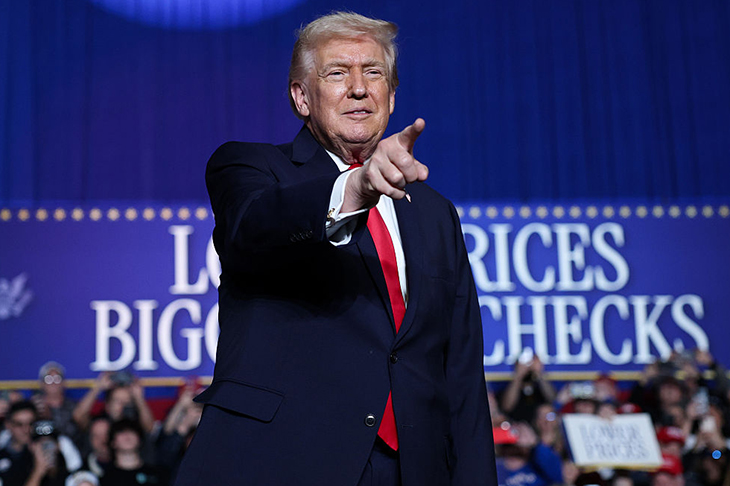
How frustrating it must be for democracy’s enemies to have the unpredictable, unconventional, brash outsider, Donald J. Trump, in the White House. The man who dares to push a new world order committed to transparency, freedom and the protection of universal human rights everywhere.
Unlike his recent predecessors, this man threatens the progress of a growing illiberal cohort, which seeks to impose authoritarian, Chinese-style, socialism on the world’s few remaining democracies.
Indeed, ever since President Barack Obama rejected ‘American exceptionalism’ and made plain the US was but one actor in a global community, globalists have pushed the inevitability of China becoming the world’s next economic and military superpower. Trump is challenging that belief.
Of course in the Sixties and Seventies similar prophecies were peddled about the Soviet Union. By 1991 the USSR had collapsed.
Iran too was touted by anti-Western elites as the next Middle Eastern superpower, yet a decade on, mass protests threaten the Islamic Republic’s very survival.
But no amount of propaganda or accounting trickery can hide China’s economic decline or Xi Jinping’s diminishing support. Recent high-level purges point to growing paranoia at the very top.
With nearly three-quarters of household wealth invested in property, its spectacular collapse weighs heavily on Chinese savings and consumption. Retail sales remain well below their pre-pandemic trend.
Beijing also confronts the insuperable problem of an ageing population which is putting increasing strains on pension and healthcare systems. High youth unemployment (officially 17 per cent, but probably higher) and a serious gender imbalance (a legacy of the one child policy) have shrunk China’s birth rate to record lows.
To arrest the accelerating population decline, the government has imposed a 13-per-cent tax on condoms and other contraceptives. However jobless youths, poor wages, rising food prices and, increasingly, work shyness, are hardly conducive to childbearing.
Income inequality is now deeply structural. According to Nikkei Asia, China has reached a point where the richest one per cent control over 31 per cent of household wealth, a magnitude greater than in major European economies and the US. And while China’s absolute poverty has declined, the wealth gap has exploded, widening further due to poor access to services in rural areas. There is no quick fix.
Indeed, the Chinese people are becoming increasingly pessimistic about their personal prospects, which probably accounts for the surge in (sometimes violent) crime.
Meanwhile, for the fourth year in a row, China’s share of the global economy has shrunk. Capital outflows have followed, forcing Beijing to become a debt collector rather than a capital provider.
Indeed, China’s social and economic weaknesses are becoming increasingly difficult to hide and pose a potential existential threat to President Xi and, his communist party. Understandably the Chinese people are rapidly losing patience.
President Trump has added to President Xi’s woes by announcing the US withdrawal from 66 international entities, including 31 United Nations agencies. If successful, it will strip nearly three-quarters of a billion dollars from the UN’s overall budget.
Seizing on Barack Obama’s self-doubts, Beijing skilfully filled the UN’s leadership void. Largely at US taxpayers’ expense, it used its influence to shift the global balance of power in favour of anti-Western, authoritarian states. Trump sees first-hand how China has captured agencies like the WTO, the IPCC and the World Health Organisation, and wants no part of them.
In his recent speech to the World Economic Forum, Trump focused on Europe’s weak and complacent leadership. And while the Western media concentrated on his pronunciation of Azerbaijan and his regrettable factual errors, they missed the more important point that, probably for the first time since Ronald Reagan, a US president was challenging a powerful global elite used to dealing with polite Western appeasers. His manner may be undiplomatic and his weaponising of tariffs disruptive, but he is committed to achieving peace through strength. Tariffs are recalibrating attitudes to American power.
But Trump is right to worry that much of the Western world is self-destructing; the UK, Canada and Australia included. Trump understands, even if they don’t, that ‘energy, trade, immigration and, economic growth, must be central concerns to anyone who wants to see a strong and united West’.
Trump also knows that the US has carried Nato for decades. In 2018 he was ridiculed for warning that relying on Russian oil was a strategic vulnerability, only to be proven correct four years later when Russia attacked Ukraine.
Due to Trump’s prodding, Europe’s defence commitments are increasing, but China’s stated aim to become a ‘polar great power’ by 2030, has made sovereignty of the US Greenland base a strategic priority should unilateral action be necessary.
His move on Venezuela was likewise motivated by concerns about China. Cuba will be next. Both have developed deep economic ties with Beijing which uses them for sophisticated spying on the US.
While Western self-loathing concentrates on Trump’s shortcomings, President Xi’s bullying escapes without comment. Yet annexation of Taiwan is looming as an imminent distraction from Xi’s domestic issues. Beijing’s increasingly hostile attitude towards Australia, Japan, the Philippines and Vietnam should not be ignored.
Meanwhile, the US midterm elections next November threaten Trump’s authority. History shows the party in power typically loses control of Congress in the midterms.
Mr Trump’s approval rating is negative, but not disastrously so and he and Vice President J.D. Vance, with a $450-million war chest, plan to campaign vigorously.
Household budgets are a hot voter issue and Trump’s tax cuts, and falling inflation are welcome. Productivity and GDP growth are up and profit margins are at record highs. However, against that, unemployment is rising and stock prices are at bubble valuations. Furthermore, budget deficits and increasing debt levels are unsustainable.
In such a fluid environment, making predictions nine months out is fraught. However, after Presidents Obama and Biden, the world’s democracies desperately need a strong America. Love him or hate him, given a chance, President Trump is capable of making America great again.
Got something to add? Join the discussion and comment below.
You might disagree with half of it, but you’ll enjoy reading all of it. Try your first month for free, then just $2 a week for the remainder of your first year.