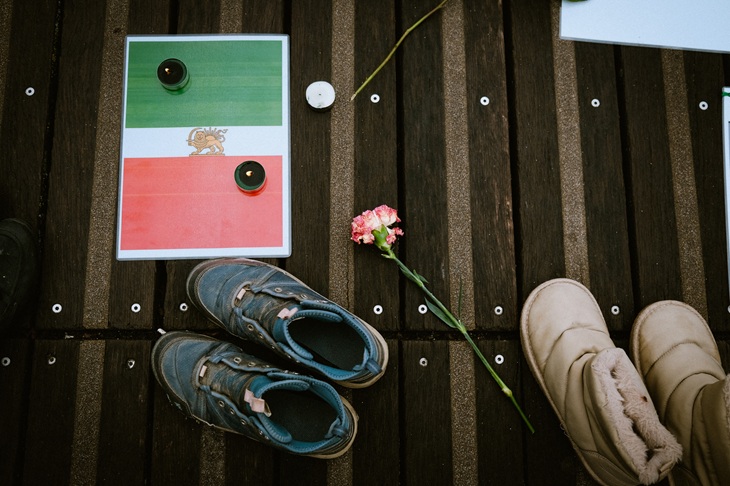
They cut off the internet. In the silence of the night, in a darkness that plunged all of Iran into mourning, people were massacred in their homes, in alleys, and on the streets inside the very places that were meant to protect them. They were killed in silence.
It took two full days before the nation was able to show the world what had been done to it: videos, photographs, burials, mass graves. Images that crushed the heart of any sane human being.
Among the thousands of images and videos documenting the crimes of the Islamic Republic, I wanted to bring just one 30-second video to life for you. It is a video that was broadcast across the world.
Let me begin with something simple and childlike: the game of hide-and-seek.
Children are playing hide-and-seek with their father. They hide behind a sheer curtain, or under a couch. These are places where most of their bodies are still visible. The father knows exactly where his child is. He can see them. But so the game won’t end, and so the children can win, he calls out their names.
‘Where are you? I’m about to find you…’
The father raises his voice slightly, pauses, and pretends not to know.
This pretending is kindness. It is paternal love.
Almost all of us know this scene either from our own childhoods, or later in life, when fathers choose to ‘not see’ so their child can win.
I say this so you understand how deep those 30-seconds truly are.
The door of the hall opens.
Bodies in black zippered bags are piled on top of one another. All alike: wounded, dignified, pure, brave, and silent.
Families enter: fathers, mothers, sisters, brothers.
No one knows where their loved one is.
They are forced to open every single bag, one by one, to look at wounded faces and the execution-style bullet wounds stamped on their foreheads.
They are forced to cry for everyone.
For each black bag, they must set aside their own pain and take on the pain of their fellow countrymen. Grief becomes collective.
The ‘luckiest’ were those who found their child sooner, with fewer searches and fewer encounters with this mountain of death.
But even that ‘luck’ was cursed.
Who can call themselves fortunate when they find their child in a black body bag?
Among those bodies, a father was flailing like a wounded bird, crying out. His voice trembled, yet he called his child’s name firmly: ‘Sepehr… Baba… Where are you?’
As if, in his mind, the game was still going.
As if a boy was still hiding behind a sheer curtain, and the father was praying for a miracle.
He wanted to hear his son laugh one more time and say, ‘I’m here.’
This time, he wanted his son to lose so the father could find him.
But this was not a game.
This was a full-scale massacre.
The reality of the mass killing of Iran’s finest children.
The Islamic Republic slaughtered more than 40,000 young people in the streets and in hospitals. This criminal regime even executed the wounded at close range. Those who managed to escape hospitals were tracked down, followed to their homes, and killed in front of their families during the very two days when the internet was shut down, so no one would see, so no one would hear, so this catastrophe could be reduced to ‘30 seconds’.
But the truth does not fit into 30 seconds.
The truth is in the cry of a father who still believes the game is not over and is fighting for his child.
The truth is in a mother who cries for every body bag, swallows her own pain, and turns it into fury.
The truth is in a sister who does not know which body to embrace, spinning in terror.
The truth is in a country where homes are no longer safe and where people stand together to bring the perpetrators of this crime to justice. And the truth also lives in Iranians outside the homeland those honorable people who answered these fathers, mothers, sisters, and brothers and said:
We are here. We will stand. Until victory, we will tell the world we are the voice of Iran’s children. And we will say: Iran is alive.
By Leila Naseri: Author | Composer | Social Cultural Activist