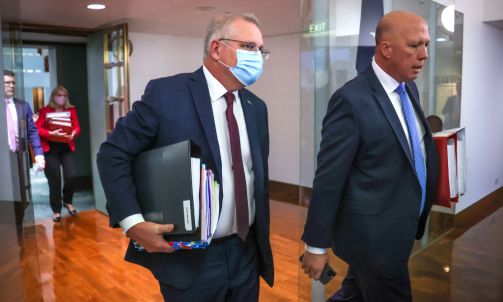
Anthony Albanese’s post-Bondi hate speech bill, rammed through Parliament in chaotic January 2026 sessions, epitomises everything wrong with the Western democratic response to violent extremism. The omnibus legislation – collapsed one day, split and forced through the next – imposes sweeping new speech offences while exempting religious texts, all cynically bundled with gun buybacks. It’s pure legislative theatre: projecting decisive action while dodging the glaring question of why 15 Australians died when the alleged killer was already on an ASIO watchlist and had access to multiple legal firearms.
The bill arrives alongside David Gonski’s review of the national curriculum and Tom Merritt’s call for civics education emphasising principles like equality before the law and the Nuremberg precedent that following orders doesn’t excuse participation in atrocities. These are worthy goals. Students should understand that democracies require impartial judgment and that institutions must apply law consistently regardless of who transgresses. The problem is that civics education and hate speech laws both arrive downstream of the actual failure. When institutions have already retreated from impartial enforcement because confronting certain forms of violence has become procedurally and politically costly, teaching principles becomes an alibi for inaction rather than a solution. When judgment collapses, these measures become mere exhibits in a show trial – performative displays where the verdict of institutional virtue is known before any evidence is weighed.
The mechanism of this collapse isn’t hatred or ignorance – it’s what Hannah Arendt identified as thoughtlessness, the refusal to judge acts plainly in favour of endless contextualisation. Dietrich Bonhoeffer observed something similar about the Nazi period: the danger wasn’t that people became evil but that they stopped thinking, stopped making elementary moral distinctions between what was permissible and what was barbaric. The modern version is more sophisticated. Motives are endlessly explained away – the perpetrator was frustrated, marginalised, responding to historical grievances. Acts are proceduralised – tragic but managed through reviews, inquiries, community consultation. Violence becomes a matter for risk assessment and procedural review while speech becomes a harm requiring urgent restriction.
This inversion has historical precedent. Greg Lukianoff and Nadine Strossen have documented what’s now known as the Weimar Fallacy – the assumption that hate speech laws could have prevented the Nazi rise to power. In fact, Weimar Germany had hate speech laws and enforced them vigorously. Between 1920 and 1933, there were over 200 prosecutions for antisemitic speech. Julius Streicher’s virulently antisemitic Der Stürmer was confiscated or prosecuted 36 times. Top Nazis, including Joseph Goebbels, received prison sentences. Hitler himself was banned from speaking in several German states from 1925 to 1927. The prosecutions didn’t suppress Nazi ideology – they provided propaganda victories, confirming Nazi claims that they were being silenced for exposing international conspiracies against true Germans.
The real Weimar failure wasn’t insufficient speech restriction but catastrophic leniency toward violence. When Hitler led over 600 Nazis in an armed coup attempt in 1923 that killed four police officers and 16 Nazi party members, he was convicted of high treason and sentenced to five years. He served eight months, during which he wrote Mein Kampf. His co-conspirator, Rudolf Hess, received an identical sentence and served an identical eight months. Other Nazi political violence went similarly under-punished or unpunished entirely, while leftist and communist violence drew harsher penalties. The German courts gave the Nazis a permission slip for violence while prosecuting their speech – exactly backwards. When the Nazis eventually took power, they inherited the speech restriction apparatus Weimar had built and turned it on their opponents with devastating effectiveness.
Why does this pattern recur? The WEIRD study – Western, Educated, Industrialised, Rich, Democratic – by Muthukrishna and colleagues provides empirical grounding. Western psychology, particularly the form that underpins dignity cultures with their emphasis on impartial institutions and rule-based judgement, is a multivariate outlier. Most human societies operate on relational embeddedness, conformity to group norms, and context-dependent rather than analytical thinking. Dignity culture’s insistence on judging acts rather than identities, on applying law impartially regardless of group membership, is psychologically rare and institutionally fragile. It requires constant reinforcement and, critically, the willingness to bear costs when impartial judgement threatens social disruption or reputational damage.
This fragility manifests when authorities become risk calculators rather than enforcers. Which groups can mount protests that disrupt cities? Which have bloc voting power? Which have religious or community backing that frames prosecution as persecution? The cost of confronting violence from groups with these characteristics exceeds the cost of procedural delay, contextualisation, or quiet abandonment of cases. Speech restrictions provide political cover – look, we’re doing something – while avoiding the confrontation that actual enforcement would require.
The pattern plays out with dreary consistency across the West. In France, the Service de Protection de la Communauté Juive documented over 470 antisemitic incidents in 2025 alone, but government responses frame these as ‘intercommunal tensions’ requiring dialogue rather than prosecutions requiring evidence and sentences. Street intimidation, property damage, and physical assaults blur into background noise labelled ‘social cohesion challenges’. In Sweden, a 2025 Lund University study found substantial immigrant overrepresentation in rape statistics, but prosecutions lag and political discourse treats this as an ‘integration challenge’ requiring sensitivity rather than a crime wave requiring deterrence. The UK’s Casey Review of grooming gangs revealed thousands of cases left in procedural limbo for years or decades, with victims’ reports treated as complicating factors in community relations rather than crimes demanding investigation.
Australia provides its own instructive example from 2012, well before the Bondi massacre. An ISIS-supporting demonstration in Sydney saw participants waving ISIS flags and carrying signs calling for beheadings – ‘Behead all those who insult the Prophet’ – in broad daylight. Police stood watching, arms crossed, making only a handful of arrests at the end. Afterwards, authorities contextualised the march as an expression of frustration against Islamophobia rather than incitement to violence or support for a terrorist organisation. Some marchers subsequently travelled to Syria to join ISIS. When the wives of ISIS fighters later sought repatriation to Australia, they were accommodated. The entire sequence – from permitting the march to contextualising the threats to repatriating family members of terrorist organisations – illustrates how judgment collapses under the weight of procedural caution and political calculation.
The common thread is that incitement to violence gets reframed or excused, while corrective speech gets penalised. When imams call for violence or Sharia law in democratic nations, authorities cite religious freedom and cultural sensitivity. When critics name this explicitly as incompatible with liberal democracy – or point out that honour cultures operate on different principles than dignity cultures – they face hate speech complaints, social media bans, or prosecution for divisiveness. The incentive structure is obvious: it’s safer to police criticism of incitement than to confront the incitement itself or the violence it produces.
This inversion has been amplified by critical theory’s reframing of speech as an exercise of power rather than exchange of ideas. If speech is primarily about domination and marginalisation, then policing it becomes a progressive imperative while contextualising actual violence becomes a sophisticated recognition of structural factors. The result is that threatening speech blends into background (‘they’re frustrated’), while speech that names threats explicitly moves to foreground (‘you’re stigmatising communities’). Authorities find themselves in the perverse position where the safer political choice is restricting corrective speech rather than confronting acts of violence.
Pope Leo XIV’s address to the diplomatic corps in January 2026 represents a rare moment of elite recognition. Speaking not to the Catholic faithful but to ambassadors and representatives of the governments creating this problem, he warned that ‘the space for genuine freedom of expression is rapidly shrinking’ in the West, replaced by ‘Orwellian-style language’ that ‘in an attempt to be increasingly inclusive, ends up excluding those who do not conform to the ideologies that are fuelling it’. The setting mattered – formal Vatican ceremony, the Pope in full regalia addressing foreign diplomats directly. This wasn’t pastoral guidance but diplomatic confrontation, an acknowledgment from a global institution that Western democracies are inverting their stated commitments. They claim to protect expression while suppressing dissent, to promote inclusion while enforcing ideological conformity, to enhance safety while normalising threats.
The Pope’s use of ‘Orwellian’ is precise. Orwell’s insight wasn’t merely that totalitarian regimes lie but that they invert meaning so thoroughly that citizens lose the vocabulary to recognise what’s happening. War is peace. Freedom is slavery. In the contemporary version: restricting speech protects expression, banning criticism promotes inclusion, and contextualising violence enhances safety. The procedural apparatus of democracy – courts, reviews, consultations – continues functioning while losing connection to its purpose. Process becomes theatre where everyone performs concern while avoiding judgment.
Civics education and legislative responses like Albanese’s hate speech bill aren’t worthless, but they’re mistimed. Teaching students about equality before law rings hollow when courts demonstrably don’t apply law equally. Criminalising hateful speech while violence stemming from the same ideology gets contextualised teaches a different lesson than intended: that institutions respond to political pressure rather than principle, that some groups can act with impunity while others face prosecution even for speech that merely names the problem, and that the appearance of action matters more than its substance.
Restoration requires confronting what dignity cultures once took as foundational but now find inconvenient: acts must be judged impartially regardless of the identity of perpetrators or the political cost of prosecution. This was never easy – it required institutional courage and public support for bearing short-term costs to maintain long-term legitimacy. But it’s harder now after decades of retreat have normalised violence as manageable background conditions while foregrounding speech as urgent threat. The Weimar precedent should haunt us: a democracy that polices words while indulging violence hands future authoritarians both permission and tools.
The Albanese government’s response to the Bondi massacre exemplifies this perfectly. Rather than asking why ASIO-watchlisted individuals are in close access to firearms, why surveillance funding was cut weeks before the attack, or why intelligence chiefs were initially removed from national security briefings while climate officials attended, the government rushes through hate speech restrictions. It’s governance as alibi – creating evidence of action while avoiding questions about competence. The parliamentary theatrics Dr Michael de Percy witnessed from the Press Gallery drive this home: Senator Pauline Hanson banned from voting on legislation meant to address the extremism she was banned for naming, omnibus bills split and rammed through in days, Opposition members vote-flipping without explanation.
If Gonski’s civics curriculum or Albanese’s hate speech laws somehow restore judgment, that will be salutary. But judgment doesn’t follow from education or legislation – it precedes them. Institutions that have retreated from impartial enforcement when costly won’t be strengthened by teaching principles they’ve already abandoned or passing laws they’ll apply selectively. The courage dignity culture once demanded – applying law impartially, bearing the costs of unpopular prosecutions, refusing to contextualise violence into background noise – has been eroded by decades of procedural caution and political calculation. Civics lessons and speech restrictions arrive too late, after thoughtlessness has already normalised what should be intolerable. Until institutions recover the willingness to judge acts plainly and bear the costs that judgment demands, education becomes performance and laws become theatre, both serving as alibis for the refusal to confront what matters: that violence has been accepted, one procedural retreat at a time, until gratuitous cruelty simply blurs into the landscape we inhabit but no longer truly see.
Matt Brennan is a Sydney-based writer interested in liberal principles and social psychology.