Few legacies have been as deliberately engineered as that of Alfred Nobel, the Swedish inventor whose name is now synonymous with excellence in science, literature, and peace.
Nobel, best known for inventing dynamite – a substance that revolutionised mining and construction but also amplified the horrors of warfare – faced a profound reckoning in 1888. When his brother Ludvig died, a French newspaper mistakenly published an obituary for Alfred himself, branding him the ‘merchant of death’ who had grown rich by finding ways to kill more people faster than ever before.
Shocked by this grim preview of his posthumous reputation, Nobel resolved to rewrite his story.
In his will, he established the Nobel Prizes, including the Peace Prize, to honour those who advanced humanity’s greatest causes, ensuring his name would be remembered for promoting progress rather than destruction. It was a quintessentially realist move – a man of science and industry confronting the harsh realities of his impact and using his fortune to develop a nobler (pardon the pun) legacy.
Today, the Nobel Peace Prize seems to have strayed far from those pragmatic roots, embracing a performative Wokeness that dilutes its credibility. The recent spectacle involving María Corina Machado, the Venezuelan opposition leader who was awarded the 2025 Nobel Peace Prize for her tireless efforts against authoritarianism in her homeland, has put the proverbial cat among the pigeons.
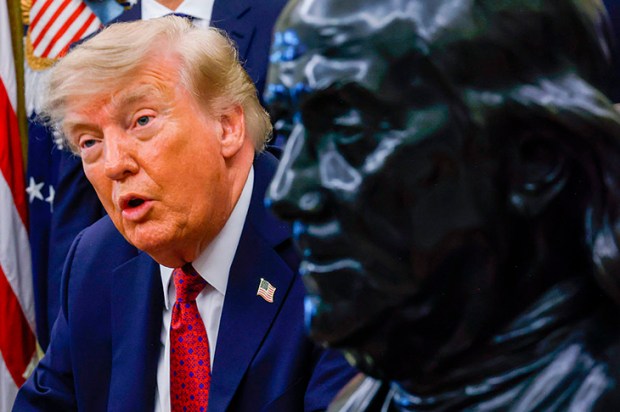
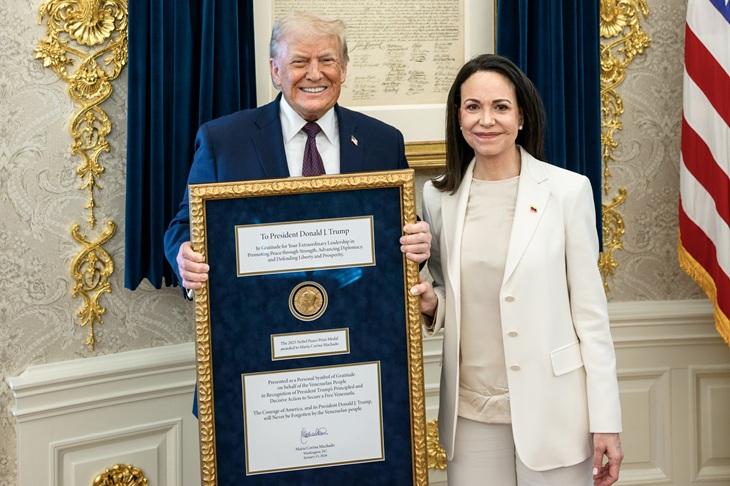
In a bold and symbolic gesture during a White House meeting on 15 January 2026, Machado presented her Nobel medal to President Donald Trump, acknowledging his ‘unique commitment’ to Venezuelan freedom.
President Donald J. Trump meets with María Corina Machado of Venezuela in the Oval Office, during which she presented the President with her Nobel Peace Prize in recognition and honor.?️ pic.twitter.com/v7pYHjVNVO
— The White House (@WhiteHouse) January 16, 2026
Trump, who has long coveted the prize and openly lamented not receiving it during his first term, accepted the medal with characteristic flair, posting on Truth Social:
‘María presented me with her Nobel Peace Prize for the work I have done. Such a wonderful gesture of mutual respect.’
This act underscores a deeper irony.
The Norwegian Nobel Committee overlooks figures like Trump, who, whatever one’s politics, brokered tangible deals like the Abraham Accords in his first term and achieved military success with the destruction of Iran’s nuclear capability and the removal of the illegitimate dictator Nicolás Maduro in his second. As a consequence, the Nobel Prize increasingly rewards symbolism over substance.
Contrast this with Barack Obama’s 2009 award, bestowed only months after his election for ‘extraordinary efforts to strengthen international diplomacy’.
What efforts? At that point, Obama had done little more than win an election and deliver soaring speeches.
Critics at the time, including some on the left, called it premature – a prize for potential rather than achievement.
Obama himself seemed bemused, admitting he didn’t feel he deserved it yet.
This set a precedent for the prize’s drift toward feel-good optics, prioritising identity and aspiration over hard-nosed results. It’s as if the committee, ensconced in Oslo’s progressive bubble, has forgotten Nobel’s own realist awakening that legacies aren’t built on intentions alone.
Norway, a small nation punching above its weight through soft power, has long used the Nobel Peace Prize as a tool to shape global narratives. But like the United Nations, once a beacon of collective security that is now mired in bureaucracy, veto paralysis, and selective outrage, the prize risks becoming irrelevant.
Recent awards have veered into what can only be described as Woke territory, honouring climate activists, journalists, and anti-nuclear groups in ways that feel more like virtue-signalling than recognition of transformative peace-building.
The 2024 award to Nihon Hidankyo, the Japanese atomic bomb survivors’ group, was noble but abstract, focusing on historical trauma rather than current geopolitical realities. Meanwhile, pressing issues like Middle Eastern stability or the Ukraine conflict get sidelined for safer, consensus-driven choices.
Machado’s decision to hand her medal to Trump is a rebuke to this trend and a reminder that true peace often requires tough, realist actions and not just platitudes. Trump, for all his swagger, has shown a willingness to engage directly with adversaries, from North Korea to the Taliban. If the Nobel Committee continues down its current path, it may find itself as marginalised as the UN General Assembly with its lots of resolutions and little real influence.
Alfred Nobel sought to atone for his inventions by fostering genuine advancement. Theodore Roosevelt brokered peace between Japan and Russia following a war that shocked the Western world.
Barack Obama, like a modern university student, received one of the world’s major prizes as a participation award while Trump (despite his shamelessly all-American bombastic demeanour) got nothing.
It’s time the Nobel Prize committee reclaimed its realist origins before it fades further into irrelevance. In my opinion, they’re probably just grumpy about Greenland.
Dr Michael de Percy @FlaneurPolitiq is the Spectator Australia’s Canberra Press Gallery Correspondent. If you would like to support his writing, or read more of Michael, please visit his website.