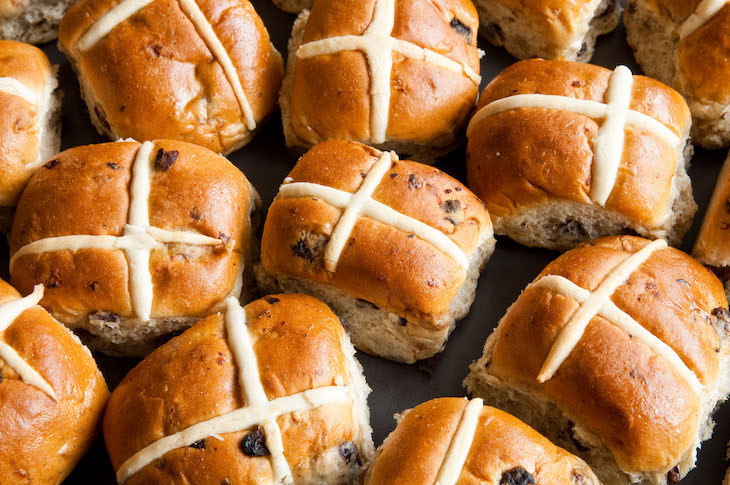
More proof that we’ve completely lost it when it comes to the cycle of the year. It’s not just that right in the middle of the twelve days of Christmas, Marks & Spencer started to sell Easter eggs; Waitrose has reported that hot cross buns are turning into a year-round staple. Not just for Good Friday, then. Leyla Page, Waitrose’s seasonal bakery buyer, calls it a ‘winter staple’ – sales, apparently, are up 39 per cent on last year – and asks, ‘Is it even winter if you haven’t reached for a hot cross bun?’
Hot cross buns are cross because they’re for Good Friday, the day the Lord died on the cross
Well, yes. Hot cross buns are cross because they’re for Good Friday, the day the Lord died on the cross. They’re not meant for any other day, let alone for an entire season. If you want a generic hot, spicy bun, toasted and plastered with butter, you want a nice tea-cake. That’s got all the constituents of a HCB, only they’re larger and minus the cross. And it’s these we should be eating at this time of year. We’re playing fast and loose with symbolism when we use the cross out of context. And that’s before we come to the abominations that are HCB variants – with cheese and marmite, or the Sainsbury’s tiramisu version. I mean, yuck.
In happier days, a hot cross bun brought you luck when it was eaten on the day of the Lord’s Passion. The old nursery rhyme, ‘Hot Cross buns, hot cross buns; if you have no daughters, give them to your sons; one a penny etc’, first mentioned in 1733, recalls a very specific treat, which was a treat because you didn’t get it every day.
Ronald Hutton, the social historian, described how bread, buns and biscuits baked on the day had especially beneficial powers: ‘They were generally believed never to go mouldy and to be capable of curing disease if eaten. If hung in a house, they were thought to protect it against misfortune.’ And the reason was, he thinks, that the bun invoked the Catholic eucharistic host with its cross, the cross which was venerated before the Reformation on Good Friday in the rite of the sepulchre. Protestant households ate them as much as anyone: it’s a genuinely English thing.
In one account of the trial of a William Smith in 1753, one of the witnesses declared to the judge: ‘Mr Harper invited me to dinner upon a Good Friday Cake, as we call it; for he was a right good neighbourly man; and he invited five other neighbours to eat of this cake…now you, my worthy Lord, must know, we have a notion in our country that if we do eat a cake made purposely of [on] Good Friday, we shall never want money nor Victuals all year round, which as for as many years as I can remember, has fallen out true.’ That just shows the virtue of a cake made on the day.
I can’t say myself that I’ve found hot cross buns to have that effect, though I’m very willing to give them another try – nor have I ever hung them up in the kitchen, but even the modern supermarket version, sold in packs of four for a pound, bears the sign of the Lord’s Passion.
If we want to respect the sacredness of the season, keep them for the one day when they have meaning because they remind us what happened on the day when, as Christians have it, mankind was redeemed. Like I say, if you want a toasted fruit bun at other times, go for a tea-cake.
As for selling Easter eggs before the twelve days of Christmas were even up, don’t get me started.