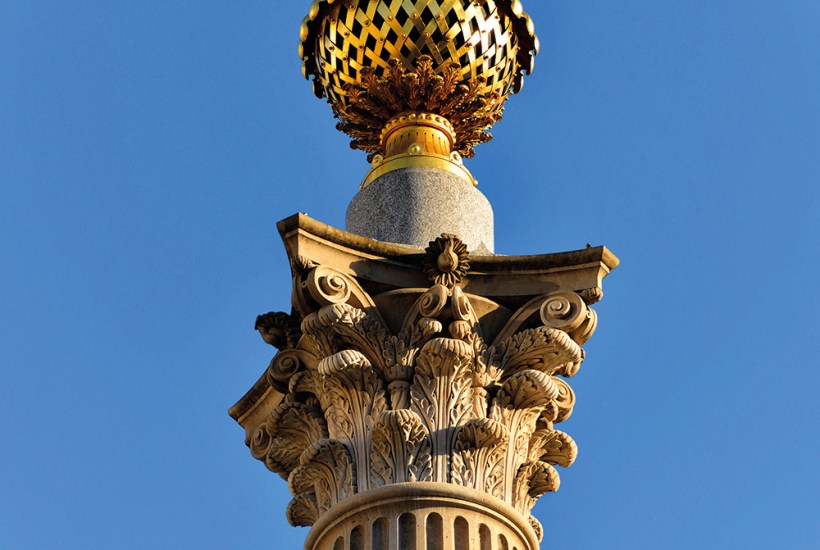
In the centre of London’s Paternoster Square there is a tall column on a heavy octagonal base that provides a few seats and shelter from the winds whipping around St Paul’s. If you look closely, you see a mishmash of styles, with the Corinthian column topped by a gold-covered flaming urn and various baroque flourishes. Passers- by might be surprised to find such an ode to eclecticism amid the rather modern neoclassicism of what was a highly controversial development in 2008 that attracted the attention of the then Prince of Wales. What few of them will know is that the column is not just a decorative addition to a dull square but has a function. It is a ventilation shaft (vent for short) whose primary use is to extract air and, crucially, fumes from the car park below.
Readers of a certain age will remember the I-Spy books. They ranged across subjects – fossils, the seaside, wild flowers, history – and you got points for locating particular things. I remember Edward VIII post-boxes being worth 40 points. When you’d spotted all the relevant items in the book, you could write off to claim your certificate and, oddly, a feather. But there was never one on vents, and the series missed a trick, as demonstrated by this revealing book on the subject.
‘Revealing’ is the operative word, since we are shown all kinds of structures that turn out to be vents hiding in plain sight. These are in fact the transition points between the two basic elements of earth and air. Serving a wide variety of purposes, they take remarkably different forms.
The earliest vents were essential life-savers, making the difference between life and death for miners. The poor canaries were hardly sufficient to prevent disasters ranging from asphyxiation by odourless carbon monoxide to explosions resulting from methane, known as ‘firedamp’. It was the creation of sophisticated ventilation systems, bringing both fresh air in and allowing smoke out, along with other potentially dangerous volatile substances, that made mines immeasurably safer.
Another need for vents arose from the spread of the railways. When I was growing up in Campden Hill in west London, I used to be terrified by certain haunting noises in the night. It was only many years later when I became a trainspotter that I learned that these were in fact train horns, sounding to warn trackworkers, and they emanated from vents created in the 1860s for the Underground line between Notting Hill and Kensington High Street.
As technology improved, the making of ever-longer tunnels became feasible, and they started being dug from above, using shafts that would eventually be the vents. Once dug down to the level required, two teams would work in opposite directions carving out the tunnel, and when completed the vent would serve its permanent purpose. These strange structures can often be seen in the countryside, and the Victorians enjoyed topping them playfully with castellated ramparts or giving them a Gothic veneer.
From chess pieces to bollards, citadels to chimneys, vents are everywhere
Vents are equally essential for sewers. The combination of rotting vegetation and faeces risked creating substantial explosions. While these would mostly be triggered by lights held by the sewage workers, sometimes the gases would seep out into a house with devastating effect if the fumes found their way to a lighted candle. While the story of the construction of London’s sewer system by Joseph Bazalgette is well known, little consideration is given to the vents that were an essential part of this system. They could be found on almost every street corner – tall, cast iron columns ‘often with beautiful detailing and sometimes topped with crowns that are mostly mistaken for defunct lamp posts’.
It is not by any means all Victoriana. Modern architects have fun with vents too, giving them form that does not in any way reveal their true purpose. Just around the corner from the column in Paternoster Square, Thomas Heatherwick created in 2002 a pair of huge crenelated angel wings to ventilate the electricity substation buried beneath. From chess pieces to bollards, citadels to chimneys (there is one outside the Albert Hall in Kensington), vents are everywhere. Time to make your own I-Spy book by taking this guide with you and trying to spot them.
The authors have focused on their 100 favourites across the UK and suggest that this is nowhere near an exhaustive list of interesting examples. Further volumes would definitely be a treat.
Got something to add? Join the discussion and comment below.
You might disagree with half of it, but you’ll enjoy reading all of it. Try your first month for free, then just $2 a week for the remainder of your first year.