What is it about Islam that motivates so many shocking attacks on Jews, Christians, and the Western world?
Following the killing of some 3,000 innocent people when the World Trade Center in New York was destroyed by Al-Qaeda Islamists in 2001, there have been numerous other mass killings by Islamists. The Bali bombings by Jemaah Islamiyah Islamists killed 200 people in 2002. In northern Nigeria since 2009, some 18,000 Christian churches have been destroyed, looted, or forced to close by Boko Haram Islamists.
Then came the attack by Hamas Islamists on southern Israel on October 7, 2023, when 1,200 Jewish people were slaughtered in the worst Jewish genocide since the Holocaust in Nazi Germany during the second world war. Most recently, the Bondi massacre on December 14 saw 15 people murdered and more than 40 wounded was allegedly undertaken by two Muslims whose car was alleged to contain two homemade ISIS flags.
A scholar of Islamic Culture and History, Dr Howard Shin, says of his book The Bloody Borders of Islam:
Islamic history is replete with so much bloodshed, slavery, mass murders, and pillage. Islam has always had bloody borders, and it continues the legacy of bloodshed which started with Muhammad about fourteen hundred years ago.
Before considering the key question of ‘Why?’, I emphasise that most Muslims in Australia today are peaceful and kind. Some years ago, I needed to negotiate a fence replacement with a Muslim neighbour. Fence negotiations between neighbours can be notoriously fractious, but our Muslim neighbour could not have been more helpful. We quickly and amicably agreed on the fence and on sharing the cost.
Muhammad was not only the founder of Islam, but his life is considered a perfect example for Muslims to follow, as the Quran (3:31) makes clear: ‘If you should love Allah, then follow me [Muhammad], [so] Allah will love you and forgive you your sins.’ So, what kind of leader was he and what example did his life and actions provide?
Muhammad was born in Mecca around 570 AD of the ruling Quraysh tribe. At that time, Mecca was a major trading centre and place of worship for the pagan deities of Arabian tribes, with hundreds of idols in and around the central Kaaba.
According to Islamic belief, from the age of 40 (around 610 AD), Muhammad started receiving revelations from Allah (‘the deity’ in Arabic) through the Archangel Gabriel. His message three years later to the Meccans, that ‘Allah is One’, offered to unite warring Arab tribes with a unified religious and political community under Islam. But this directly challenged the city’s polytheism and multiple idols, which the Meccans credited with bringing trade and wealth to the city.
The response of the Meccans was extremely hostile. Believing his life was at risk, Muhammad fled for safety to Medina in 622, with a small band of followers.
This migration, or Hijrah, is considered by Muslims to mark the birth of Islam as a community and state. The event is so significant that the Islamic calendar starts from the year of the Hijrah, not from the Prophet’s birth or the beginning of revelations. It signifies the transition from persecution to freedom, laying the foundation for Islamic civilisation. This migration is now commemorated annually in the hajj, or ‘pilgrimage’, one of the Five Pillars of Islam.
While not a mainstream Muslim view, some Islamic scholars see migration to Western ‘lands of disbelief’ (Dar al-Kufr) as a strategic tool for expansion – ‘Migration for Dawah’. Their goal is not to integrate into the host society, but to establish a ‘pioneer’ community that will eventually expand its influence.
Medina welcomed the arrival of Muhammad. It was an oasis that had been settled centuries earlier by three Jewish tribes, who farmed the land. Over time, two Arab tribes from southern Arabia, who had been fighting each other for nearly a century, settled alongside the Jewish community. Through resolving longstanding disputes, Muhammad was soon accepted as the city’s political leader. As ruler, he united the different communities under the ‘Constitution of Medina’, that specified the rights and duties of all citizens, thereby establishing the first Islamic state.
Inspired by Muhammad’s example in Medina, Muslims who embrace the Migration for Dawah strategy, may view seeking political leadership and influential positions in government, civil service and judiciary as a vital strategic goal. They may view political engagement as a tool for ‘civilisational-jihad’ — a long-term process of transforming a non-Muslim society from within. The Muslim Brotherhood founder, Hassan al-Banna once declared:
‘It is the nature of Islam to dominate, not to be dominated, to impose its law on all nations and to extend its power to the entire planet.’
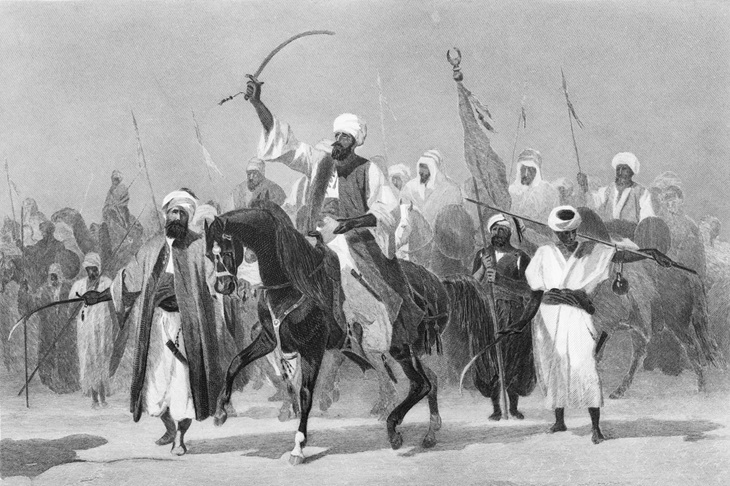
Once established as Medina’s ruler, Muhammad developed a loyal band of militia. He persuaded the people of Medina to take an oath pledging allegiance to him in the ‘Pledge of War’. To increase his wealth and power, he raided a large caravan carrying valuable goods to Mecca for the Quraysh tribe that had rejected him. In the resulting Battle of Badr, Muhammad’s Muslim army of 313 defeated the larger Quraysh force of some 1,300 men. This Muslim victory was highly influential and transformed Muhammad from a Meccan outcast to the prestigious leader of the city of Medina.
Initially, the Jewish communities understood their oath of allegiance as a military and civil pact only, but it fell apart when Jews were required to abandon their beliefs and customs in favour of Islam. The Jews were given an ultimatum: become Muslims or be killed. First, Muhammad besieged the Qaynuqa tribe until they surrendered. The tribe pleaded for mercy and Muhammad banished them from Medina and took their possessions as booty. Next, the Nadir tribe suffered a similar fate. Finally, the powerful Qurayza tribe was accused of treason and attacked in the Siege of Banu Qurayza. After surrendering, instead of banishment, their men were slaughtered and their women and children were taken as slaves.
After a decade as ruler of Medina, Muhammad had developed an army powerful enough to threaten the city of Mecca that had rejected him years earlier. By 630 AD, Muhammad had grown strong enough to assemble a military force of 10,000 men to march on Mecca. In the face of such overwhelming force, the Meccans surrendered and converted to Islam. The idols inside and around the Kaaba, the central shrine, were destroyed, rededicating the site to the worship of Allah alone. The Conquest of Mecca was complete.
Muhammad had proved to be a highly effective, if brutal, military commander. Since his life is considered a perfect example for Muslims to follow, his prowess as a warrior provides a blueprint for violent Islamic jihad – the use of force as necessary to impose Sharia law.
Radical Islamists divide Muhammad’s life and example into three tactical phases. First the Meccan phase of weakness, when he had no political power and jihad was an internal personal struggle. Second the Medinan phase of statehood, when he used his growing political power to establish an Islamic state. Third the Conquest phase of dominance, when he used superior military force to subject the Meccans to Islamic rule. Finally, the principle of abrogation is applied – later laws override earlier ones (as in Australian legal interpretation). Thus radical Islamists consider that violent jihad, to impose Sharia law by force, is justified.
What is it about radical Islam that motivates so many shocking attacks on Jews, Christians, and the Western world?
First, it is clear that Muhammad was an able and remarkably versatile leader. He was an inspiring religious leader, who founded the new religion of Islam. He was an effective political leader, who united the tribes of Medina. And he was a successful military commander, who forged a powerful and victorious army.
Second, since Islam is shaped by Muhammad’s life and actions, it has three expressions: a religious community, a political movement, and a military campaign. Most Islamic scholars use historical context to emphasise an irenic interpretation. However radical Islamists use the principle of abrogation to stress a bellicose understanding.
The risk is that peaceful Muslim communities could provide fertile soil for radical Islamist preachers to recruit or inspire more terrorists in Australia.
Dr David Phillips is a former research scientist and founder of FamilyVoice Australia