The demise of Stranger Things was not quite a Games of Thrones level of disaster, but it came awfully close despite $400+ million being spent on Season 5.
It follows a pattern of initially exceptional shows deteriorating over the years into stinking heaps of barely coherent, poorly written, indulgent Woke drivel obsessed with pushing ‘the message’ instead of telling a good story.
True Detective serves as another example, as do the legendary series of Westworld, Sherlock, and Altered Carbon.
The same thing happens to movie franchises. Consider one of cinema’s best, Jurassic Park, devolving into the utter tripe of Jurassic World Rebirth. Ridley Scott’s 1979 masterpiece Alien became the dreary Alien Earth. Everyone’s favourite Indiana Jones turned into the unwatchable Indiana Jones: Dial of Destiny. Star Wars jumped the space shark, killing off Harrison Ford’s Han Solo before the final instalment of utter trash The Last Jedi. The cultural empire of Star Trek starring William Shatner transitioned into the laughable Star Trek: Discovery. And maybe the biggest downgrade can be awarded to the Lord of the Rings, easily one of the most successful book-to-movie triumphs, which somehow spawned the cringe-inducing TV series Rings of Power.
I could go on. The pattern of failure in the entertainment industry is extraordinary given how much money is thrown at the product. Maybe it’s our fault, the viewers, for showing up to give objectively dreadful films like Avatar: The Way of Water over $2 billion or Transformers: Age of Extinction $1 billion at the box office. Why do we do that?
If studios release an AI film with AI actors and AI scripts and we pack out cinemas for the sake of curiosity, that’s what Hollywood will keep making. For an industry full of champagne socialists, they certainly govern their arts based on the worst aspects of unconstrained capitalism which has well and truly exchanged competition for a handful of film studio and streaming service monopolies.
Returning to the problem of Stranger Things.
Even if you haven’t been watching Stranger Things, you probably saw the ‘I don’t like girls’ meme floating around this week where Will, one of the original children (now grown up), spends an excruciatingly large amount of the runtime telling a room full of characters that he’s gay. Something we knew from the first episode ten years ago.
Gayness was presented as Will’s superpower which allowed him to defeat the monster who turned out to be another person with a traumatic childhood. Whatever.
Five seasons, hundreds of millions of dollars, and this is all Stranger Things will be remembered for.
Netflix is a joke. pic.twitter.com/H2vWCKb8Bn
— Jon Del Arroz | Sci-Fi And Fantasy (@jondelarroz) December 26, 2025
There are hundreds of review articles and videos that detail every nauseating Woke plot device that slowly chipped away at the show’s dignity and turned its characters into billboards for progressive indoctrination and self-congratulatory moralising.
All of that is true, but Stranger Things was ruined by two other major problems.
This first is nostalgia.
Stranger Things immediately gripped audiences because it embraced the pre-Woke era of the 1980s when life in the West had reached its peak.
This matters. Look at the audience pattern…
In the 90s, audiences felt all-powerful. They were the world’s geopolitical superpower and they had been comfy and safe in their civilisation for many decades. Naturally, they were fascinated by the fictional destruction of the empire. Their centrepiece landmarks being destroyed by terrorists, natural disasters, or aliens. The 90s became the age of the disaster blockbuster. The stalking ground of Michael Bay. Our heroes were bad arse men beating the shit out of bad guys. Intergalactic diplomacy via the fist. Think Will Smith in Independence Day when he punches an alien’s lights out with the quip, ‘Welcome to Earth!’ That’s another ruined franchise. We’re all doing our best to forget Independence Day: Resurgence.
The shine wore off landmark destruction when the Twin Towers fell. Suddenly, the demise of our Western empire was real, and we didn’t seem to have any Bruce Willis characters to punch out the baddies. Just a whole lot of dopey politicians and bent bureaucrats rubbing their hands together as society stumbled.
Today’s audiences don’t want to see their cities destroyed because our civilisation is in a real-world state of decay. We’re dying. We feel unsafe. Our minds are regressing back to better times when we still knew who we were as a people. We don’t find entertainment in reality.
This is why audiences loved everything about living within this recreated 1980s world of Stranger Things. It wasn’t just latchkey kids riding their bikes at night, playing board games, or making mixtapes. There was a sense of personal independence that some of us remember living, while young audiences longed for the possibility of a life unmonitored by helicopter parents and an overbearing government.
How refreshing when the biggest threat to society came from the Russians and a shady secret lab instead of the constant scourge of Islamic terror and Nanny State busybodies.
The socially cringe parts of the 1980s the show creators sought to repair later were met with rejection by the audience. Viewers were not seeking a fix. They desired immersion to give their brains a rest from the painful suffocation of the 2020s. This loss of nostalgia started going wrong in Season 3, but by Season 5 we were watching modern sensibilities smashed into the past and it felt repulsive. Putting actors in dated clothes does not sell authenticity any more than Channel 5 casting a black woman as Anne Boleyn.
Having lost its warmth, the next thing Stranger Things sacrificed was its fear factor.
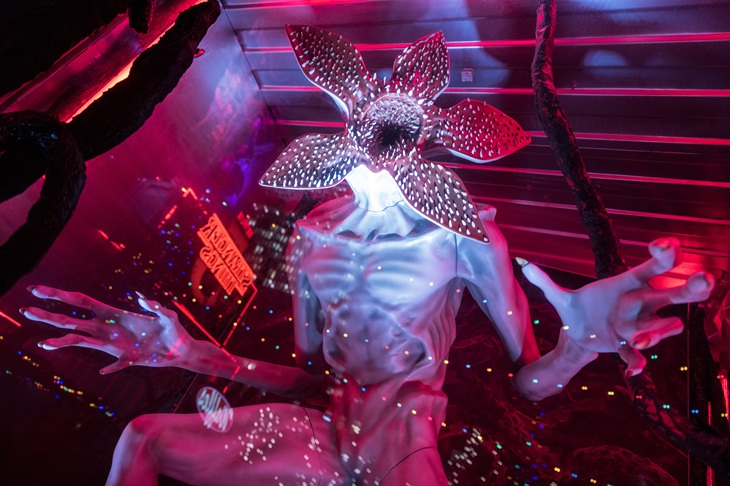
Stranger Things began as a true cosmic horror in the Lovecraftian style.
Yes, it borrowed elements of famous science fiction and horror (leaning heavily on Alien in the first season), but it built its own narrative constrained in believability by a detective story. The source of fear came from the existence of an unknowable, inexplicable cosmic horror dimension full of monsters bleeding into the world. These creatures had no motive. They had no spoken lines. And the villains at Hawkins Lab were just as clueless about their mistake as the local police trying to find a missing child.
It played with themes of death and life beyond our living realm. Even the name given to the nightmarish landscape, the Upside Down, is meant to fuel a sense of mystery.
To summarise the progression of this story, when the monsters were switched out for a human villain with a tangible motive, the cosmic horror was lost. Vecna was a Marvel villain and poorly written compared to the similar story of Billy in Season 3. Billy’s sacrifice was compelling because he was a flawed human manipulated by an unknown evil from another dimension. Vecna had too much agency while the exposition attempting to explain the Upside Down robbed the cosmic realm of its terrifying mystery.
No doubt the CGI extravaganza in the final episode of the giant spider-like creature stomping toward our central cast cost a fortune, but it was the poor cousin of Will’s body being dragged out of the water or the Christmas lights in Joyce’s house illuminating as the creature moved in the other dimension and confirmed her son was alive. When the monster came through the wall for the first time, it was actually scary. The very first scene of the nameless scientist being dragged up by his head as the elevator doors closed was scarier than Seasons 4 and 5 combined.
Since the final aired, I have watched many YouTube reaction videos of disappointed fans who invested 10 years of their life following the show. Science Fiction is my true passion, and I have seen too many series end this way, but it wasn’t always the case. Even if some endings were a little disappointing, the shows of my childhood managed to offer a decent conclusion.
It makes me wonder, has Woke truly ruined the entertainment industry (and if so, why?) Or do we have a generation of writers who, like first time authors, don’t understand how to write an ending?
Are writers too afraid to kill off money-making characters and so clad them in plot armour so thick it negates the expensive CGI?
Does real-world politics, and the perception of how fans on social media will react, skew the writers’ room?
I’m not sure what causes the cascade of failures that plagues modern entertainment, only that it keeps happening. I don’t know about you, but I’m being pushed back toward books and away from over-hyped shows.
The centrepiece of a civilisation is the art it creates. We are not building beautiful architectural works. There are no extraordinary churches or public buildings which stretch the imagination of the human mind. When was the last time a work of art drew people from across the world to stand in front of a canvas in awe? What music do we write now that can move the soul? Where are the works of fiction which will define our era for the next thousand years?
It’s as though Woke robbed the West of its soul.